New Zealand: 5. New Zealand’s most photographed public toilet, and a homestead stay

The next day was the first of many long days on the road, as we left the Northland heading south into the centre of North Island.

The first stop on the way was at Kawakawa, to cast our eyes on, and even make use of, the most photographed public toilets in New Zealand. You feel a bit awkward walking into a public toilet with your camera – is this perhaps an arrestable offence? or at least, likely to arouse suspicion? So I took the coward’s way out and locked myself in one of the cubicles before bringing my camera out.

These toilets were designed by the Austrian architect Friedenreich Hundertwasser. An eccentric, and probably difficult to live with – at least, the women he married generally divorced him after only a year or two – he moved to New Zealand were he lived the last 25 years of his life as a kind of recluse, in a house without any power or electricity. The local community persuaded him to use his talents to build something for them, and this was the result.

Public toilet attracts attention from tourists

The whole of Kawakawa has an arty kind of feel to it, with numbers of murals, and other buildings that must have been either designed by Hundertwasser himself, or by other people in homage to him.

Our road then took us back through Auckland and on into the Waikato region. At over 400 km, the Waikato (= long water) is the longest river in New Zealand, powering lots of hydroelectric schemes that generate some large proportion of the country’s electricity needs. For sure Denis told us the exact figure, but …

At Cambridge (good name!) we were met by our hosts for the evening’s Homestead Stay. Alison and I, together with fellow-travellers Chris and Judy, were entertained by Ron and Beth Richardson. Ron is a retired police inspector who now farms, owning and raising horses for the popular local sport of harness racing. Beth was in high hopes that their horse would win the trophy at the following Saturday’s race. We never did find out whether they succeeded. A brief tour of the farm, riding on a trailer behind the tractor; then we sat down to some real home cooking: roast lamb with, I think Alison counted 8 or 9 vegetables.

The homestead visit is an increasingly popular part of many tours to this part of the country, enjoyed by both the visitors and the hosts, for whom it must be a source of company and also income.

Tapu tapu tapu

That little wooden church in Russell, which is said to be the oldest church in New Zealand, was one of the special holy places, for me, of our visit to New Zealand.

Of course it can’t compare in age, with the medieval churches and cathedrals of England, where God has been worshipped for so many centuries more. But this little building has been a place of Christian worship since the 1830s. It enjoys the beautiful setting of that little township on the shore of the Bay of Islands. The churchyard and the building convey an atmosphere of simplicity and peace, even with many visiting tourists in and around the place.

It was a place where Alison and I could sit and enjoy a moment of reflection. Where we found a copy of the New Zealand Prayer Book, and like the liturgy nerds that we are, pored over some of its pages to compare it with the prayers and liturgy we know. Like the liturgy of the Church in Wales, the prayer book of Aotearoa is partly bilingual, so we were able to spot some Maori words and work out what they mean.

The names of the three Persons of the Trinity, painted on weathered boards (which had been the kauri wood roof shingles of the church, before its restoration) on the wall of the church: Atua, Tama, Wairua Tapu. Father (the word also used for God, I think), Son, Holy Spirit.

Tapu is the same word as ‘taboo’, which we often take to mean something forbidden. But here it simply translates ‘holy’. In Christ the awesome Mystery of God, so alarming and terrifying apart from Jesus, becomes accessible, beautiful, adorable, ours. Yet still fills the whole universe with glory.

Tapu, tapu, he tapu te Ariki
Te Atua o te mana me te kaha,
kī tonu te rangi me te whenua i tōu korōria.
Ōhana i runga rawa.

Holy, holy, holy Lord, God of power and might,
heaven and earth are full of your glory.
Hosanna in the highest.

New Zealand: 4. Bay of Islands

The Bay of Islands, so named by the imaginative Captain James Cook because it was a bay with lots of islands in it. Well, give the man some slack: he was being expected to think up names for lots of places that no Englishman had boldly gone before.

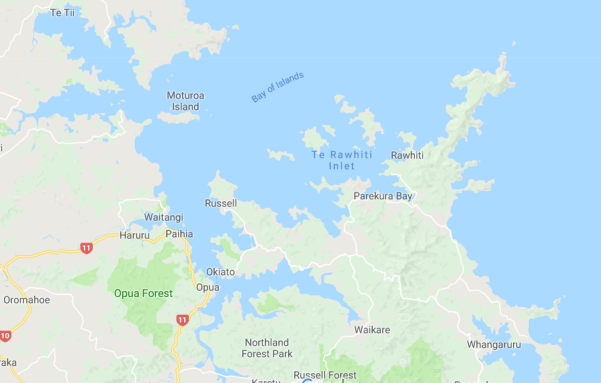
It’s up towards the north end of North Island, a beautiful part of the country with a subtropical climate. We drove up from Auckland on the third day of our New Zealand tour, stopping along the way at Parry Kauri Park, Whangarei, and the Waitangi Treaty House.

Before the coming of human beings, most of New Zealand was covered with dense forests including the gigantic, slow-growing kauri trees. Maoris began to fell these to carve out their great wakas or canoes; but it was the European settlers who destroyed most of the forest cover, to clear the land for farming, use the timber for building, and eventually to export much of it to Europe. Too late they realised this was unsustainable (or perhaps they didn’t care), and now the few remaining forests of kauri are strictly protected. This is a long term project, as it takes centuries for the trees to grow to maturity. Most will live for at least 600 years, while the oldest known specimens may be 1000 or even 2000 years old.

Alison hugs kauri

The Waitangi Treaty House is said to be ‘the place where New Zealand history begins’. Here on 6 February 1840, the Treaty of Waitangi was signed between representatives of the British Crown, and the local Maori chiefs of North Island. I must have still been jet-lagged, because the enthusiastic and knowledgeable commentary given by the Maori guide who showed us round, passed all understanding. There was Too Much Information, without enough context or previous knowledge or time to look around the exhibition in the house itself. Truly, we were on the tourist group conveyor belt, I guess.

My limited knowledge of the history makes me think the British in New Zealand did try to respect, and live in some measure of harmony with, the Maoris who were already there (themselves relatively recent arrivals). And although there were tensions, wars, injustices, there were never the genocidal episodes which are such a terrible chapter in the history of the Americas. But perhaps I’m wrong about this. I really would have liked to hear other versions of the story to support or challenge the somewhat upbeat version we were hearing.

The Waitangi Treaty House

Maori ways and spirituality, their respect for Nature and the environment, seem to have many parallels with the Celtic spirituality of our own islands. I would really have liked to hear what a Maori Christian would have to say about this, as well as a critic of the Western missionary work of converting the Maoris.

On the day after we arrived in Paihia (which I think I understood was supposed to mean something like “Good place, this”) we enjoyed a boat cruise on the bay. Our all-female skipper and crew carefully told us that it was a bit bumpy out on the bay, today. One or two people chose to stay on land; some others who chose to go, were seasick and made use of the ‘Just in Case’ bags; but most survived well enough. Because there was some movement of the waters, the dolphins were out to play. Do they do all that stuff for the sheer joy of it? Or are they coming up to watch all those human beings whooping with excitement about seeing them? Or do they get a buzz from showing off to us? Who knows?

The highlight and destination of the Bay of Islands cruise is the Hole in the Rock, on Motukokako Island. Perhaps it’s part of the show that the skipper will tell you, “It’s a bit rough today, I’m not sure I’ll be able to steer us through,” then steer close up and retreat… But she did get us through, supposedly with just a metre clearance on each side, and here’s the video clip to prove it.

After the cruise we went ashore at Russell, once known as ‘the Hellhole of the Pacific’ because of the wild lifestyle of the whalers and sealers who lived there. It was also one of the first places to which missionaries came, and the site of the oldest Anglican church in New Zealand, Christ Church, Russell.

You eat fish at the Bay of Islands; and we did at the carefully named Only Seafood restaurant. They serve what I call a pavlova:

New Zealand: 3. Auckland

Auckland, our first city stop in New Zealand. It’s a fantastic, fun place. The largest city of NZ, with one third of the country’s 4.5 million population living in and around the city. But that means it’s still small. And it is so beautifully situated: on a narrow neck of land near the top end of North Island, with harbours on two sides. And the airport is small and beautiful too. What’s not to love about an airport where you sit in the gate lounge and look out one way over the runway, the harbour and the distant mountains, while on the other side there’s a field full of bales of hay?

Auckland is called the City of Sails, because of the number of yachts and marinas around it. There are 8 boats for every New Zealander. Or is that sheep? Yes, it must be sheep. But I think what Denis told us was that 1 in 8 New Zealanders owns a boat, which they mostly use for about 8 days a year. Something like that… after a while the statistics kind of wash over you without leaving a trace. Let’s just say, there are a lot of boats, and most of them spend most of their time in the marina or in multi-storey boat parks. (No, really.) We saw a few of the very big, very expensive millionaires’ boats heading out for the weekend, on the Saturday morning we were there.

The day before that, we had landed after a disagreeable overnight flight from Singapore (10 hours in the plane, a 5 hours time difference). It was late morning, our eyes felt like they were propped open with matchsticks, and our hotel rooms weren’t going to be ready till mid-afternoon. Jet lag for me took the form of a dodgy tummy so that I didn’t want to stray too far from the loo. Instead we had an extra bit of coach tour, across the astonishing Harbour Bridge to the bayside village of Devonport with its Victorian and Edwardian buildings and many cafés. We managed an ice cream and a stroll in the sun, still feeling pretty amazed that it was summer at all and we were walking around in tee-shirts and sun hats.

It was a relief to get back to the hotel, check in, and the rest of the day was ‘our own’. After several days (it seemed) of eating Asian food, we were glad to find a friendly little pizzeria, where the waiters were authentically German and Russian.

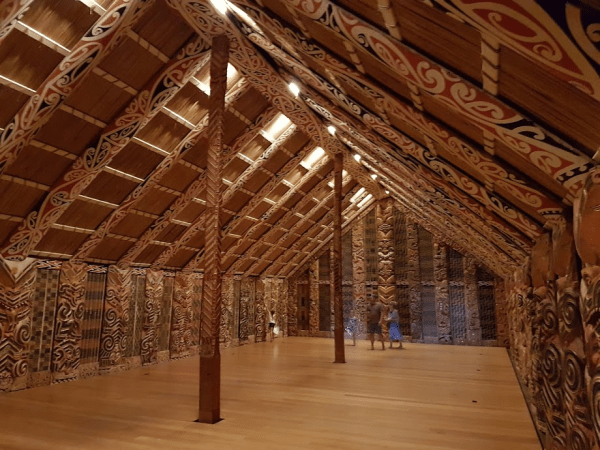
And then on the Saturday, a full day of looking around Auckland. The coach tour took in the waterfront (photos of men fishing), the Michael Savage Memorial, with its fine views back over the city (photos of tourists standing in front of the view), and Mission Bay, the site of the first Anglican mission established by George Augustus Selwyn. Then back into the city for a visit to the Auckland War Memorial Museum. I hadn’t expected to be quite as interested in the Maori history and culture, but both were fascinating. I hadn’t really known, for example, that the Maoris themselves were such recent arrivals in New Zealand. They first discovered the islands and settled them only around 800 years ago, before which there seem to have been no human inhabitants. Just giant flightless birds (now extinct), and a few smaller species like the famous kiwi that surprisingly gives its name to the present human inhabitants. (A bit like calling us Brits ‘chickens’; though come to think of ‘turkeys’ might be more appropriate these days.) So many possible pictures: here’s one of a traditional Maori meeting house which give just a taste of the decorations in carving, painting and weaving.

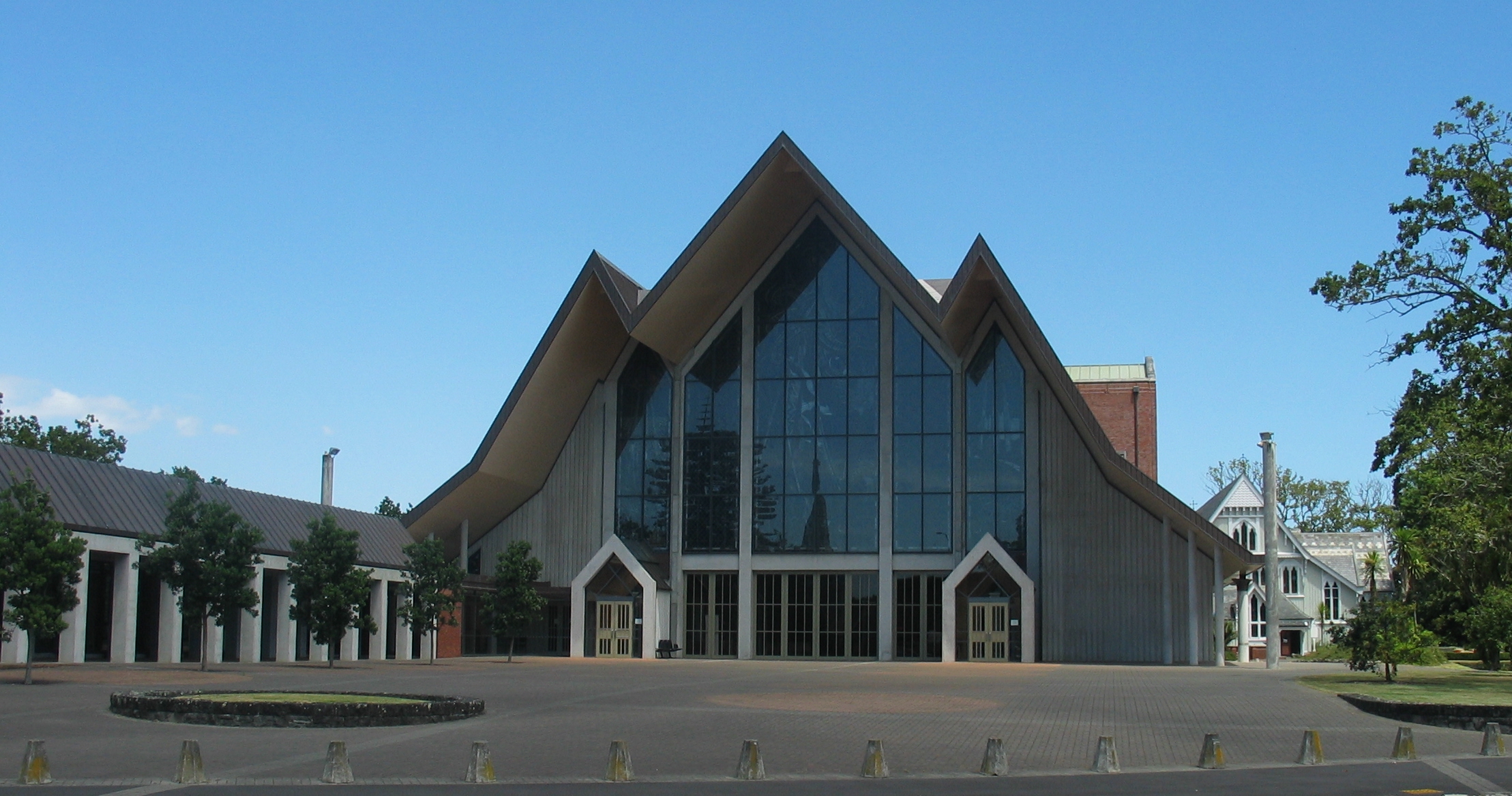
We also visited Auckland’s modern Cathedral. A bright, attractive place, once we had walked all around it and finally found a door that was unlocked. We weren’t the only visitors trying to get in, convinced it must be open because we could see people inside, but unable to find an entrance. At least British cathedrals are usually signposted so that visitors can find the way in.

One more great thing about Auckland: the city centre favours pedestrians. The traffic lights stop vehicles frequently, allowing lots of time for people to cross the roads. And at intersections the traffic is stopped in all directions so it’s possible for footgoers to cross diagonally. This would be a great idea for British cities to adopt.

Diagonal crossing at intersections

Lots more, still unprocessed and unannotated, photos of our holiday are here in this Google Photos album. If you want to explore them.

New Zealand: 2

Time to introduce two of the most important people on our New Zealand holiday.

Suzanne by the front door of the coach, Denis by the rear

First, Suzanne, our tour guide. We first met her at Heathrow and she flew with us to Singapore, where we were joined by the others who had flown from Manchester. She was then with us through the flight to Auckland, all the travels around New Zealand, and on the three flights back to the UK. It’s hard for me to imagine the life of a tour guide. Suzanne doesn’t only do New Zealand: she has also acted as guide on tours to Japan, South Africa and elsewhere. You must have to like people a lot, and be very patient, well-organised, and efficient, to do this job. Making sure that everyone arrives at places when and where they should, that hotel rooms are ready and keys assigned, that nothing and no one gets left behind (she also had a story about the time a man deliberately left his wife behind, saying he’d had enough of her…) When Suzanne first took the job, her father told her, “You’ll never be a success at this: you’re much too bossy.” But bossy is just what you have to be. With so much to fit into the schedule, punctuality and early starts were essential. Many tours I’ve been on have one or a few people who can be relied on to be late whenever possible, and who infuriatingly keep the whole group waiting. Not Suzanne’s group! The credit goes to the good people in our group, naturally; but also to Suzanne, who didn’t allow unpunctuality.

Second, our patient and indefatigable Kiwi driver, Denis. (“Why only one N? Were your parents French?” We still don’t know the answer to that one.) Much more than a driver, he was also the principal guide and explainer throughout the tour, about where we were going, what we would see and were seeing, New Zealand history and politics, the best places to get something to eat (which may also have been his own personal favourites, or places he could get a discount for sending people – who knows?) The summer in New Zealand – just like here in the UK – is the season of roadworks. Over there driving is made even more complicated by steep mountain passes, and diversions because of earthquakes and rock falls. Denis took them all in his stride, including the steepest gradient I’ve ever been driven down, where the road passes under a waterfall… though it should also be mentioned that in most of New Zealand, “quite a lot of traffic around here” means there are two or three other vehicles in sight.

I mentioned already the early starts. In many of the places we stayed, we were only there for one night. So we lived out of our suitcases, and in the morning it was “Bags out at 7; leave at 8”. (Once or twice, even earlier.) It wasn’t long before we were saying, “This doesn’t feel like a holiday; more like hard work.” Suzanne encouraged us: “Don’t think of it as a holiday: think of it as an Adventure.” Well, it was.

New Zealand: 1

It was Alison’s idea, and big wish, to go to New Zealand. It was right at the top of her list of Ways To Spend Our Savings While We Still Can.

Me, I didn’t want to go so much. “But it’s so far away! It’s such a horrible journey!”

But she talked me round. Somewhere deep down, I always want to do what she wants to do, especially if it means doing it with her. And she also reminded me that New Zealand was where Peter Jackson filmed LOTR, so I would see the Shire, the Misty Mountains, Lothlorien and Edoras, possibly even run into Galadriel and Eowyn. How could I resist? So we booked a three-week tour of both North and South Islands with Riviera Travel. We had a really good experience in September 2016 with their Heart of Europe river cruise on the Danube, Main and Rhine. And their video of the tour to the Land of the Long White Cloud gives a really good (and faithful) impression of what it’s like.

And yes, New Zealand is very far away, and it is a truly unpleasant journey. For me, one of the worst parts of any overseas travel is getting to the airport in the first place; so we set off from home the day before and stayed overnight at one of the airport hotels. It sure takes the worry out of getting there in time to check in.

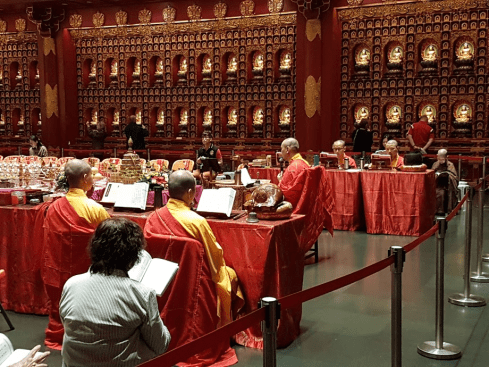
The outward journey involved a stopover in Singapore after the first 13 hour flight. I wasn’t sure I wanted to go to Singapore. It rained. The Raffles Hotel is closed for refurbishment, so we couldn’t even get an authentic Singapore Sling in the place where it was invented. It has a history that reminds you of so much of British imperialism and colonialism, which always makes me feel uncomfortable. But, it had its moments. It certainly is a remarkable place. We visited the Buddha Tooth Relic Temple, and witnessed a time of prayer which in some ways feels like a Christian monastic prayer office, but in other ways is so very different: the constant repetitive chanting, the amplified sound, the extravagant mass of images…

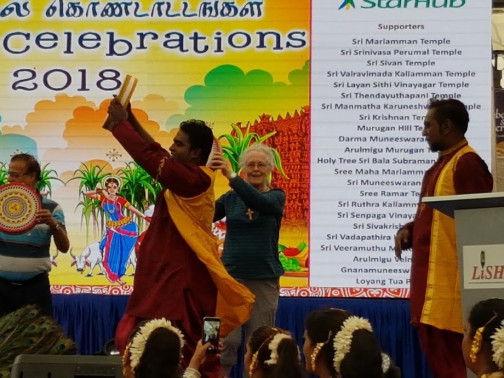
We also saw a Hindu celebration of their harvest festival of Pongal, with colourful dancers. Alison had a go too:

The evening of the next day we set off for our second flight to Auckland. A ten hour flight, with another five hours’ time difference, making a total of 13 hours difference from GMT. If anything this bit of the journey was even more horrible, because it was all overnight, it’s always so hard to sleep on planes, there was a fair bit of turbulence, and you arrive early in the morning feeling unrested and unrefreshed. It wasn’t like this back in Captain Cook’s day; though it’s true we didn’t have to suffer the seasickness or the danger of 18th century sea travel. Airplane meals were bad enough, though, and upset my tummy more than a little.

But how extraordinary it is, that in such a short time you can travel halfway around the world! Leaving out the overnight stops and the waiting in airports, the actual travelling time from home to New Zealand was about 25 hours: a distance of what Google tells me is some 11,700 miles (18,830 km).

And so we found ourselves on the fourth day of our trip, and our first day in New Zealand, in the city of Auckland.

Some statistics from our fabulous New Zealand holiday

  • 3 buses to take us to and from Heathrow Airport (and 1 lovely daughter to take us to the bus)
  • 5 air flights, totalling about 48 hours in the air
  • 49 British holidaymakers, most of them what we like to call ‘Over 50s’
  • 1 British tour guide
  • 1 Kiwi driver
  • 2 same-sex couples – and the great thing was no one seemed at all fazed by them, or made any negative comments. On the contrary, there seemed to be complete open acceptance. A lesson for the Church of England, here?
  • 11 different hotels
  • 1 overnight stay in a North Island homestead
  • 1 ferry crossing
  • 4 boat cruises
  • about 3,500 km on the coach
  • 1 Landrover ‘safari’
  • 1 talking toilet
  • 21 days away from home
  • 1 train journey, the Tranzalpine over the Southern Alps
  • 1 helicopter flight
  • 1 cable car ride
  • 1 cardboard cathedral
  • 1 cave with glow worms
  • several churches and cathedrals which would benefit from taking the Everybody Welcome course
  • 3 days of record-breaking summer temperatures for South Island: up to 37℃

All adds up to One Awesome Experience.

The first churches in my life, part 2

I ‘graduated’ from the Methodist primary Sunday School at the age of 11, with memories I’ll share in another post. The next step would have been to move on to their secondary school age section, but this met at the church in Palmerston Road, which was more than a mile away (more than a mile away!) and would have involved crossing some major roads to get there. So instead I tried the group at our parish church, which turned out to be St John the Baptist & St James the Great, Tottenham.

This was only half a mile away, and involved crossing an even more major road, but for some reason was felt to be preferable. This extraordinary building – like no other church I’ve ever known – was built in 1939 and designed by Seeley and Paget. We knew it as St John the Baptist: again, I don’t know any other church with a paired dedication to St James the Great. Where does this come from, I wonder?

My experience of Sunday School here was disappointing and short-lived. I was 11 years old, a shy and wimpy kid, in a small group where I was the only boy together with six girls. This did not appeal at the time. The curate (of course!) who led the group was probably one of those young clergy who, like me much later, thought working with children, pre-teens and youth generally was “not his special gift”. At any rate, he didn’t inspire me with enthusiasm. With hindsight I can see the aim of the group must have been to prepare us for Confirmation, since we were being encouraged to learn the Apostles’ Creed by heart, and read St John’s Gospel. I didn’t succeed with either of these at the time. And incidentally, I’ve never been sure about the predilection for encouraging religious seekers to read John. It’s such an odd book. Long before you get on to any of the stories you know about Jesus already (of which, frankly, there are precious few in the whole thing, anyway) you have to wade through verses and verses of mystical Greek philosophy and metaphysics. (OK, I like John better now, but I still think Mark would be a better gospel to give to people wanting to know what Jesus was about.)

Apart from this, most of what we were ‘exploring’ in our sessions was St Paul’s Missionary Journeys, from the Acts of the Apostles. Perhaps they were in vogue at the time, or part of some curriculum for 11-year olds, because later that year we were covering the same ground in RE lessons at school. And both were equally boring. It has remained one of life’s great mysteries to me, how anyone telling these stories, surely some of the greatest and most exciting adventures in history, can make them dull? Was it something to do with the maps?

I mean, I love maps, always have. But somehow these particular tiny maps, always out of context and always in black and white, did little to impart the excitement or stir the imagination. They looked like they were only about pouring facts into jug-shaped heads, rather than firing God-shaped hearts with excitement, and passion for God.

So within a very few weeks I became a Sunday School drop-out. I think I have a memory of the curate coming round to visit and “follow me up”, an occasion of acute embarrassment for all the family. It was no use. I was gone from formal church for the next decade.

Except for… Yes, there is one other church which features in these memories, and that is the old parish church of All Saints’, Edmonton, which I attended every Ascension Day for the next seven years.

The secondary school I joined in September 1960 was the Latymer School: the local grammar school, but bearing the same name as the more prestigious (and fee-paying) Latymer Upper School in Hammersmith. The founding benefactor of both was a London city merchant named Edward Latymer, who on his death in 1624 left a bequest for education. Most of this bequest went to the people of Hammersmith, but a part of it was designated, according to Wikipedia, ‘to fund the education and livelihoods of “eight poore boys of Edmonton” with a doublet, a pair of breeches, a shirt, a pair of woolen stockings and shoes distributed biannually on Ascension Day and All Saints’ Day.’ It was widely believed in Edmonton that the twice-yearly handout included half a pint of ale for each boy, as well as the clothing; but both had lapsed by the time I was a scholar there. What remained was Founder’s Day on Ascension Day, when the whole school walked to the parish church for a morning service of thanksgiving, and then were granted a half day’s holiday. Long before I became a regular churchgoer, or knew what the Ascension was, I acquired a lasting affection for the day. Ale or no ale.

Apart from these church encounters, and the uniformly boring RE lessons (not helped by the fact that our regular teacher was off sick for most of the first two years), my main experience of the Christian faith for seven years was daily school assembly. Our headmaster was an ordained man, the Reverend Dr Leonard Jones. The school’s daily act of worship consisted of a hymn, a Bible reading, and a prayer, often one of the Collects for Morning Prayer from the Book of Common Prayer. No attempt to preach, or convert, or interest, or entertain; no suggestion that you might not believe what you were hearing and singing. In other words, probably the best of all possible ways to present the Anglican version of the Christian faith.

I’m still convinced that the plain words of the Bible, good traditional hymns, and the words of the liturgy, are the most powerful ways we have of communicating the faith, and teaching what it is. That seems an unfashionable idea these days. But it’s a part of my own life and faith journey that I am forever grateful for.

Watching If… again after nearly 50 years

I watched Lindsay Anderson’s If… when it came out in 1968, in one of the cinemas in Oxford, with my undergraduate friends. I loved it. When you’re young, and your world is heady with Flower Power and the Summer of Love and the protest songs of Dylan and the student unrest of ‘68, which all promised such great new things – what’s not to love about a film like If…?

Our teenage heroes, raging with existential questions and hormones, are sixth-formers suffering under the tyranny of tradition and authority at their hidebound school. Its culture is represented by the spineless housemaster who gives permission to the senior prefects or ‘whips’, to carry out sadistic beatings, because, well, anything for a quiet life, while his sexually unsatisfied wife roams naked through the boys’ dormitories; the chaplain preaching violent militarism and leading the military parades; the wannabe trendy headmaster, mouthing platitudes about progress and privilege in the cause of service. Our heroes steal a motorbike and ride to a transport cafe where they meet The Girl. This leads to a scene of naked romping and love-making on the floor, (probably a fantasy?) to the accompaniment of the Sanctus from the Missa Luba. They finally strike a blow during an exercise of the Officer Training Corps, when they’ve found some live ammunition, and shoot the Chaplain. Because, as they agreed in one of their vodka-fuelled discussions, “one man can change the world with a bullet in the right place”.

Here the film becomes (probably?) a surreal fantasy, as the headmaster makes them apologise to the Chaplain, who appears lying in a drawer in his study. Our heroes are punished by being made to clear out a forgotten old storage space. Here they find a supply of weapons and ammunition that’s just been abandoned there, obviously. They climb to the school rooftops on Founder’s Day, set fire to the Chapel, and let loose a hail of bullets upon the fleeing school and guests. The Girl turns out to be a dead shot, killing the headmaster with a pistol bullet between the eyes.

If… has been described variously as the 12th, 16th, or 9th best British film of all time. Cinematically, that may be true; I couldn’t say. And it’s fun to watch, not least for old time’s sake. It feels like we’ve shared so much of our lives together.

But I’ve also got to say that watching If… again after nearly 50 years left me kind of lukewarm and disappointed. All of that rebellion and revolution and change that it dreams of, and seems to promise: what does it actually amount to? These lads are not oppressed and under-privileged. They are the privileged elite, enjoying education at one of the country’s leading private schools (fees £634 per annum, the headmaster proudly tells them). They’re not going to stand in line in the dole queue. They are the ones who, when traditional morality is thrown out of the window, will go on to be the Bullingdon Club, the bankers and financiers and CEOs and landlords and politicians, still at the top 50 years later, with an even bigger gap between them and us oiks below them.

So, pardon me if I’m not really cheering them on as they massacre their hated enemies down in the school quadrangle. Instead, I’m secretly hoping they’ll be shot down and the whole place be blown up. And that the nation will decide, in light of the massacre, that elite private schools, and films about them, are a blight on a free society that we have suffered way too long.

Perhaps that’s the message of the film after all? But if it is, it’s a message we surely haven’t understood, and 50 years on our society is even more divided and more unequal than it was back in 1968.

(If… is currently available on Netflix UK)

Cynophobia

This post comes with a confession, and an apology to all my pet-loving friends. Please do not hate me, or unfriend me, after what you are about to read.

The fact is, I have never liked dogs. It would be truer to say, I have always disliked dogs. It is only with the most concentrated effort that I can even imagine how anyone can bear to share their space with a dog, let alone love one. I know this makes me a seriously defective human being (see Genesis chapter 1). But it’s just the way I am. I would like to say, it’s the way God made me (if it’s even possible for God to make seriously defective human beings?) … but I don’t think I’m going to change at this point in my life. Sorry, and all.

So, one of the stories of my cynophobia goes like this.


The Methodist Sunday School was an extension and outreach work, run from what used to be Bowes Road Methodist Church. There’s still a church on that site, but it’s now something that looks like an imaginative contemporary community church called Trinity at Bowes. Since that main church building was a couple of miles from the neighbourhood where I lived, the church leaders had decided to run this Sunday School annexe in a small meeting room above the Co-op Shop at the end of Chequers Way. There was always a strong link between the Methodist Church and the Co-operative Movement, so it seems fitting.

The access to this meeting room was through a gate at the back of the store, after which you had to climb a metal staircase with those kinds of grille-like stairs, through the gaps in which you could look down and see the ground hundreds of feet below. So it seemed to 9 or 10-year old me. The secret, of course, was Don’t Look Down. This was maybe the first lesson you had to learn from the Sunday School.

But there was an even greater terror involved in getting there, and it was compounded by the fact that I was responsible for taking my sister Sally to Sunday School, and bringing her safely home. We would turn left out of our front garden gate, walk to the end of Empire Avenue, cross Pasteur Gardens and on down Chequers Way. The first part of this was just the same familiar way we walked to school each day, between the ages of 5 and 11. Then we’d cross over Tile Kiln Lane, and continue past Jack’s the grocer and the Post Office, over Pymmes Brook, and past the Metal Box Factory that always seemed so huge.

It was on the first part of Chequers Way, the hill going down to Tile Kiln Lane, that the danger lay. On a quiet Sunday afternoon, when there was little traffic and no people about, you were bound to encounter the Cerberus who was set there to guard the way, and prevent anyone from passing. There a little alleyway ran between two houses, leading to the gardens and garages behind. As we walked past it, on the other side of the road, this monstrous small dog would see us, and run out barking. It was obvious that it was out for our blood, would pursue us, bear us to the ground and tear our throats out.

My Cunning Plan to avoid this fate was about as successful as you would expect. Instead of walking down on the opposite side of the road to the dog, which gave it a wider field of vision in which to spot us, we would cross over to the same side. When we reached the alley we would peep round the wall to see if the dog was in sight, and dart across before it could see us. But the dog did see us. It ran out barking and chased after us. We ran, terrified, down the rest of the hill, hoping that when we crossed the lane, it would give up its pursuit.

I was nearly four years older than Sally, and could run faster, especially with a dog behind me. I reached the edge of the pavement, didn’t stop to look or listen, leaped into the road, heedless of anything but canine homicide, and crossed to the other side. There I stopped and looked back. My little sister, much more obedient to the Highway Code (Stop. Look right. Look left. Look right again.) was standing at the kerb. With the dog at her side, attempting to lick her knees.

“COME ON! COME ON!” I yelled. But she wouldn’t come on. She had been commanded not to cross the road unless her big brother was holding her hand to keep her safe. It was clearly not going to be possible to leave her standing there while I went on to Sunday School, in the hope she would still be there, uneaten, when I returned. In what felt like one of the bravest things I had ever done, I crossed the road again, took Sally’s hand, and dragged her back with me to safety. The dog, I suppose, shook its head and went back home.

We never tried that Cunning Plan again, and it’s more than likely I resorted to the alternative strategy of always thinking of a new excuse for Not Going to Sunday School Today. But I promised in my last post that this is a story of something I learned about myself. I suppose what I learned was Shame. I learned that I was really a coward who would sacrifice others, even those who looked to me for protection, to save myself. Nearly sixty years later I would like to hope that, even if and when I’m still afraid, I would now try to help and save other people in danger. But I’m not too confident about that, and am rather grateful that I’ve never been in a situation of having to find out.