Christmas – And whose Church is it, anyway?

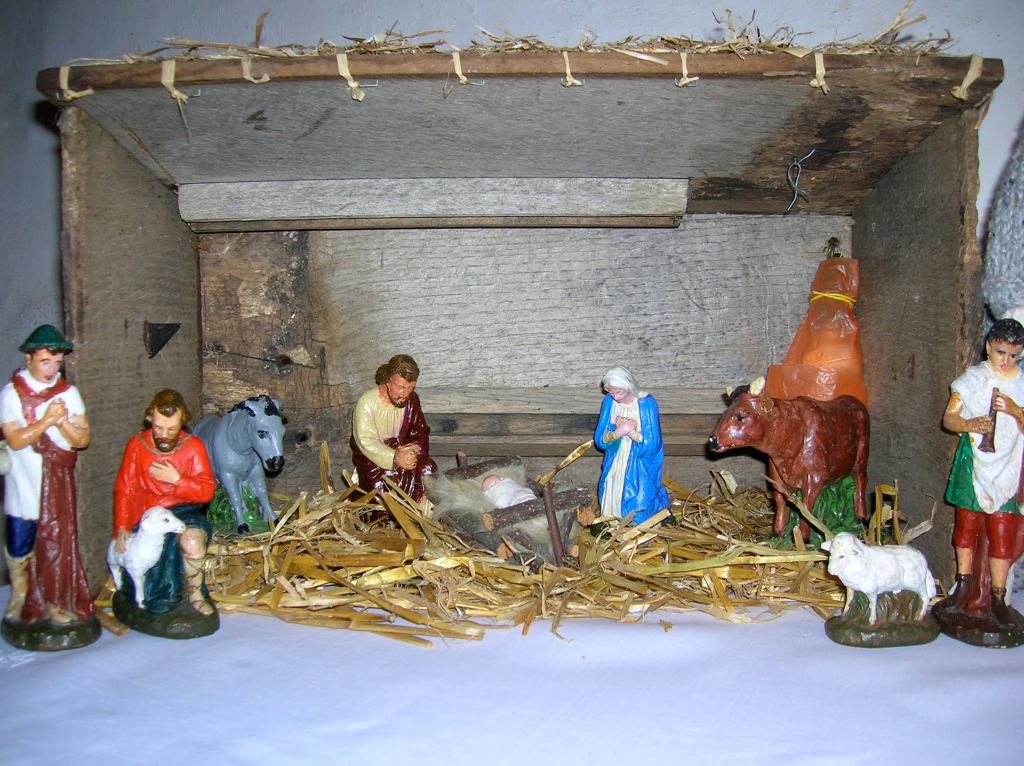
Christmas crib at St Nicholas, Marston

It’s that time of year again. When all the working clergy (God bless ’em. Who’d want to be one of them, just now1 ?) are planning for the annual influx of Christmas worshippers, and trying to think of different events and services to draw them in. Here’s my advice, guys: don’t bother with all those wizard wheezes for new and innovative and ‘relevant’ services. People will come anyway. They prefer the traditional, the tried and trusted, the things they remember and are used to from the last time they came, and the time before that, and every time they’ve ever come at Christmas. Listen, that’s what they come for.

It’s because Christmas is magic, miraculous. Even for the rest-of-the-year-round practical atheist or convinced agnostic, there is something about Christmas, the traditional so-familiar readings and hymns, that draws them again and again. And for some reason they tolerate all the extra stuff that the working clergy (God bless ’em) try to include in the services. Sermons (ugh) that are clearly meant to convert them into ‘real Christians’ who will come during the rest of the year. Activities. Film clips on the big screen. Sharing their thoughts with the people sitting round them.

It’s almost as if the clergy who plan such events don’t trust God, or the tradition. Trust them, brothers and sisters! The familiar readings really are the Word of God – so let them do their work. The traditional carols were written by people who were steeped in that Word: that’s why they work so powerfully. Let them do their work too: they don’t need endless commentary, and contemporary references laid on with a trowel.

Most important of all, please please please don’t refer to the extra worshippers who come at Christmas as ‘visitors’ or ‘guests’. If they are parishioners, it is their church. Calling them visitors or guests is already telling them they don’t belong; and I reckon part of the message of Christmas is that this is for everyone; that in God’s eyes, everyone belongs; that the angels at Bethlehem announced ‘good tidings, of great joy, which shall be to all people’. In the same way, don’t thank them for coming. They’re not doing you a favour, and that’s not what they came for. They came, for whatever mysterious, miraculous reasons, to meet with God. And they will meet with God, as long as there isn’t too much of you getting in their way.

And who knows? If you don’t stand in the way of other people in the Christmas services, maybe God will meet with you there, too. I’m certainly praying just that for all worship planners and leaders, and for all those who come to worship with you, this Christmas. In their church.

  1. Actually, it’s one of the best vocations in the whole world. I wouldn’t have missed it for anything. But I’m still happy to be out of it, and no longer to have the responsibility and all the pressures and demands laid on the working clergy. God bless ’em. ↩︎

Coming ‘Home’

So, I’ve been away. For quite a time – it’s coming up towards two years since my last post. The truth is, I’ve been on a Journey. A Pilgrimage, maybe, towards some holy destination. Or a Quest, to seek and find my True Self.

In my last post, I wrote about a part of that spiritual journey I had been on since retiring back in 2016. It’s a mistake to suppose that, if you’ve been a Christian for 45 years and a vicar for 37 of them, you have somehow ‘arrived’. At certainty, or a place where you no longer have any progress to make, or something. Pretty much the opposite of the case. I’m sure I’m not the only retired vicar who finds themselves

a) relieved beyond measure that they’re no longer responsible for running a parish, filling in all the returns required by the Bureaucracy, keeping up to date with the law regarding marriages, burials and what have you

b) but also, asking themselves, What was that all about? I know it’s impossible for people in many professions to measure how successful they’ve been, but: Did I actually achieve anything? Was it worth all the hard work and soul-searching? Do I really believe all the things I used to preach to others, or at least, thought I ought to preach? Was it all even true?

So yes: some time around the start of the Pandemic, I had been disturbed by reports of growing antisemitism in many European countries, including the UK. I started reading about the history of antisemitism, and especially the role of the Church, and many of its most famous preachers and theologians (St John Chrysostom, Martin Luther, et al.) in promoting and institutionalizing this hatred of Jews and Judaism. Soon I was wanting to learn about what it was that they hated: Did I even know very much about Judaism.

To cut a long story short, I fell in love with the faith I was reading about. The contribution that Judaism and its adherents have made to the world is beyond reckoning, far greater than you would expect from a people who number probably less than 0.25% of the world’s population. I thought that Christianity grew out of, or at least alongside, the Rabbinic Judaism we know nowadays. Yet I found that many of the articles of Christian faith which I found most difficult and unpalatable were simply not there in Judaism. Like Original Sin. The need for blood sacrifice to turn away God’s anger so that He will not punish us for our sins. The need for people to ‘believe in and accept Jesus Christ’ in order to be ‘saved’. Because God incomprehensibly chose to create a human race of which the vast majority are destined for everlasting punishment if they don’t believe the right things about Him. The dualism of ‘Spirit Good, Matter Bad’. The Patriarchy and suppression of women’s voices and contribution.

You could say (as I did), “I don’t like Christianity very much.”

As well as reading a lot about Judaism, I also started using Jewish prayers for my daily prayer. And I loved them! There’s so much less of the whinging and grovelling that Christian prayers sometimes feel like, trying to curry favour from a mean and ungenerous Deity. The standard mode of Jewish prayer is Thanksgiving, in the form of blessing God 100 (or more) times a day. Blessing God for everything. The prayers frequently take the form of

  • Blessing and praising God because He does X
  • Asking God to do X
  • Thanking God for doing X.

For a time, I even contemplated converting to Judaism. I spoke to a rabbi about it, and she said “You can’t.” (I think that, like the Benedictines, they deliberately don’t consider wannabe converts until the fifth time of asking, because it takes five attempts to prove they are serious.)

The great thing about that episode of ‘not liking Christianity very much’ was that I never stopped believing in God. In fact, I came to believe in and love God even more, as I learned to thank God more and more, in and for all things. And came to suspect that He often doesn’t like Christianity very much at the moment. And I’m immensely grateful for this time of wilderness wandering, when I was not entirely sure about who I was, or where, or where I was meant to be and meant to be heading.

And then, Someone apparently decided it was time for me to come ‘Home’, or at least somewhere approximating to it. Alison wanted to go to a week’s conference at Lee Abbey – a place that’s hard to get to without a car. So my services as chauffeur were required. I hadn’t been to Lee Abbey for years, and was glad for the incentive to go again. So we both went to a conference entitled ‘The Call of the Wild: The Feel of the Holy’, on the themes of Pilgrimage, holy journeys and places, and the Celtic Christian tradition, led by Michael Mitton and Russ Parker. They are great friends and a great team; their talks are much more like witnessing a dialogue between two men who know each other well, have abundant wisdom, and above all enjoy each others’ company and their subject.

I found the ‘worship’ hard going. There were lots of ‘worship songs’ which as far as I’m concerned were anything but. But the talks, the walks around the Lee Abbey grounds, and the opportunities to talk and pray together at the seashore, among the trees, and on the hilltops, were times of real blessing. Russ recommended to me a book on theories of the Atonement, which for all that it was weighty, was very readable and helpful. By Fleming Rutledge, it’s called The Crucifixion: Understanding the Death of Jesus Christ.

I thought I’d give Christianity, especially of the Celtic variety, another chance. This was how, about six weeks later, I found myself driving Alison to Swanwick for the Annual Gathering of the Community of Aidan and Hilda, which is “a dispersed, ecumenical body drawing inspiration from the lives of the Celtic saints.” Getting excited about it as a ‘place’ that offers refuge and encouragement to people like me who feel disillusioned with much of what we see in the contemporary Church, and applying to become an ‘Explorer’, as they call wannabe members of the community.

So yes, it feels like coming ‘home’. And it feels like taking some tentative steps away from the spiritual home I’ve known, though not really away, but let’s say, forward, on new adventures of life and faith.

Watch this space, then…

A Testament, a Prayer

When I am gone I would like it to be remembered
that I took pleasure in the common things of life
delighted in the joys of Everyday
waking in the morning to life and breath and sound
and sight and smell, and the taste of bread
and the human voice and touch of those I love.
That everything is Gift — and more than this —
that there’s a Giver to whom one may give thanks.

That Everyday brings news of discoveries
fresh adventures of learning and knowing
words to hear and read and chew on, and minds to meet,
music to charm the ear and people I love
with whom to share the things that I have found
who’ll share with me what they have found also

I’d like it to be remembered —
that I was kind to others and myself
that I would smile at people (not at cameras)
laugh when I caught myself being over serious
that truth and beauty made my spirit soar
that I was wise with the wisdom of my years
yet innocent as the child who still, somewhere,
plays in my soul
that I loved questions more than answers
stories to tell, yet better, to inhabit —
that I dreamed that there could be a better world
yet never hated this one that isn’t so
nor gave up hope of how it all might be.
At day’s end never closed my eyes in sleep
without I blessed the Author of my life.

If this is what I’d like remembered when I’m gone
let it become my habit while I’m still here.

Re-enchanted Christianity? I don’t think so

Two important and challenging reads from this week. First, in the New Statesman, from Anthony Sheldon’s review of A World Without Work: Technology, Automation, and How We Should Respond.

Susskind asks the right question – what will replace the dignity work gave? – but falls short on answers. The building of relationships, family, adult education, communities, the arts, sport and volunteering are barely mentioned. Oddly, religion too is dismissed as no longer giving meaning to lives. But in this century there has been an explosion in people searching for meaning in spirituality and religion.

Where are those people going to look for, and find, meaning in spirituality and religion? I’ve given the whole of my working life to the hope that the answer might be: in the Church of England. But how likely is that, I’m now asking myself, when it’s clear to people that the Church of England is more interested in telling them who’s allowed to have sex, than in telling them how they can know and experience God?

And then, in the Church Times, an opinion piece by the pseudonymous Ines Hands, entitled We are failing the next generation of Anglicans.

The loss of confidence in traditional worship stems from the fact that its tenor (solemnity, ceremony, and repetition) has few if any parallels left in modern life. Interpreting this as a barrier to participation, the response has been to adapt the life and worship of the Church so that it more closely resembles life outside the Church.
Certainly, the Church should have its eyes open to wider society. But it is absurd for the worship of the Church to be dictated by what we imagine those outside the Church want. I recently asked a friend, another lifelong Anglican of about my age, whether he expected other faiths to adapt their worship to outsiders. Without hesitation, he said that he would expect no such thing.
Likewise, for change to be dictated by the presumed tastes of children is frankly, bizarre. If children are routinely excluded from the eucharist and other liturgical rites, if the term “all-age” is applied only to patronising forms of worship, what children implicitly understand is that the way adults worship is boring and incomprehensible when they should infer that it is rich and sustaining. All worship is all-age. It is involvement and exposure that breed attachment. We cannot afford to disregard how much children learn from the attitudes that adults – parents in particular – unconsciously enact. If adults have little confidence in, or respect for, traditional worship, then it is already as good as lost.

You never heard of “Messy Synagogue” or “Messy Mosque”, did you? How is it that we have so lost confidence in what we do in church that we have virtually killed the dignity and beauty of worshipping and encountering the Mystery?

What went wrong?

I’m re-reading some of the spiritual and theological titles that have meant most to me over the years of my spiritual journey and ministry, and today I came across this paragraph in A. M. Allchin’s The Kingdom of Love & Knowledge. This was published in 1979, so over 40 years ago:

… the developments of the last ten years, both in North America and Western Europe, have suggested that we are faced with an undeniable spiritual hunger, a renewed thirst for the experienced knowledge and love of God. We observe a desire to rediscover suppressed or neglected aspects of man’s being, his search for the transcendent, his capacity for delight and wonder, for a non-exploitative attitude towards the world around. We see a desire to re-integrate the body into the totality of life, not least the life of prayer and worship. The problems of ecology, the rediscovery of the sacredness of the material world, the nature of spiritual, indeed mystical, experience, these are questions which are alive now in a way in which they were not ten or fifteen years ago.

That spiritual hunger and thirst is just what I’ve tried to convey with the strap line to this blog: Enchanted by God: Looking for a re-enchanted Christianity. Yet 40 years have passed, and it sometimes seems that most of what the Church has done and tried in the mean time, most of its new schemes and initiatives and projects and other good wheezes, have had precisely the opposite effect. They have trivialised the Gospel, dumbed down worship with inane lyrics to (some) new worship songs, managerialised Church structures, tried to make Church ‘relevant’, ‘entertaining’, ‘appealing’ and simply made it look stupid, and generally robbed worship and God of mystery.

The only notable exception I can think of is the ordination of women, which has hugely enriched the ordained mystery, but not yet allowed the dangerous gifts of women to re-enchant the faith.

What went wrong with Allchin’s vision? How can we put things right? If, indeed, it isn’t already too late?

Language and Mystery

Most people have a favourite psalm or psalms, perhaps one that they have become familiar with at some special moment in their life, or that means a lot to them for some other reason. For many people it might be Psalm 23, just because it’s one of the shortest and best-known. When I was at primary school, many years ago, it was one of the pieces of verse we were encouraged to learn in our English class. (I never learned it: even at the age of 10, I was the bolshy child who wants to learn ‘A Poem of Your Own Choice’, rather than one that the teacher had chosen for us.) Or it might be Psalm 139, at some moment in our lives when it’s especially important for us to learn that God knows us intimately, and values us:

I praise you, for I am fearfully and wonderfully made. Wonderful are your works; my soul knows it very well. My frame was not hidden from you, when I was being made in secret, intricately woven in the depths of the earth. Your eyes saw my unformed substance; in your book were written, every one of them, the days that were formed for me, when as yet there was none of them. (verses 14-16, ESV)

My ambition is to get to know all the psalms so well, that they are all my favourites for their own unique reason. In the meantime, there are lots that stand out for me. One of the recent additions to my ‘list of favourite psalms’ is Psalm 85. For a number of years, I would say Evening Prayer on Christmas Day, using the Book of Common Prayer order for Evening Prayer. The traditional lectionary lists Psalm 85 as one of the psalms appointed for the day, and I came to love the verses which explain that, in the coming of Christ into the world, God’s mercy was satisfied, and God’s righteousness and justice also.

For his salvation is nigh them that fear him:
that glory may dwell in our land.
Mercy and truth are met together:
righteousness and peace have kissed each other. (verses 9-10)

Whenever I say Psalm 85 in the daily course of psalms, it reminds me of that message about the Incarnation. So I have a great affection and concern for these words. Imagine my dismay, then, when I find that the Psalter used in Common Worship Daily Prayer, and the translation that appears in the New Revised Standard Version, reads

9 Truly, his salvation is near to those who fear him, *
that his glory may dwell in our land.
10 Mercy and truth are met together, *
righteousness and peace have kissed each other;

Where has that his come from? How has it crept in before the word ‘glory’, when my guess is, it’s not present in the Hebrew? And why does it make such a difference to me, and grate so, and feel that it has taken something away from the meaning of the line?

It’s because there is something about modern translation – in the Bible and in liturgy, too – that wants to over-specify, over-define. By making it crystal clear, what it wants you to understand by the words, it takes away ambiguity, and the possibility of reading different things in the text, from what the translators want you to read. This impoverishes Scripture and liturgy, where it is often the ambiguity of a phrase, its ability to bear many possible shades of meaning, that leads the reader or the worshipper deeper into the meaning and reality of God.

Thomas Cranmer, and the translators of the King James Bible, often had a better sense of this. It wasn’t that they didn’t know the different meanings: what they knew was, that if there were several possible meanings, it wasn’t their job to define any single one as the meaning

Clearly, language is supposed to communicate meaning; but if the meaning of a thing is mystery, then it is mystery that the language ought to convey. That’s one of the reasons why I find some of the more traditional formularies of liturgy and hymnology so much more satisfying than modern attempts to update them.

False sisters?

We’ve spent this week in Salisbury, staying in Sarum College right in the Cathedral Close. It’s a place I could bear to live, if only I were a millionaire or a former Conservative Prime Minister (Ted Heath had a house here.) The joy of it all is to be able to share in Morning and Evening Prayer, together with a daily Eucharist, in a place of such aweful holiness.

But even holiness has its merry moments that make me smile. Like this morning’s reading from St Paul’s second letter to the Corinthians, where he’s going on about his qualifications as an apostle: namely, that he’s suffered so much more than all the self-proclaimed apostles who criticise or oppose him.

He boasts: “Five times I have received from the Jews the forty lashes minus one. Three times I was beaten with rods. Once I received a stoning. Three times I was shipwrecked; for a night and a day I was adrift at sea; on frequent journeys, in danger from rivers, danger from bandits, danger from my own people, danger from Gentiles, danger in the city, danger in the wilderness, danger at sea, danger from false brothers and sisters; in toil and hardship, through many a sleepless night, hungry and thirsty, often without food, cold and naked.” (2 Corinthians 11.24-27 NRSV)

Danger from false brothers and sisters? The Greek word translated thus is ψευδαδέλφοις – meaning pseudo-brethren or ‘false brethren’ in the KJV. I can only think the NRSV’s version is its inclusive language policy carried to absurd lengths: I can’t imagine that many of the dangers Paul faced were caused by women (pace The Life of Brian). But that didn’t stop my imagine wanting to discover the story behind these wicked women, these false sisters, who caused the saint such trouble.

Perhaps there’s an idea there for next NaNoWriMo?

Playing with God

Last week I spent four days on retreat at Mucknell Abbey. Why does a retired vicar even need a retreat? I hear you ask. Isn’t the whole of his life one long retreat? Well, yes and no. I may be much more the master of my time, than I was when I was a working vicar; but there are still all sorts of ways in which the business of ‘everyday living’ can feel as if it gets in the way of being able to think about God, and spend as much time thinking about God, as you might like. Also, I’ve found myself spending the odd idle moment asking myself, What am I actually supposed to do, now that I’m nothing but some superannuated old priest?

Mucknell Abbey is one of my favourite places to be in the whole world. Just a few miles from Worcester, it’s the home of a community of Anglican Benedictines, men and women, who devote themselves to living and praying according to the Rule set out by St Benedict 1,600 years ago. They used to be at Burford Priory, but when that property became too expensive for them to maintain, they sold it and moved to their new, purpose-built monastery, in 2010. There are 12 members of the community, including two novices, and their number is sometimes augmented by a few ‘alongsiders’: young people who have chosen to share the community’s life for a short period of time. If you want to know more about them, have a look at their excellent website.

The Oratory, Mucknell Abbey

Staying at Mucknell, even for just a few days, is a spiritual tonic. Sharing in the community prayers six times a day (I never managed the seventh, the Service of Readings at 6 a.m. each day), enjoying their simple but ample (mostly vegetarian) meals, and lots of hours to read or think or wander around the grounds up there on their windswept hill.

Perhaps I hoped for some dramatic revelation, a flash of light and the voice of God telling me exactly what I have to do. One always does hope for that. Or maybe not. Instead of that kind of drama, something much better happened. In my thinking alone, and my reading and praying, and the Offices, I began to discern a common theme, which was about God being present, and near. (In fact the Rule of St Benedict has a lot to say about God being present everywhere and anywhere.)

You know how it feels if you’re in the same room as someone you really love and admire but you maybe don’t know very well – perhaps a celebrity or popstar or some other kind of hero – and they look at you, and your heart jumps? It was a bit like that. I got the sense that God was there, and that God looked at me. Not with reproach or blame or anything scary like that – it would be possible I suppose to feel terrified by the thought that God was looking at you. No, this look was with interest, and love.

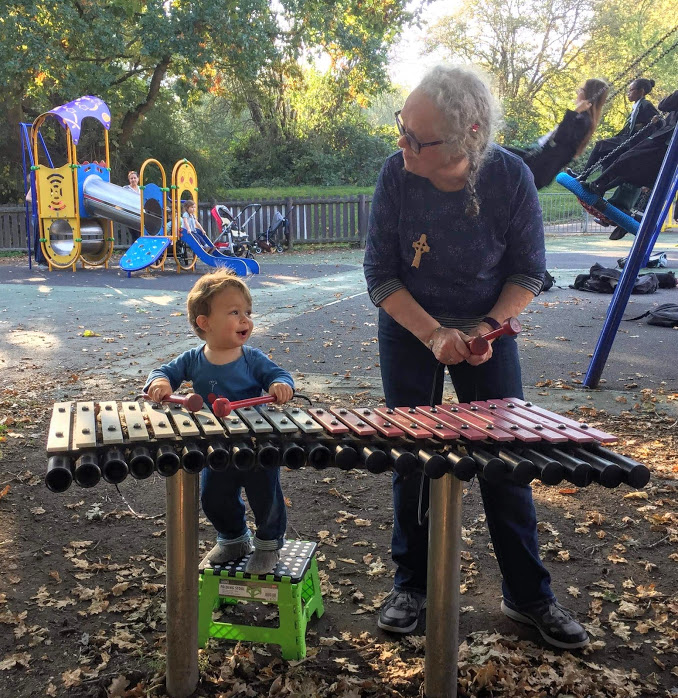
While I was away, Alison posted a picture of her visit to youngest grandson Jerm. It somehow became a lovely kind of icon for me, that described my week at Mucknell. In this icon, God is represented by Alison, and me by Jerm. We’re involved together, we’re looking at each other, we’re playing together, we’re having fun.

That’s kind of how the spiritual life should be. Hang it all, that’s how life should be, and how St Benedict sets out to regulate it so it can be. Living with God, being with God, sharing God’s deep joy in all things. I’m really hoping to bring that sense home with me and hold on to it as the special revelation that God did indeed give during my retreat.

The first churches in my life

One of the most influential teachers in my life used to tell the story of how and why he was a firm believer in infant baptism. Both of his parents were somewhere along the agnostic – unbeliever spectrum, one nominally Jewish, one nominally Christian, but neither of them practising their faith with any great conviction. He was born, however, in a time when some infant rite of passage was expected. So they decided that, if their child was a girl they would bring her up as a Jew, and if a boy, they would bring him up as a Christian. So when M was born, he was duly baptized. He always claimed it worked, in spite of his parents’ relatively low level of commitment to the enterprise, because when he was an undergraduate he came to fully-fledged Christian faith, and ended up being ordained and teaching me liturgy and much else besides.

It only goes to show. Though I’m not sure what.

But the story makes me often reflect on my own childhood, and the mysterious and unknown influences of what was done for me or to me. My parents were both of the generation who had enough of religion in their childhood. Dad sang in the choir at St Bartholomew the Great. He enjoyed the singing and the pocket money he earned him, and being able to get the autograph of film stars who occasionally showed up in the congregation, but he never told us much else about the experience. Mum had a pretty difficult childhood and teenage years, much of them spent as a weekday boarder in a children’s home. I don’t remember her ever mentioning church from those years.

But they had me christened, on 23rd October 1949, at our parish church of St Aldhelm in Edmonton. I wasn’t paying much attention at the time. Or at least, don’t remember anything of the experience. But that doesn’t stop me being grateful, and believing like my teacher M that it must have worked.

St Aldhelm’s Church, Edmonton

For some years Mum and Dad sent me and my sister to Sunday School, because that was the way your parents got you out of the house on a Sunday afternoon in the 1950s. There is another story about going to Sunday School and what I learned about myself in the going (rather than the being there). But I’m grateful for what I got from it, too.

And then the other church of my earliest years was St Cuthbert’s Wood Green.


St Cuthbert’s Church, Wood Green

This was my earliest experience of public worship, from the days of Church Parade with the Cubs. When I couldn’t think of an excuse for not going, I had to go there once a month, especially after I got to be a Sixer. There was no such thing as Family Service in those days. We got Prayer Book Matins, like it or not. There was, yes, some concession to the fact that children were present in the form of what I suppose was intended to be a child-friendly talk. But we still had the psalms and canticles and the language of the Book of Common Prayer.

How accurate, ever, are memories of when you were 9 or 10 years old, 60 years ago? What I think I remember, is puzzling over the language of those words, and feeling that I was beginning to get some sense of what they were about. And of being aware that what we were doing when we sang and prayed was Serious Stuff, so that I was impatient with my peers who kicked and scuffled under the pews, when we were expected to be somehow reverent about doing that Serious Stuff. I wouldn’t say I have loved Prayer Book Matins ever since. But I love it now, and still think there’s more solid meat and nourishment in it, than there is in most contemporary Services of the Word.

Yes, I am grateful for the first churches in my life. One ‘High’, one ‘Low’, both still seemingly alive and active, describing themselves as vibrant, friendly, inclusive, ethnically diverse, engaged with the local community: all the boxes that churches are supposed to tick.

I pray for them, their priests and congregations, that they may above all still be places where God meets people, and where children, women and men meet God. Even if they’re not paying attention at the time, or not fully understanding what it’s about. Who of us ever is?

What Else I Miss

This morning a happy collection of accidents led us to a very special service at the Cathedral. Our parish church decided not to hold a mid-morning service because they have their Christmas Eve extravaganza of Christingles this afternoon: three sittings, and every one of them packed. Apparently there were other churches in and around Oxford that made similar decisions, so those who wanted to celebrate the Fourth Sunday in Advent, and receive Communion, had to go elsewhere.

As it happened, the Cathedral’s Choral Eucharist was also the first celebration of the Eucharist by Canon Sarah Foot, the Regius Professor of Ecclesiastical History, who was ordained priest last Thursday by the Bishop of Dorchester. The Cathedral clearly love her, because they pulled out all the stops to make it a cracking good service.

And incidentally it reminded me of What Else I Miss. Because my last post was chiefly about quiet, often almost private prayer in a holy place. I realised this morning that a great deal of what I miss in priestly retirement is also about public worship. I realise that it is quite a while since I have felt I have really ‘met with God’ (whatever that means!) in corporate, public worship. And the things that helped me to have that sense of worship and presence and communion this morning included

  • the beauty of architecture in Christ Church Cathedral (though of course this can’t be essential, as you don’t get quite this quality in most places)
  • really excellent music – by Victoria, Palestrina and Buxtehude (ditto)

but then also some things which you might more reasonably expect in other places, even parish churches, as well:

  • real Anglican liturgy, as decently and reverently done as circumstances allow
  • Bible readings thoughtfully and well read
  • sincere, intelligent and godly preaching
  • hymns you can sing that actually mean something, that express worship and prayer, that teach the faith and give you something to think about, and aren’t the kind of candy floss piffle in the wind that so many modern worship songs are.

We love our parish church where the people have welcomed us so warmly, and we know God has called us to belong here, not least to support and encourage the clergy in their ministry. But I’m thinking that, for my own spiritual health and well-being, I need to plan in regular times when I can get away to the Cathedral or elsewhere to be ‘blessed up’, and to get the sustenance I need for the desert walking in between times.