Category: My life
Having a go at Shakespeare
I haven’t recorded a poem for over two months. I’d been asked to read something by Shakespeare and was too afraid to try: how could I dare to do what the greats of acting and speaking have done? But hey – life’s too short to be a coward for long. And I took courage from the remembrance of things past about my classmate Judith, who recited this in our English Verse Speaking.
Little, Big
Iโve been wanting to write this blog post for 35 years. What? Youโre telling me blog posts hadnโt even been invented 35 years ago? No, of course not: back then this would have been an article or an essay. But you know what I meanโฆ
In 1984 I was a young curate with a struggling wife and three young children, serving a tiny church in an industrial village in Bedfordshire. I had felt a strong call to take the post, but my ministry there turned out to be not what some might call โsuccessfulโ in terms of making converts and growing the church. I didnโt see much noticeable fruit of my ministry, and although the people of the church loved us and we had some good friends there, it often felt there was little to support or encourage my wife and me in our own spiritual life.
Then I read a book which I thought at the time, and have often thought since, โchanged my lifeโ. It wasnโt a book you might have expected to change the life of a minister in that kind of situation.
It was Little, Big by John Crowley.
How can I describe this book, or explain (or perhaps, even, remember) how and why it changed my life? Itโs a complex fantasy novel โ Ursula K. Le Guin called it โa book that all by itself calls for a redefinition of fantasyโ. Itโs a love story โ or better, a whole collection of love stories. Itโs a family saga spanning generations. Itโs a nature book, with beautifully written descriptions of field and forest, river and lake, birds and animals. Itโs about architecture and literature and ideas โ over and over again you want to mark sentences and whole paragraphs you think you must remember and quote. Itโs full of mysterious events that you donโt understand the significance of until much later in the Tale โ if indeed you ever do. Itโs about the nature of Story itself: how stories are told and if they ever can have an ending. Itโs a political thriller about the End Of Civilization As We Know It, when the failing democratic republic is taken over by a charismatic populist leader, whom the elite powers of the Establishment, the bankers and the media think they will control for their own purposes โ but they are mistaken. (Remembering that this book was published in 1981, you have to ask yourself: How did the author come to be so prescient? What could have greater contemporary relevance for us?)
But above all, it is a fairy story. And the secret of how and why this book changed my life is tied up with this, and the old question we all remember from our days of watching Peter Pan: Do you believe in fairies? As I read this book in 1984, a time of struggling with and trying to make sense of questions of faith, again and again it helped me to learn more about just what faith means.
The Drinkwater family, around whom the whole Tale revolves, are said from the outset to be โvery religiousโ. But this is not Christian or any other kind of mainstream religion: it is about knowing and living and walking with โthemโ, the inhabitants of another world, the world of Faerie. Into this family marries a young man who doesnโt share their โfaithโ, who is introduced to us in the very first wonderful paragraph of the book:
On a certain day in June, 19โ, a young man was making his way on foot northward from the great City to a town or place called Edgewood, that he had been told about but had never visited. His name was Smoky Barnable, and he was going to Edgewood to get married: the fact that he walked and didnโt ride was one of the conditions placed upon his coming there at all.
Smoky is aware of and respects the beliefs of his bride and her family, but he cannot share them. He never sees or hears or speaks to โthemโ: so he simply cannot believe in them. Yet out of courtesy he keeps quiet about his lack of faith, never speaks of it, seems almost to pretend that he does share it. Suspects, sometimes, that many of the other members of the family are also โpretendingโ because they also are too reticent to speak of it. One of the most moving moments in the book describes the conversation, many years later, between Smoky and his grown-up son Auberon, when Auberon finally asks him, โDo you believe in fairies?โ And it transpires that each of them has thought that the other knew Something all along that remained a Mystery to him. What is the difference between believing, and pretending we believe, because we think that all the people around us believe something we cannot, and yet they expect us to share their faith, and imagine that we do?
In the end (SPOILER ALERT! โ or maybe not?) They all withdraw into the smaller world within their one, which turns out to be far far bigger, while all the characters in our world journey into that inner world that They have vacated, and take Their places. (I think.) All of them except Smoky who cannot make that journey. But it doesnโt matter, because
how could he desire another world than this one?
and
He couldnโt go where all of them were going, but it didnโt matter, for heโd been there all along.
His life, and all their lives and the things that have happened to them, are part of the Tale. Which is now ended; and yet itโs a Tale that never ends.
I have always been most fully convinced of things not by reasons or proofs, but by imagination. Itโs why the moment I came to believe was when I read the Gospels and realised that this was a Story that I could, and wanted to, inhabit. Itโs why the stories of C. S. Lewis, Narnia and the were so helpful on my spiritual journey.
And Little, Big helped me too, because it taught me to imagine the truth that โThere is another world, but it is in this one.โ1 Some of the most important discoveries of my own spiritual journey have been deepening insights into this truth. The โother worldโ that we believe or aspire to believe in is โinโ this world, or touches it at every point, or is separated from it by only the thinnest of veils. And we come to know that โother worldโ most fully as we learn to love and know this world. If we hate this life, we will never enjoy the life of Heaven. Or whatever.
You may not like Little, Big at all, it may leave you completely cold. But I hope that, if you do read it, you catch a glimpse of the same mysterious, wonderful truths that so captivated me and continue to do so.
-
Variously attributed to W. B. Yeats, Paul Eluard, and even Rilke โฉ๏ธ
The Day of Shoulda Beens
Sometimes the cancellation of events because of the Covid-19 pandemic has the very slightest of upsides. It would have been so tough to decide what I would have done today, with two events both of which I really wanted to go to.
First: the Haddenham Beer Festival. Over the years this has been taking place, always on the first Saturday in July, it’s become far more than just (just?) an opportunity to enjoy a huge choice of real ales and craft beers. It’s become a real family fun day, with music, bouncy castles and other activities for the children, and a range of street food from fish and chips to burgers to Scotch eggs to South African bunny chow. There’s cider or gin, prosecco or Pymms for them as wants it. But chiefly there are the 130 or so varieties of beer from real ale breweries far and wide.
We’ve been going for several years with as many of the family as have been able to be with us. A growing number as the children have more children of their own; a declining number as some of the children decide it’s too far or too difficult for them to travel in a day, with the numbers or age of their children, and the ‘decisions’ about who’s going to be the designated driver. We don’t have that problem: we can get there and back by bus.
But then there is also the School Reunion. This year it’s 60 years since I started at secondary school, aged 11. It’s not an occasion I go to every year, but 5 years and 10 years ago it seemed important, and today would have been just as important to meet up with my cohort of the 1960 intake. It’s an opportunity to meet old friends and classmates we may hardly have spoken to for years, to wonder “What am I doing here with all these old people?!”, to look at what’s changed and what hasn’t changed in the buildings, to ask “Do you know what happened to so-and-so?” (Increasingly with the sub-text, Is he/she still alive?) And we get to gather in the Great Hall and sing the deeply loved and loathed School Song.
This year, of course, both have been cancelled. I’m not aware of any plans for a virtual beer festival. Even if I could drink my can or bottle of beer while looking at other people drinking theirs, it wouldn’t be the same as a half a pint of Tiffield Thunderbolt or Bad Kitty or Bishop Nick’s 1555. Today the pubs are re-opening after over three months; but I don’t want to be part of whatever unsafe excess I’m afraid may ensue when their doors open.
There is, however, a virtual class reunion of Latymer 1960, being set up by one of the old classmates. I’m planning to ‘be there’, and I may even take a sip from my can of Brew Dog — with a tear in my eye? — while I do so. We’re told there won’t be any singing of the School Song. Shame.

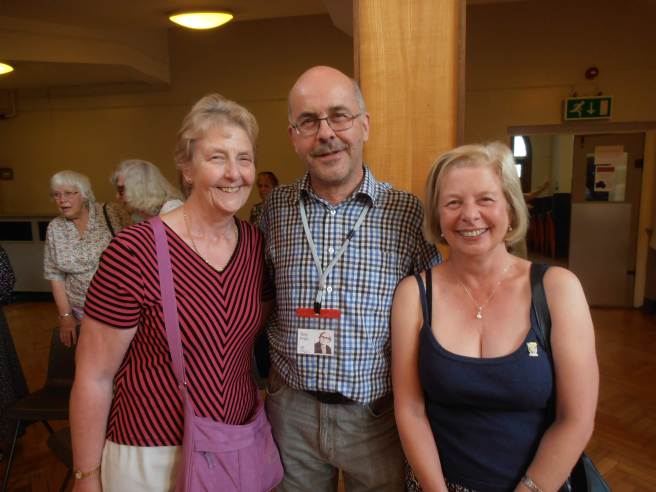
Five years ago I met up with these two lovely ladies, Chris Humphries and Christine Budd, who were actually part of the 1961 intake. (As an August-born I was closer in age to many of that year group than my own.) I worked with both of them at the local library where the three of us had weekday evening and Saturday jobs. As a 17-year old I loved Christine B. from afar. She grew up to be a Maths teacher. Very much like the even lovelier lady I actually married. (What is it about maths teachers?)
Being tested for Covid-19
Ever since the beginning of the Covid-19 lockdown, we’ve been reporting daily to the Covid Symptom Tracker. There are now nearly 4 million people who have signed up to the app, and it’s been producing enormously valuable data in understanding the virus and the pandemic. For example, they were the first people who were really able to test and confirm that loss of taste and smell were symptoms of the illness. If you are not using the app, please do download it and use it. It only takes a minute a day to report if you’ve been tested for Covid-19, and if you’re feeling well or have any symptoms. If you do report symptoms, there are a few extra questions to answer.
Last week, Alison was feeling unwell with something that felt like migraine attacks, from which she’s never (hardly ever) suffered. So she reported this, and got an email in reply asking her to arrange for herself and all members of her household (that’s me, folks) to be tested for Covid-19. I don’t know if they’ve had any other evidence that migraine-like symptoms might also occur with Covid-19, but this is presumably what they might be wanting to look for.
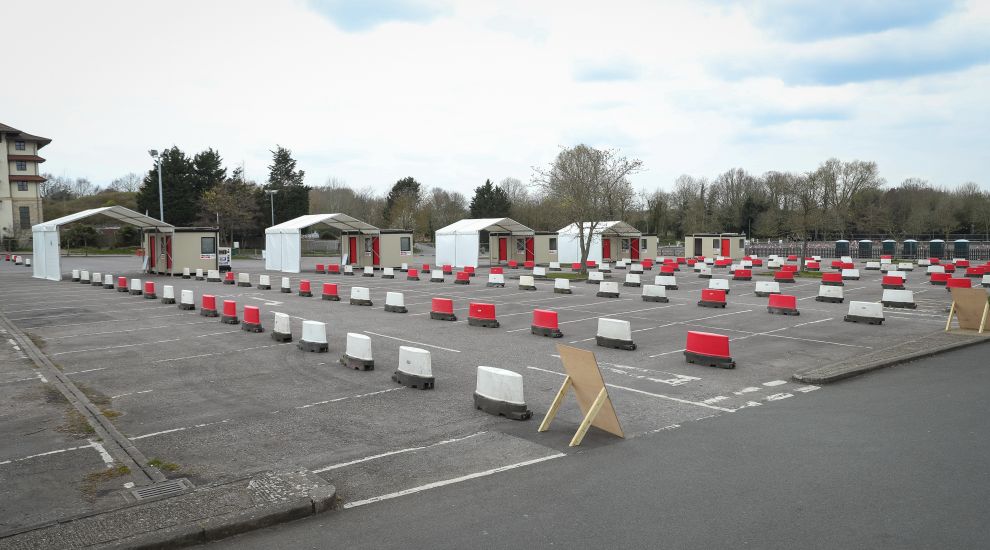
Our nearest testing site is at Thornhill Park and Ride, where half the large car park has been converted for this purpose. Before you go there there you have to fill in an online form for the NHS, with details of name, date of birth, NHS number, and they send a QR code to your phone which is your passport to the testing area.

There are signs everywhere to keep your car windows closed until they say to open them. So you’re stopped at the entrance where a guy reads your QR codes, shouts through your window to ask if you want to administer the test yourself (which will be fairly quick i.e. take quite a while) or have someone else administer it (which will take even longer because they’re very busy and there’s a 15 minute wait. Probably.) We opt to do it ourselves, and are directed to the left to drive round the site to the self-administration area.
Here a guy holds up a piece of paper on which is written ‘Please phone this number 07* ****.’ We dialled the number, so that we can hear the instructions without him having to shout at us. This would be very helpful, except that our particular guy is Polish (?) so we have a few accent difficulties with the instructions. Use alcohol hand gel. Open the rear passenger window — just an inch — so they can post the kits through. Drive on and reverse park on the left. Now open the kits.
The first thing we see is the instruction leaflet: ‘Please read this carefully before using the test kit.’ But we’re not allowed to, because he is going to talk us through the procedure. Place the card and the plastic envelope on your dashboard. Open the envelope with the swab, holding it carefully at the end away from the swab itself. Take two samples: one from the back of the mouth (around the tonsils), one from a nostril. Open the plastic phial of testing liquid and place the swab inside, then break off the end of the stick and screw on the top. Place the phial inside the bag, squeezing out as much air as possible, then squeeze the air out of the envelope and seal it up.
That done, we are to drive on to the collection point where there is another number to phone to speak to the collector guy. Did we have any problems doing the test? Have we done everything we were supposed to do? When we’re ready, open your window — just an inch — and post the envelopes through into the box that is being held up to catch them. And that’s it. Hold on to the card with this QR code and they will email you the results within the next day or so.
In fact we get the emails within 24 hours, it’s in our Inbox when we get up the following morning. We’ve tested negative so we can go back to work (What?!) We never really thought we had it.
But at least we’ve got something different to tell the Tracker app today.
The Inbetweeners and Sex Education
Hereโs a reflection I’ve been pursuing about contemporary culture, sexual attitudes, mores, popular entertainment, and humour, inspired by two TV sitcoms. You could frame it as an essay question:
Compare, contrast and evaluate The Inbetweeners, (2008-2010) and Sex Education (2019-present).


They are apparently similar in being British comedy dramas about teenagers coming of age, and especially exploring their sexual identities, doing their best to look cool to their contemporaries, and to get laid as often as possible.
I quite enjoyed The Inbetweeners when it was first aired. I canโt say the same about viewing it again on Britbox, where it is currently available. Each episode opens with the moral health warning: Contains strong language and adult humour. This isnโt exactly true. The humour is relentlessly adolescent, and I would add, aimed at adolescent males. In the ten years since it first came out, there has been a huge sea change in the way we (or at least, I) react to this brand of humour. Perhaps it has been the effect of revelations about the abuse of women perpetrated by men, the whole #Metoo phenomenon, the language used by Donald Trump and others that sets out to humiliate, degrade and objectify women. I can no longer listen to Will, Simon, Neil and Jay’s conversations with even the wry recollection, “Yes, that’s just what being a spotty adolescent was like, my body raging with lust and hormones.” Now it’s just repulsive and gross.
Sex Education is different. It’s still about teenagers at a sixth form college agonising about sex, identity and the rest. It’s still a jungle in there – why is it that teenagers are often so outrageously cruel to each other? But it’s so much funnier, cleverer, more adult in fact, but without repelling in the same way. You might say, perhaps, that it’s about what the title says it’s about: these young people know more about sex (well, not always – witness among other examples the chlamydia “plague” panic in series 2, episode 1), and it’s also, seriously, about how they learn more. It’s also much more inclusive: girls have sexual desires and experiences as well as the boys. There are lots of strong female characters in the comedy, and they are often shown in a better, more sympathetic light than the boys. Adults have sexual desires and experiences too, and they form an important part of the action. The adults elicit our sympathy but also our disapproval, as they mistreat their pupils or children.
I thoroughly enjoy Sex Education and can watch it again without that disgust that not only The Inbetweeners, but other more vintage ‘comedies’, arouse.
What do others think?
Mowing the lawn
What else is a retired gentleman in lock-down to do?

What I imagine my lawn will look like when I’ve cut it 
What it actually looks like
Job done!
Apocalyptic
Last Edited: Mar 25, 2020 2:01 PM

It seems strange when I remember it now. When I retired at the end of August 2016, and for some months afterwards, I quite often found myself having anxious, fearful thoughts about different kinds of disasters and apocalypses that might happen.
Some of it, I’m sure, was the stress of something I had never experienced in my life until then: the burden and responsibility of living in a house that we actually owned. Say what you like about living in a tied cottage – such as a vicarage is – but you don’t have to worry much about maintenance. You just pick up the phone to Church House and get the Diocesan Surveyor to send someone round to fix it. It’s also true that the Diocesan Surveyor got a bit fed up with phone calls from Marston Vicarage (which has since been demolished and a new one built.) Starting with the leaky flat roof, and progressing through numerous cracks in the walls caused by alternating heave and subsidence from the huge willow tree about ten metres from the house, rebuilding of said walls, and at the last water leaking from the pipes embedded in the concrete floorโฆ Now I write all that, I wonder how we put up with it for 25 years, unless it was something to do with the wonderful parish and people. But at least it kept us entertained, and was really the only thing we had to complain about in the whole of our wonderful time there.
But when all that was left behind, I would often find myself – chiefly in those sleepy moments of doing the washing up – thinking what it would be like when you turned the taps on and no water came outโฆ or when there was no electricityโฆ or when rats crawled out of the toilets. Like in Raymond Briggs’s terrifying When The Wind Blows. Or when bands of brigands roamed, terrorising neighbourhoods, or tanks rolled along the streets. This was in the months following the Brexit Referendum, with that sense of dread over the divided country we were suddenly living in, and the possibility, that I imagined, of actual civil war or some similar calamity.
Never, in my wildest fantasies, did I imagine an apocalypse in the form of a global pandemic. Clearly I needed a more fertile imagination.
What a difference a year makes
If you were reading my blog about this time last year, you’ll remember that I wrote quite a lot about the health problems I was having. After my RARP (Robot Assisted Radical Prostatectomy) I developed osteomyelitis of the symphysis pubis – a bone infection of the pelvis. This is such an unusual complication of the surgery I’d undergone, that it was some time before it was recognised and diagnosed, by which time I had been in real pain, practically unable to walk, for about five weeks. The treatment prescribed was three months of antibiotics, and about the time of the spring equinox last year, I had been on ciprofloxacin for a week, and not yet seeing noticeable easing of the pain. I noted in my diary that I went out for a walk – aided by my two walking poles – and managed about a couple of hundred metres and back.
It was a grim time, and there was further unpleasantness to come, in the form of acute urinary retention which required a urethrotomy. One of the things that helped me cope with this whole months long ordeal, was telling my story. I told it to anyone and everyone I thought would listen. I told it so often and in such horrifying detail that it probably drove my family and friends to distraction. Fortunately they had the wisdom, the patience, and the grace to listen, because telling your story is a healing thing. Victims of far worse traumas than mine – rape, war, genocide – have all testified how telling their story can help, even if there’s an element of it forcing you to relive the bad time.
For me there are still ongoing maintenance procedures I have to do, chiefly intermittent self-catheterization, which sounds terrifying but proves to be manageable even for someone as squeamish as me. It’s amazing what you can do when there’s no alternative. But as 2020 began, we began to think that this year we could get away for holidays and breaks again, in a way that was impossible in 2019. Nothing as ambitious as overseas travel, because foreign health insurance was likely to be difficult to obtain. Instead, we planned a progress north to see some of the cathedrals and medieval abbeys we we have never visited or would like to revisit. This was to finish with a week’s retreat on the Holy Island of Lindisfarne, one of our very favourite places. A thin place, a place where you really feel that you can draw near to God.
And then came Covid-19.
It has turned the world upside down, in a way that seems more extraordinary and frightening than any of the other disasters that have befallen the world in the 70 years I have known. In October 1962, when I was only 13 years old, the Cuban Missile Crisis convinced many people that we were on the brink of a Third World War which would destroy us all. I have hardly any recollection of it – certainly not of being unduly terrified at the time – though I know some of my contemporaries who were more aware of world events shared that great fear. The Vietnam War was terrible, but far away from being an immediate threat to our survival. Likewise the Gulf War(s), 9/11, and all the subsequent Middle East horrors. Suddenly an invisible killer is out there in the world, and all the powers we have been accustomed to look to for help seem powerless against it.
Each day that passes brings news of further restrictions, as the Government struggles to find the least worst way forward in dealing with the crisis. It often has the look of people thrashing about in the coils of a monster that is dragging them inexorably towards destruction. Apparently our Prime Minister was driven by enormous ambition to reach the place he is now. I’ve found myself wondering whether he regrets that nowโฆ Or would it be worse if he’s sitting in No. 10 thinking he really is the man for this hour?
We’re hoping to stay well, and if that doesn’t happen, we’re hoping to survive (what a thing to come to!) Perhaps we really are coming to a time when Bishop Ken’s hymn becomes real:
Redeem thy misspent time that’s past
And live this day as if thy lastโฆ?
How would my thoughts, words, actions be different, if I considered that every journal entry, every blog post, every phone call, every conversation, might be my last? Not many of us are ready to think like that. Maybe we should cultivate how to be.
Oysters? No way

We enjoyed a lovely 4-night stay at the Grand Hotel in Brighton. It was partly to celebrate Alison’s 70th birthday, but also to get away from the Middle-of-England for a few days. Is that the same as Middle England? I’m not sure, but Oxford is about the furthest away from the sea that you can get in these islands, and Alison was really wanting to see the Sea again.
The weather was kind of what you expect from the seaside in January. Windy, misty, damp, cold. The wind farm out at sea, which we caught a glimpse of on the day we arrived, was invisible after that until the morning we left to return home – when the weather, it goes without saying, was the best it had been all week. Much of the time you couldn’t see the top of British Airways i360, which was closed for annual maintenance. Sometimes you couldn’t even see the roof of the seafront hotels. At least the city was not overrun with holidaymakers, so it was always possible to find somewhere to eat. We enjoyed some good meals. But not oysters and champagne, which I wasn’t tempted to try, and which I truly believe nothing on earth could ever induce me to try. Even though your 70s are supposed to be a time for trying new things. I draw the line here.
If you were to fancy trying them, I suppose you would go to Riddle & Finns.

This is their seafront place: it looks appealing enough, doesn’t it? But I googled how to eat oysters, and confirmed what I had suspected and feared: that you eat them raw, and alive, and swallow them down whole out of the shell. If you knew the difficulties I have swallowing stuff (e.g. paracetamol, a particularly troublesome thing to be swallowed), and knew that according to my family I even have to chew yoghurt before I can get it down, you would realise that this is a perfect recipe to have me gagging and throwing up the whole of my stomach contents on the well-kept floor of Riddle & Finns.
So forgive me if you should get a glimpse of my bucket list and be dismayed that ‘Enjoy a breakfast of oysters and champagne’ is strangely missing.