Memories of a lost school-friend

It’s disconcerting in an age of instant communication of so many things (that often don’t even need to be communicated) when you come across a notice of something that happened several years ago, that you would have liked to know about sooner.

So it was this afternoon, when I opened the Winter Newsletter for alumni of my old school (Latymer Links: Always A Latymerian). Naturally I clicked on the link to the Obituaries page, as I find myself doing more and more often. And find that one of my cohort of 1960 joiners appears there.

Let’s call her J. At the most recent school reunion, in July, there was a special table for those who had joined the school 65 years ago. There were fewer of us than there used to be, though a number of ‘the missing’ were absent not because they’ve died, but because they were ill or just don’t like to drive on the M25 or A10 these days. J was one of the people I hoped I might see there, but she wasn’t there, and no one knew anything about her. And today I read that she died in April 2022.

I last met her at our 55th anniversary reunion in 2015 (the 60th in 2020 one was cancelled because of COVID…) and our conversation that day was a Blessing to me. Because, you see, for years I had had a bad conscience about J. Long ago, in our schooldays, I Did Her A Wrong. Back in the Sixth Form, I and some other lads took it upon ourselves, or maybe were asked to take it on, to edit the Sixth Form magazine. A scruffy and poorly-duplicated thing called i. J submitted a piece for the magazine. And we told her we would print it if she changed it. I can’t remember whether it was a poem and we asked her to put it into prose. Or a piece of prose and we told her it had to be broken up into lines of verse. The point was there was nothing at all wrong with her contribution. We did it solely Because We Could. It was the raw, posturing power of adolescent males. And I really really hope it wasn’t laced with the misogynistic possibility that we were doing it because she was a girl. (But alas, I can’t be sure of that.)

So the last time I spoke to J, I reminded her of what we had done, and apologized. I can’t be sure she even remembered the incident, still less whether for nearly 50 years she had harboured the seething resentment we richly deserved. Instead of that, she graciously accepted my apology and assured me I was (or had long been?) forgiven.

What I read in her obituary made me wish I had known her better… But of course 59 years ago I was terrified of the girls of my age, already women when I was some way off being a man. J had had a tough childhood, but she was a nice person, and went on to be a good woman.

My one line…

…and I blew it.

I’m currently reading the Bible in great whacks, using Grant Horner’s Bible Reading Plan It assigns 10 chapters of the Bible to read every day, each from a different part of the Bible: Gospels, Law, Epistles, Wisdom, History, Prophets. Professor Horner devised the scheme in 1983 as a new believer, wanting to learn as much about the Bible in as short a time as possible. It takes about half an hour a day, because the aim is not close study of each chapter, but rapid reading to get a good overview. This helps the close study that you can do later.

One of the things I love about it is the way a familiar verse can suddenly strike you in a way you’ve not seen before. Or can bring back memories of a significant time you read or hear it before, or listened to a sermon about it.

Just yesterday I came across the Angel Gabriel’s words in Luke 1.37: For with God nothing shall be impossible.

And suddenly I was taken back 60 years to 1965, when I was in the Sixth Form and took part (a very small part!) in two of the annual School Plays. I can’t remember what it was that induced me to do it. Perhaps there was some talk somewhere about how extra-curricular activities could enhance your chances of getting into university? It wasn’t so much the buzz of performing in front of an audience that attracted me, as the socialising in the Green Room while waiting to go on stage. Playing cards, or chatting to the girls. Things I might be ashamed of now (why wasn’t I trying harder to get a really good, big part?) but thought were pretty cool at the time.

The two plays we put on in those years were Bertolt Brecht’s The Caucasian Chalk Circle, and The Government Inspector by Nicolai Gogol. In which I played the part of a Russian gentleman by the name of Rastakovsky, who has one line to say. It’s in a scene in which the townspeople are at a party in honour of the Government Inspector, when the Governor expresses a longing to be made a General. And the otherwise silent Rastakovsky interposes, “Nothing is impossible with God.”

When I delivered this line in performance, it invariably got a laugh from the audience. Which startled me, because I could never understand why. The line wasn’t funny in itself. I didn’t deliver it in a comical voice or with extravagant gestures (more on this later). I’ve sometimes wondered whether the teacher who directed the play had given the part to me because he thought – and everyone in the audience may have thought – that I gave the impression of being a pious bore who might start talking about God at a social gathering? If we had had school yearbooks back then, would I have been the person voted ‘Most likely to become a Vicar’? At 16, I may have been serious and a bit dull, but I wasn’t in any way religious, so surely that can’t have been it.

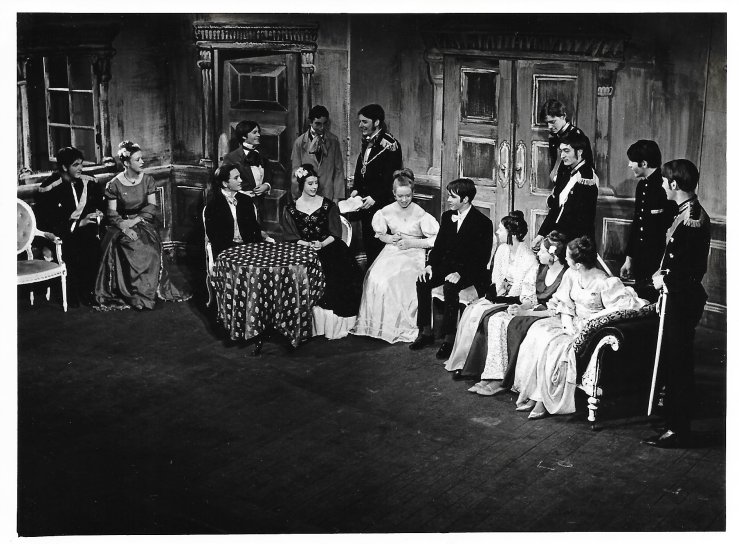
School Play 1965
The Government Inspector by Nicolai Gogol

Some time later, the school arranged a trip to see a performance of The Government Inspector in the West End. The only thing I remember about it is the performance of Rastakovsky, who, when he came to deliver the line, stood up, clearly as a very old man, gesticulated wildly, uttered the one line, had some kind of a fit, collapsed and was carried off stage. It got a much bigger laugh even than the way I did it. Now, why hadn’t I thought of that? Or maybe, been encouraged (by the director, or someone) to embroider it in some way like that? It was an opportunity which I simply didn’t have the experience, or the imagination, or the guidance, to take advantage of. Instead, I just sat there, and delivered it solemnly and po-faced. Maybe that was funny enough. But I can’t help thinking that (like so many other things I remember at this age) it was just another of life’s Great Missed Opportunities.

And do you recognize me among those aspiring Thespian teenagers? I’m the lad seated, 4th from the right, among all the young ladies…

Coming Home

Well it wasn’t exactly a Lenten observance, but something that grew out of a dissatisfaction with how things were. That’s kind of what Lenten observances are supposed to be about, isn’t it? But I’m referring, specifically, to my different computer setups.

Ever since I was the proud owner of a ZX81, I’ve been fascinated by computers and what they can do – and how to make them do it. I’ve lost count of the number of different devices I’ve owned. Back in the 1980s, most personal computers were too expensive for my budget. (Living on a clergy stipend!) But as the prices dropped and we became a little better off, it was possible for us to enjoy better things. Starting with an Amstrad PCW8256, graduating through a series of tower computers whose names and numbers I forget, to an Apple Macbook and other laptops. In the early years of the 21st century I began to explore Linux, getting it to work on various desktop computers and on my first HP laptop. I think I succeeded more because I didn’t know how many things could go wrong, than because I had any idea of what I was doing. Though it’s true that there were a couple of times when I managed to wipe my whole hard drive: once or twice without having remembered to make a complete backup of all my files beforehand. It’s a mistake you soon learn from. But essentially, it was the idea of Linux that appealed to me: the freedom, the open-source cooperation of the developers, and the ideology that went with it.

But newer technologies sometimes made it harder to continue with Linux. I loved the 12-year old ThinkPad I bought for the sole purpose of playing with Linux on it; but the sound and graphics quality were so poor I eventually let it drop. By the start of this year my principal devices were a Microsoft Windows laptop, and a Chromebook. (Not counting the iPad, Android mobile phone, Kindle etc.) The Windows laptop certainly had more power; but the Chromebook was often more convenient with its instant startup and web-based content.

But then: Lent 2025. I started seeing more articles and videos about running Linux on Chromebook. I gave it a try; but never succeeded in making a full Linux desktop environment work. Still, I got some of the old applications that I loved to work: vim, Emacs, command line working in the Terminal. These were enough to make me hanker for something more. I looked at several of the manufacturers who claim to make laptops that will run with Linux: Lenovo, HP and others. But somehow there was always a caveat: that you needed to check whether the various Linux distros were compatible with that particular model. In the end it came down to the decision to look for a laptop that came with Linux preinstalled.

It looked like the main UK companies were
Laptop with Linux,
Starlabs Systems,
Juno Computers,
or Entroware.

After looking at all of them, I decided my Easter reward and treat would be to buy myself this attractive model from Entroware:

the Apollo, which comes with Ubuntu pre-installed.

Yes, it feels like coming home… to a more friendly and grown-up version of Linux, which has obviously changed since I last visited. There’s a lot to learn and relearn. But that also feels like it’s fitting in with the theme of the Christian Year: the new life that follows Easter.

My Recurring Nightmare

Christmas Night … and I had one of my recurring nightmares, that never fails to wake me up. I dream that I’m trying to crawl or squeeze or climb through a narrow place that I can’t get my head through. I’ve often wondered whether this is some deeply ingrained memory from a preconscious state, of the trouble and danger of being born. I’ve never heard that my mum had special difficulty giving birth to me. But she was quite little, and I do have quite a big head, so it wouldn’t be surprising.

Then I remembered, I had been watching the Christmas episode of Call The Midwife just the evening before.

Man of the Borderlands

One of the things I do remember about that St Albans diocesan clergy conference in 1971, was one of the small discussion groups I was part of. One of the chapters in the book of preparatory reading, included the thought that, in order to engage with contemporary culture, Christians would need to be ‘people of the borderlands’, as Jesus was. Bridging the gap between people who were usually considered to be ‘in’, and those who were considered to be ‘out’.

I was taken with this idea. So much so that in between sessions I was inspired to write a poem about it. Not only that, but also to share that poem in the small group session. (I now think that was a bit bold, maybe presumptuous, for a brand new curate. But maybe I was too young to know better.) The poem:

God’s Debatable Lands

We all are people who fight shy of borders:
we want to life safe, deep in black, or white;
are creatures of light or darkness, fearing twilight.
Look how we build up fences against marauders,
miles, miles of wire that shout mankind’s disorders
in empty lands. There Love cannot alight —
it is a frightened bird flung into flight,
a beaten madman cringing from his warders.

Loving our brittle refuge better than God,
we shun his country, the Debatable Lands.
— But then, by brambly ways we never trod
there comes to us, with broken, bleeding hands
which hold out risk, and healing — not a rod —
our Jesus, Christ, the Man of the Borderlands.


You’ll notice, maybe, that it’s a sonnet. Malcolm Guite writes more of them. And better.

Stewards of the Mysteries of God

In the course of nearly six decades of adult life, with numerous changes of address, most of them upsizing to a larger house, but latterly including a major downsize, we’ve acquired large numbers of books. Anyone who thinks ‘too many’ is clearly not One Of Us – for We all know there is no such thing as too many books. Nevertheless, there comes a time when downsizing means there will not be enough shelf space for all of our books… and certainly not enough for all the books we are bound to continue to buy. So during those six decades, we have not only acquired, but also from time to time shed books.

I’ve often wondered about the criteria for deciding which books to get rid of, and which to keep. Sometimes it’s easy enough: ‘I hated that’, or, ‘I’m never going to want to read that again.’ Sometimes you get rid of a book and later regret it and buy it again. In the worst case, you buy a book you think you got rid of, only to find the original copy is still there on your shelf. But that doesn’t happen very often. And sometimes there is something that makes you keep a book you haven’t opened for 20 or 30 years, because – well, what? Because it has some special significance in your life, because you feel it spoke to you or changed you in some really important way.

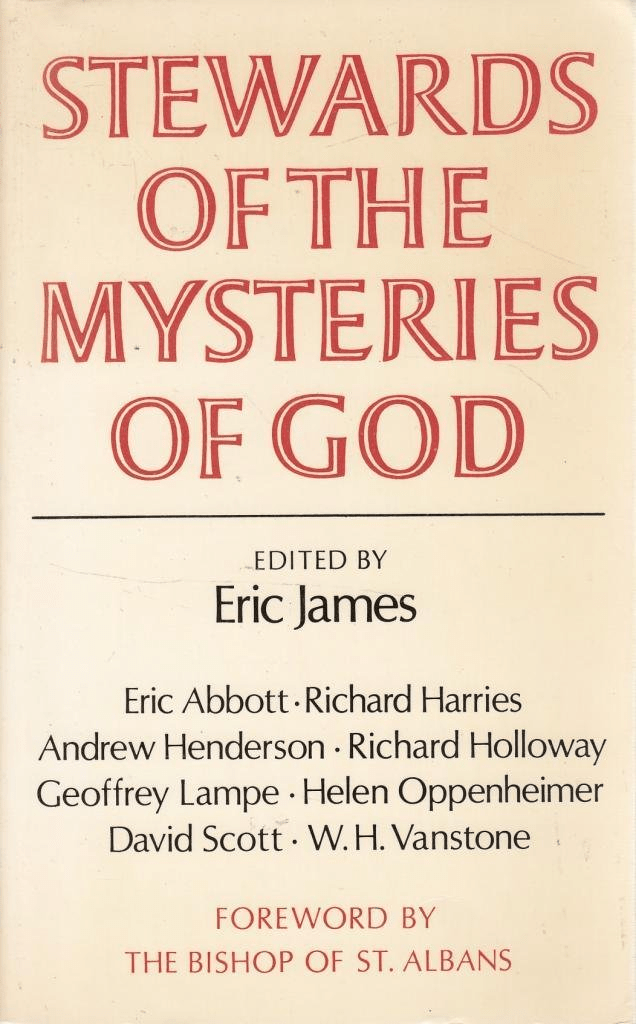
I was reminded of one of those books this week, when the Collect for the Third Sunday of Advent asks God to ‘grant that the ministers and stewards of your mysteries may … prepare and make ready your way’. It’s a reference to St Paul’s First Letter to the Corinthians, where he writes ‘Think of us in this way, as servants of Christ and stewards of God’s mysteries. Moreover, it is required of stewards that they should be found trustworthy.’ (1 Cor. 4.1) The slender book on my shelves (only 88 pages) that takes its title from that verse is Stewards of the Mysteries of God, edited by Eric James, published by Darton, Longman & Todd in 1979 at £1.95.

It was a collection of essays written by a number of theologians whose names read like a Who’s Who of the Church of the 1970s. Richard Harries – not yet the Dean of King’s College, let alone Bishop of Oxford or Baron Harries of Pentregarth… Richard Holloway, not yet the Bishop of Edinburgh. But all of them, in some way, connections of the then Bishop of St Albans, the Rt Revd Robert Runcie. The book was planned as a preparation for the St Albans Clergy Conference in September 1979, but published as something of interest to the wider Church (as well as, incidentally, to help with the costs of producing the book and so save the diocese money.)

And the significance of that clergy conference, for me, was that it was the first major diocesan event that I attended after my ordination as Deacon just two months before. I can’t remember how many clergy attended – it must have been a few hundred – but we all travelled to the University of Kent at Canterbury, then a mere 14 years old. And there were all the things you would expect a clergy conference to include: worship, lectures, discussion groups, meals, drinks in the bar… Of which I remember almost nothing. It was 45 years ago, after all.

And yet. And yet. I believe now that the conference, and the book that I had (obediently, as a new young curate) read in preparation for it, represented a big turning point for me. It was perhaps not the first thing, but certainly one of the first things, that opened my eyes to the undoubted truth that there was more to Christianity than ‘Conservative Evangelicalism’ had to offer1.

So I took the book off my shelf and read it again, and find it does indeed have many insights which may not always have been part of my faith before then, but certainly have become important in the years between.

Concerning the importance of Mystery in the Christian faith, rather than certainty. The mysteries of God are not things that are secret or concealed, but things we could not discover by our own efforts, which God reveals to us. The ‘deep affinity between the mystery of God and the mystery of humanity’. Gabriel Marcel writes, ‘A mystery is something in which I am myself involved’. Patrick White’s epigraph to his book The Solid Mandala:
There is another world,
but it is in this one.2
I thought I came across this only years afterwards with the shock of recognition, ‘Yes, that’s true!’ but no, I first read it in 1979.

Vanstone, on the Church’s purpose:
“The raison d’être, the responsibility, of the Church is to recognize what is happening in the world, and what is actually at stake in what is happening. What is at stake is the triumph or the tragedy of the love of God.”
And on What God needs: (How radically daring it was, to consider that God needs anything!)
“God needs only that which love itself needs — the response of the beloved other, without which love’s own work of giving remains incomplete.”

Richard Holloway, on the proper role of the Church, following Jesus, a ‘spiritual terrorist’, out of whose mouth came both the certainty of hell and damnation for sinners, and a gentleness and pity for us in our lostness:
“The Church is really the trades union of the damned. … I have come to believe that it is always the Church’s task to plead with the divine anger on behalf of the divine mercy. I say this because I believe that this, finally, is the meaning of the mystery of Christ. … The final mystery, then, is forgiveness.”

And Richard Harries, arguing that the Church needs to take seriously the reasons for the radical unbelief of many in contemporary society. While remaining faithful to our own convictions, we must not immediately leap in to refute unbelievers, but listen and give full weight to the reasons for the unbelief that is in them. We must learn to be comfortable with inhabiting the space between faith and unbelief: “A person will therefore be a person of the borderlands, to use a word of Professor Donald MacKinnon.”

Listing some of those ideas now, they all seem so obvious. They make it sound like discovering Stewards of the Mysteries of God was a small thing. It wasn’t, at the time.

  1. Oh, you noticed that none of the worthies contributing to the book came from that wing of the Church? ↩︎
  2. This is often attributed to W. B. Yeats, but was actually by the French surrealist poet Paul Éluard who wrote, “Il y a assurément un autre monde, mais il est dans celui-ci”. ↩︎

Coming ‘Home’

So, I’ve been away. For quite a time – it’s coming up towards two years since my last post. The truth is, I’ve been on a Journey. A Pilgrimage, maybe, towards some holy destination. Or a Quest, to seek and find my True Self.

In my last post, I wrote about a part of that spiritual journey I had been on since retiring back in 2016. It’s a mistake to suppose that, if you’ve been a Christian for 45 years and a vicar for 37 of them, you have somehow ‘arrived’. At certainty, or a place where you no longer have any progress to make, or something. Pretty much the opposite of the case. I’m sure I’m not the only retired vicar who finds themselves

a) relieved beyond measure that they’re no longer responsible for running a parish, filling in all the returns required by the Bureaucracy, keeping up to date with the law regarding marriages, burials and what have you

b) but also, asking themselves, What was that all about? I know it’s impossible for people in many professions to measure how successful they’ve been, but: Did I actually achieve anything? Was it worth all the hard work and soul-searching? Do I really believe all the things I used to preach to others, or at least, thought I ought to preach? Was it all even true?

So yes: some time around the start of the Pandemic, I had been disturbed by reports of growing antisemitism in many European countries, including the UK. I started reading about the history of antisemitism, and especially the role of the Church, and many of its most famous preachers and theologians (St John Chrysostom, Martin Luther, et al.) in promoting and institutionalizing this hatred of Jews and Judaism. Soon I was wanting to learn about what it was that they hated: Did I even know very much about Judaism.

To cut a long story short, I fell in love with the faith I was reading about. The contribution that Judaism and its adherents have made to the world is beyond reckoning, far greater than you would expect from a people who number probably less than 0.25% of the world’s population. I thought that Christianity grew out of, or at least alongside, the Rabbinic Judaism we know nowadays. Yet I found that many of the articles of Christian faith which I found most difficult and unpalatable were simply not there in Judaism. Like Original Sin. The need for blood sacrifice to turn away God’s anger so that He will not punish us for our sins. The need for people to ‘believe in and accept Jesus Christ’ in order to be ‘saved’. Because God incomprehensibly chose to create a human race of which the vast majority are destined for everlasting punishment if they don’t believe the right things about Him. The dualism of ‘Spirit Good, Matter Bad’. The Patriarchy and suppression of women’s voices and contribution.

You could say (as I did), “I don’t like Christianity very much.”

As well as reading a lot about Judaism, I also started using Jewish prayers for my daily prayer. And I loved them! There’s so much less of the whinging and grovelling that Christian prayers sometimes feel like, trying to curry favour from a mean and ungenerous Deity. The standard mode of Jewish prayer is Thanksgiving, in the form of blessing God 100 (or more) times a day. Blessing God for everything. The prayers frequently take the form of

  • Blessing and praising God because He does X
  • Asking God to do X
  • Thanking God for doing X.

For a time, I even contemplated converting to Judaism. I spoke to a rabbi about it, and she said “You can’t.” (I think that, like the Benedictines, they deliberately don’t consider wannabe converts until the fifth time of asking, because it takes five attempts to prove they are serious.)

The great thing about that episode of ‘not liking Christianity very much’ was that I never stopped believing in God. In fact, I came to believe in and love God even more, as I learned to thank God more and more, in and for all things. And came to suspect that He often doesn’t like Christianity very much at the moment. And I’m immensely grateful for this time of wilderness wandering, when I was not entirely sure about who I was, or where, or where I was meant to be and meant to be heading.

And then, Someone apparently decided it was time for me to come ‘Home’, or at least somewhere approximating to it. Alison wanted to go to a week’s conference at Lee Abbey – a place that’s hard to get to without a car. So my services as chauffeur were required. I hadn’t been to Lee Abbey for years, and was glad for the incentive to go again. So we both went to a conference entitled ‘The Call of the Wild: The Feel of the Holy’, on the themes of Pilgrimage, holy journeys and places, and the Celtic Christian tradition, led by Michael Mitton and Russ Parker. They are great friends and a great team; their talks are much more like witnessing a dialogue between two men who know each other well, have abundant wisdom, and above all enjoy each others’ company and their subject.

I found the ‘worship’ hard going. There were lots of ‘worship songs’ which as far as I’m concerned were anything but. But the talks, the walks around the Lee Abbey grounds, and the opportunities to talk and pray together at the seashore, among the trees, and on the hilltops, were times of real blessing. Russ recommended to me a book on theories of the Atonement, which for all that it was weighty, was very readable and helpful. By Fleming Rutledge, it’s called The Crucifixion: Understanding the Death of Jesus Christ.

I thought I’d give Christianity, especially of the Celtic variety, another chance. This was how, about six weeks later, I found myself driving Alison to Swanwick for the Annual Gathering of the Community of Aidan and Hilda, which is “a dispersed, ecumenical body drawing inspiration from the lives of the Celtic saints.” Getting excited about it as a ‘place’ that offers refuge and encouragement to people like me who feel disillusioned with much of what we see in the contemporary Church, and applying to become an ‘Explorer’, as they call wannabe members of the community.

So yes, it feels like coming ‘home’. And it feels like taking some tentative steps away from the spiritual home I’ve known, though not really away, but let’s say, forward, on new adventures of life and faith.

Watch this space, then…

A Very Peculiar Hatred

In his excellent little book Radical Then, Radical Now, the late Chief Rabbi Jonathan Sacks addresses the question: Why be a Jew? He wrote the book originally as a wedding gift for his son and daughter-in-law, but then enlarged and published it for a wider audience, both Jews and non-Jews. In the post-Holocaust age, in spite of the greater freedom enjoyed by Jews in many (especially Western) countries, most Jewish communities report an alarming decline in numbers of adherents. Jews are abandoning traditional practice, ‘marrying out’ and not creating the ‘Jewish home’ that used to be a central feature of Jewish life. They are not so much unaware of their Jewish identity, as rejecting it or trying to shed it.

At the same time, Sacks quotes statements of non-Jews who admire Judaism.

The British historian and writer A. L. Rowse described in his memoir written near the end of his life one of his unfulfilled dreams: “If there is any honour in all the world that I should like, it would be to be an honorary Jewish citizen.” Winston Churchill said, “Some people like Jews, and some do not. But no thoughtful man can deny the fact that they are beyond question the most formidable and the most remarkable race that has ever appeared in the world.”

Jews make up only about half of 1% of the world’s population. Yet the contribution they have made to world civilization is out of all proportion to their numbers. Since the Nobel Prize was established in 1901, over one-fifth, 20%, of Nobel prize winners, have been Jews.

Yet in spite of all they have suffered through millennia of persecution, in spite of the horrors of the Holocaust, in spite of their achievements and contribution, they are perhaps the most hated people in the world. In every country there are reports of antisemitism growing more widespread, more violent, more extreme.

Why this extraordinary, irrational, peculiar hatred?

At some time during the second year of COVID lockdowns, in the spring of 2021, as I became increasingly aware of the news of growing antisemitism, I decided to read about it. After years of not wanting to believe there was antisemitism in the Labour Party, I eventually learned I was wrong. I began to read more widely about Judaism and the experience and beliefs of Jewish people. It turned out that it was fascinating and beautiful. In retirement I was allowing myself to re-examine the beliefs of Christianity, expecially the ones I had always found difficult or unattractive. Like Original Sin, ‘total depravity’, the excellence of the spiritual over the physical and material, so that virginity was often prized over marriage. Like the exclusiveness of ‘salvation’, only through Christ — which, if you push it to its logical conclusions, suggests that a loving God created the vast majority of human beings knowing that they would be condemned to eternal punishment. Like, all the theories of atonement which attempt to explain how ‘salvation’ works. Like, the relentless drive to convert anyone and everyone who isn’t a ‘born-again’ Christian, and make them just like us.

And I find that most of these are just not there in Judaism. Whatever its peculiarities — and of course it has many difficulties of its own, like every human religion — it is in so many ways more humane, more universalistic, more life-affirming. Its typical mode of prayer is largely blessing and thanking God, not begging to be ‘let off’ the punishment we justly deserve, and longing for God to bring the world, and with it the whole human Story, to a blessed End.

So what’s to hate, about it?

Perhaps one answer is, it’s easy for bullies and haters to hate the people they regard as weak and unable to fight back. No one makes a scapegoat of a lion, which might have its own ideas about what was happening. But I have come to wonder if the real, deeper reason for the irrational hatred that is antisemitism, is that bad people hate what is Good. In its very essence, Judaism is about Freedom. Moses brought the people of Israel out of their slavery in Egypt, and made of them a nation who would be God’s “treasured possession among all peoples… a kingdom of priests and a holy nation.” The people of Israel are radically free. And that is what rulers and tyrants have hated more than anything through all the centuries. And it’s what the little people, who know that they themselves are not free but are slaves or victims, also hate passionately. They envy the Jews and so they hate them. They would admire them, but they cannot bear to admit that they are admirable, and so they hate them.

When God first called Abraham, God promised him,
“I will make of you a great nation,
And I will bless you;
I will make your name great,
And you shall be a blessing.
And I will bless those who bless you;
And curse him that curses you;
And all the families of the earth
Shall bless themselves by you. (Genesis 12.2-3)

Anyone who hates Jews, will be — already is — under God’s curse. No wonder they are such unhappy, unfulfilled, violent, hate-filled people.

Family Christmas/New Year Gathering

Back row: Sephy, Esther, Paul, David, Naomi, Alex, Tom
Middle row: Martha, Dodie, Bethan, Lotte, Libby, Tilly, Annie
Front row: Jeremy, Owen, Alison, Tony, Elsie, Aurelia

Another New Year, and on the last-but-one day of the Old Year we had our one and only whole-family get-together of the year. When there are 20 of us, it gets more difficult to have these occasions very often. Thanks to Tom and Annie having a bigger house now, and being the most centrally located of the families, we are able to meet at their place. A bring-and-share lunch with each family contributing a course, and a lot of (too much) drink. What could be nicer?

It was a noisy, beautiful, fun event, often too much for various of us in turn, so that everyone needed an ‘escape room’ at different times. The cousins are all close enough in age (2 to 12 years) to get on really well.

We feel wonderfully blessed to have such fine children, grandchildren, and children-in-law. I’ve recently been reading the stories in Genesis of the Patriarchs and Matriarchs. Looking at this picture makes me feel a but like Jacob. We haven’t got 70+ descendants, but what the children of Alison and Tony lack in quantity, they make up for in quality.

A Testament, a Prayer

When I am gone I would like it to be remembered
that I took pleasure in the common things of life
delighted in the joys of Everyday
waking in the morning to life and breath and sound
and sight and smell, and the taste of bread
and the human voice and touch of those I love.
That everything is Gift — and more than this —
that there’s a Giver to whom one may give thanks.

That Everyday brings news of discoveries
fresh adventures of learning and knowing
words to hear and read and chew on, and minds to meet,
music to charm the ear and people I love
with whom to share the things that I have found
who’ll share with me what they have found also

I’d like it to be remembered —
that I was kind to others and myself
that I would smile at people (not at cameras)
laugh when I caught myself being over serious
that truth and beauty made my spirit soar
that I was wise with the wisdom of my years
yet innocent as the child who still, somewhere,
plays in my soul
that I loved questions more than answers
stories to tell, yet better, to inhabit —
that I dreamed that there could be a better world
yet never hated this one that isn’t so
nor gave up hope of how it all might be.
At day’s end never closed my eyes in sleep
without I blessed the Author of my life.

If this is what I’d like remembered when I’m gone
let it become my habit while I’m still here.