When I was on retreat at Mucknell Abbey at the beginning of December, Fr Stuart Burns recommended a book I hadn’t heard of before: David F. Ford’s The Gospel of John: A Theological Commentary. It promises to be an excellent read, touching on many of the themes I now realise I need to pursue about John’s Gospel. Ford urges that the Church and the world need a new ‘Johannine Renaissance’, rediscovering, or more deeply discovering, Who Jesus is, and Why Jesus Now?
Among so many passages I want to reflect on and remember, today I made a note of this:
“The Psalms are the part of the Bible that probably is most fully part of Christian (and Jewish) personal and community prayer and worship, most committed to memory, most set to music, most important in shaping the imagination. They take up into poetry and worship leading themes of Israel’s Scriptures and the main elements of its faith and practice — creation, patriarchs, the exodus, the law, prophecy, wisdom. Both Jesus and John were, clearly, steeped in the psalms, and continually reading the psalms in conversation with the Gospels deepens understanding and nourishes fuller faith, further following, and richer worship.”
Yes! And I wonder, then, why the Psalms are so routinely omitted from much (I’m tempted to say, most) of contemporary worship? Dare I say, especially in ‘Evangelical’ churches? In the days when I used to think it was the Evangelical wing of the Church that I felt most at home in, I firmly believed it was the Bible, and its authority, which were the features that attracted me. Since that time I’ve come to believe that, in fact, the major weakness of ‘Evangelical’ churches is that they are so unbiblical. Instead of proclaiming what the Bible says, they are more likely to proclaim what the preacher, or their favourite church leader, says the Bible says. They’ll hammer home the parts that say what they want the Bible to say, while ignoring the parts of the Bible which contradict their favourite message.
David Ford’s commentary is honest about the apparent contradictions and different viewpoints, for example in the ways the Bible has often been used to preach a ‘supersessionist’ message, and contempt for Judaism. The remedy is to stay with that question of Who Jesus is, until we fully understand what it means that Jesus shows us, and leads us into relationship with, a God who is for all people, and for all creation.
In the course of nearly six decades of adult life, with numerous changes of address, most of them upsizing to a larger house, but latterly including a major downsize, we’ve acquired large numbers of books. Anyone who thinks ‘too many’ is clearly not One Of Us – for We all know there is no such thing as too many books. Nevertheless, there comes a time when downsizing means there will not be enough shelf space for all of our books… and certainly not enough for all the books we are bound to continue to buy. So during those six decades, we have not only acquired, but also from time to time shed books.
I’ve often wondered about the criteria for deciding which books to get rid of, and which to keep. Sometimes it’s easy enough: ‘I hated that’, or, ‘I’m never going to want to read that again.’ Sometimes you get rid of a book and later regret it and buy it again. In the worst case, you buy a book you think you got rid of, only to find the original copy is still there on your shelf. But that doesn’t happen very often. And sometimes there is something that makes you keep a book you haven’t opened for 20 or 30 years, because – well, what? Because it has some special significance in your life, because you feel it spoke to you or changed you in some really important way.
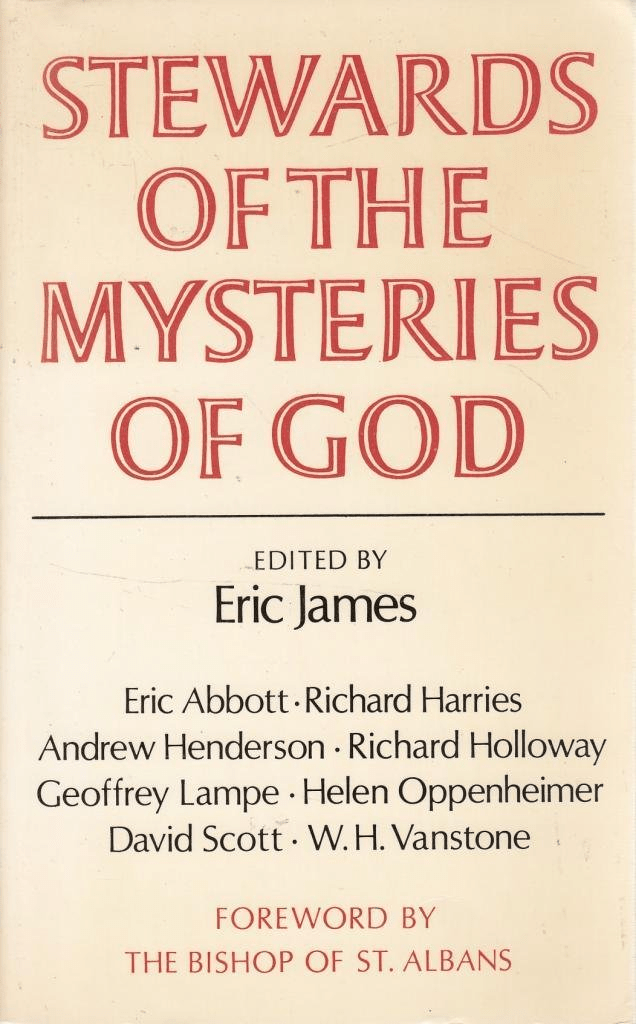
I was reminded of one of those books this week, when the Collect for the Third Sunday of Advent asks God to ‘grant that the ministers and stewards of your mysteries may … prepare and make ready your way’. It’s a reference to St Paul’s First Letter to the Corinthians, where he writes ‘Think of us in this way, as servants of Christ and stewards of God’s mysteries. Moreover, it is required of stewards that they should be found trustworthy.’ (1 Cor. 4.1) The slender book on my shelves (only 88 pages) that takes its title from that verse is Stewards of the Mysteries of God, edited by Eric James, published by Darton, Longman & Todd in 1979 at £1.95.
It was a collection of essays written by a number of theologians whose names read like a Who’s Who of the Church of the 1970s. Richard Harries – not yet the Dean of King’s College, let alone Bishop of Oxford or Baron Harries of Pentregarth… Richard Holloway, not yet the Bishop of Edinburgh. But all of them, in some way, connections of the then Bishop of St Albans, the Rt Revd Robert Runcie. The book was planned as a preparation for the St Albans Clergy Conference in September 1979, but published as something of interest to the wider Church (as well as, incidentally, to help with the costs of producing the book and so save the diocese money.)
And the significance of that clergy conference, for me, was that it was the first major diocesan event that I attended after my ordination as Deacon just two months before. I can’t remember how many clergy attended – it must have been a few hundred – but we all travelled to the University of Kent at Canterbury, then a mere 14 years old. And there were all the things you would expect a clergy conference to include: worship, lectures, discussion groups, meals, drinks in the bar… Of which I remember almost nothing. It was 45 years ago, after all.
And yet. And yet. I believe now that the conference, and the book that I had (obediently, as a new young curate) read in preparation for it, represented a big turning point for me. It was perhaps not the first thing, but certainly one of the first things, that opened my eyes to the undoubted truth that there was more to Christianity than ‘Conservative Evangelicalism’ had to offer1.
So I took the book off my shelf and read it again, and find it does indeed have many insights which may not always have been part of my faith before then, but certainly have become important in the years between.
Concerning the importance of Mystery in the Christian faith, rather than certainty. The mysteries of God are not things that are secret or concealed, but things we could not discover by our own efforts, which God reveals to us. The ‘deep affinity between the mystery of God and the mystery of humanity’. Gabriel Marcel writes, ‘A mystery is something in which I am myself involved’. Patrick White’s epigraph to his book The Solid Mandala: There is another world, but it is in this one.2 I thought I came across this only years afterwards with the shock of recognition, ‘Yes, that’s true!’ but no, I first read it in 1979.
Vanstone, on the Church’s purpose: “The raison d’être, the responsibility, of the Church is to recognize what is happening in the world, and what is actually at stake in what is happening. What is at stake is the triumph or the tragedy of the love of God.” And on What God needs: (How radically daring it was, to consider that God needs anything!) “God needs only that which love itself needs — the response of the beloved other, without which love’s own work of giving remains incomplete.”
Richard Holloway, on the proper role of the Church, following Jesus, a ‘spiritual terrorist’, out of whose mouth came both the certainty of hell and damnation for sinners, and a gentleness and pity for us in our lostness: “The Church is really the trades union of the damned. … I have come to believe that it is always the Church’s task to plead with the divine anger on behalf of the divine mercy. I say this because I believe that this, finally, is the meaning of the mystery of Christ. … The final mystery, then, is forgiveness.”
And Richard Harries, arguing that the Church needs to take seriously the reasons for the radical unbelief of many in contemporary society. While remaining faithful to our own convictions, we must not immediately leap in to refute unbelievers, but listen and give full weight to the reasons for the unbelief that is in them. We must learn to be comfortable with inhabiting the space between faith and unbelief: “A person will therefore be a person of the borderlands, to use a word of Professor Donald MacKinnon.”
Listing some of those ideas now, they all seem so obvious. They make it sound like discovering Stewards of the Mysteries of God was a small thing. It wasn’t, at the time.
Oh, you noticed that none of the worthies contributing to the book came from that wing of the Church? ↩︎
This is often attributed to W. B. Yeats, but was actually by the French surrealist poet Paul Éluard who wrote, “Il y a assurément un autre monde, mais il est dans celui-ci”. ↩︎
Long, long ago, I used to think I was a ‘Conservative Evangelical’. Maybe I even was one. All through theological college, while I was studying for my B.A. in Theology, and other qualifications for ordination, I somehow felt that I had to ‘hold the line’ against the liberalism (or whatever?) of modern academic theology. I have no idea where this came from… Perhaps it’s matter for another blog post sometime.
This didn’t survive for very long when I went to serve my curacy in a ‘Conservative Evangelical’ parish. I quickly learned that this wasn’t quite where I stood after all; I wanted something different and maybe broader; I realised there was more to truth than I had thought.
The things that I valued about the tradition I thought I belonged to were: love of Scripture; devotion to Jesus; personal faith and commitment. Somehow, unaccountably, I had learned that these were the special characteristics of this brand of Christianity, which were not shared by any of the other groups that called themselves Christian. Again, I have to ask where this came from, and how I could possibly have believed it. It’s one of the mysteries of my reflection on my faith journey, the way we pick up and believe and live with and find it so hard to move on from, what we are taught (or sometimes only imbibe subliminally) in the tradition we find ourselves in.
Looking at the Makin Review makes me not only wonder how I continued to think of myself as a ‘Conservative Evangelical’ for so long. It makes me wonder how anyone can still feel happy to subscribe to the narrow beliefs of that particular subset of God’s people. Of course, not every ‘Conservative Evangelical’ is going to be an abuser. Most people who call themselves ‘Conservative Evangelicals’ will have been as appalled as the rest of us, at the report of the Review’s findings. But at the same time, it’s obvious that John Smyth’s long history of physical, sexual and spiritual abuse, of his family first, and later of hundreds of boys and young Christian men, had its roots in the kinds of belief that were, and still are, often found in ‘Conservative Evangelicalism.’ A particular kind of emphasis on sin and repentance which focuses more on sex than on any of ‘the weightier matters of the Law’ like injustice, love and mercy, the abuse of power… Together with patriarchy, misogyny, homophobia, belief in corporal punishment, self- and body-hatred. The image of God that Smyth must have had, to believe and behave as he did, must have been a hideous, cruel and bullying, idol.
I was particularly horrified by the quote from one of Smyth’s victims, describing the policy of the Iwerne Trust and its summer camps:
“The philosophy was … that you could only really serve God with a dog collar around your neck in the Church of England and that the job, the mission, the task, the quest was to get boys of real promise to become ordained in the Church of England, to become bishops and archbishops, and for the Iwerne tribal, evangelical, narrow-minded brand of Christianity, which is anti-gay, as Smyth was with the Whitehouse trials, to infiltrate the whole of the Church of England and to take it over.”
The sectarian arrogance of believing ‘We’re right and every other variety of Christian is wrong’, and ‘Therefore we plan to take over the whole of the Church of England’ beggars belief. It’s as if they had never read the Bible, either the teachings of Jesus, or St Paul’s injunctions to love one another and consider other Christians better than oneself. In the end, I guess that was one more reason why I left ‘Conservative Evangelicalism’: I wanted to be a biblical Christian; and for all their claims and posturings, I don’t believe that’s a priority for ‘Conservative Evangelicals’.
One more thought about the Makin Review, is about all the men who were involved in covering up Smyth’s abuses, not only when they first became known around 1981, but even after he had fled to Africa where he continued his activities. I knew some of these men, I went to some of the churches where they had been active. They were apparently sincere, honest, intelligent, educated men. So how could be so stupid? One of them, David Fletcher, explains why he did nothing to pass on what he had learned about Smyth’s abuses:
In an interview with us, David Fletcher said: “I thought it would do the work of God immense damage if this were public.”
How could he really imagine it would not inevitably become known some time down the line, and by then do even greater damage to the ‘work of God’?
Another leading Evangelical figure, also now deceased,
said that he was told of the abuse by a curate at Winchester College and was “sworn to secrecy.”
It’s a strange kind of morality that gives more value to ‘keeping a confidence’ than speaking out against evil, and telling the truth, even if it means ‘betraying’ a confidence (which should never have been asked for by a Christian clergyman in the first place), if it means saving not one but hundreds of victims from harm and trauma. Surely, that’s a sorry kind of modern Pharisaism, like the one that believes you can protect the work of God from damage by covering up the Truth?
I haven’t read all of Makin’s review, and don’t know if I have the stamina to get to the end of it. No doubt the repercussions will run and run. Who else will resign or be called on to resign? It’s good if we now have a culture of safeguarding which brings abuses to light sooner than the 40+ years it took for Smyth’s to be fully known. Or do we, yet? I pray, and long, for this battered old Church that I love to become a safe and inclusive space for everyone. Sooner, rather than later.

 Godspelled