Seeking a more biblical Church

When I was on retreat at Mucknell Abbey at the beginning of December, Fr Stuart Burns recommended a book I hadn’t heard of before: David F. Ford’s The Gospel of John: A Theological Commentary. It promises to be an excellent read, touching on many of the themes I now realise I need to pursue about John’s Gospel. Ford urges that the Church and the world need a new ‘Johannine Renaissance’, rediscovering, or more deeply discovering, Who Jesus is, and Why Jesus Now? 

Among so many passages I want to reflect on and remember, today I made a note of this:

“The Psalms are the part of the Bible that probably is most fully part of Christian (and Jewish) personal and community prayer and worship, most committed to memory, most set to music, most important in shaping the imagination. They take up into poetry and worship leading themes of Israel’s Scriptures and the main elements of its faith and practice — creation, patriarchs, the exodus, the law, prophecy, wisdom. Both Jesus and John were, clearly, steeped in the psalms, and continually reading the psalms in conversation with the Gospels deepens understanding and nourishes fuller faith, further following, and richer worship.”

Yes! And I wonder, then, why the Psalms are so routinely omitted from much (I’m tempted to say, most) of contemporary worship? Dare I say, especially in ‘Evangelical’ churches? In the days when I used to think it was the Evangelical wing of the Church that I felt most at home in, I firmly believed it was the Bible, and its authority, which were the features that attracted me. Since that time I’ve come to believe that, in fact, the major weakness of ‘Evangelical’ churches is that they are so unbiblical. Instead of proclaiming what the Bible says, they are more likely to proclaim what the preacher, or their favourite church leader, says the Bible says. They’ll hammer home the parts that say what they want the Bible to say, while ignoring the parts of the Bible which contradict their favourite message. 

David Ford’s commentary is honest about the apparent contradictions and different viewpoints, for example in the ways the Bible has often been used to preach a ‘supersessionist’ message, and contempt for Judaism. The remedy is to stay with that question of Who Jesus is, until we fully understand what it means that Jesus shows us, and leads us into relationship with, a God who is for all people, and for all creation.

Man of the Borderlands

One of the things I do remember about that St Albans diocesan clergy conference in 1971, was one of the small discussion groups I was part of. One of the chapters in the book of preparatory reading, included the thought that, in order to engage with contemporary culture, Christians would need to be ‘people of the borderlands’, as Jesus was. Bridging the gap between people who were usually considered to be ‘in’, and those who were considered to be ‘out’.

I was taken with this idea. So much so that in between sessions I was inspired to write a poem about it. Not only that, but also to share that poem in the small group session. (I now think that was a bit bold, maybe presumptuous, for a brand new curate. But maybe I was too young to know better.) The poem:

God’s Debatable Lands

We all are people who fight shy of borders:
we want to life safe, deep in black, or white;
are creatures of light or darkness, fearing twilight.
Look how we build up fences against marauders,
miles, miles of wire that shout mankind’s disorders
in empty lands. There Love cannot alight —
it is a frightened bird flung into flight,
a beaten madman cringing from his warders.

Loving our brittle refuge better than God,
we shun his country, the Debatable Lands.
— But then, by brambly ways we never trod
there comes to us, with broken, bleeding hands
which hold out risk, and healing — not a rod —
our Jesus, Christ, the Man of the Borderlands.


You’ll notice, maybe, that it’s a sonnet. Malcolm Guite writes more of them. And better.

Christmas – And whose Church is it, anyway?

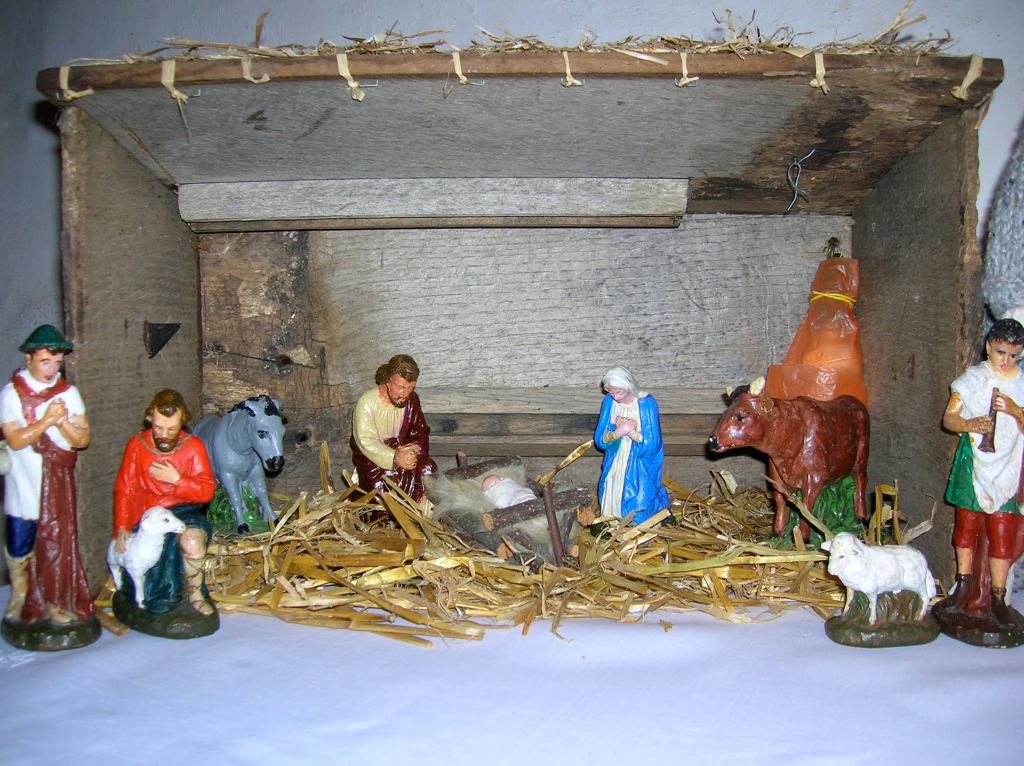
Christmas crib at St Nicholas, Marston

It’s that time of year again. When all the working clergy (God bless ’em. Who’d want to be one of them, just now1 ?) are planning for the annual influx of Christmas worshippers, and trying to think of different events and services to draw them in. Here’s my advice, guys: don’t bother with all those wizard wheezes for new and innovative and ‘relevant’ services. People will come anyway. They prefer the traditional, the tried and trusted, the things they remember and are used to from the last time they came, and the time before that, and every time they’ve ever come at Christmas. Listen, that’s what they come for.

It’s because Christmas is magic, miraculous. Even for the rest-of-the-year-round practical atheist or convinced agnostic, there is something about Christmas, the traditional so-familiar readings and hymns, that draws them again and again. And for some reason they tolerate all the extra stuff that the working clergy (God bless ’em) try to include in the services. Sermons (ugh) that are clearly meant to convert them into ‘real Christians’ who will come during the rest of the year. Activities. Film clips on the big screen. Sharing their thoughts with the people sitting round them.

It’s almost as if the clergy who plan such events don’t trust God, or the tradition. Trust them, brothers and sisters! The familiar readings really are the Word of God – so let them do their work. The traditional carols were written by people who were steeped in that Word: that’s why they work so powerfully. Let them do their work too: they don’t need endless commentary, and contemporary references laid on with a trowel.

Most important of all, please please please don’t refer to the extra worshippers who come at Christmas as ‘visitors’ or ‘guests’. If they are parishioners, it is their church. Calling them visitors or guests is already telling them they don’t belong; and I reckon part of the message of Christmas is that this is for everyone; that in God’s eyes, everyone belongs; that the angels at Bethlehem announced ‘good tidings, of great joy, which shall be to all people’. In the same way, don’t thank them for coming. They’re not doing you a favour, and that’s not what they came for. They came, for whatever mysterious, miraculous reasons, to meet with God. And they will meet with God, as long as there isn’t too much of you getting in their way.

And who knows? If you don’t stand in the way of other people in the Christmas services, maybe God will meet with you there, too. I’m certainly praying just that for all worship planners and leaders, and for all those who come to worship with you, this Christmas. In their church.

  1. Actually, it’s one of the best vocations in the whole world. I wouldn’t have missed it for anything. But I’m still happy to be out of it, and no longer to have the responsibility and all the pressures and demands laid on the working clergy. God bless ’em. ↩︎

Coming ‘Home’

So, I’ve been away. For quite a time – it’s coming up towards two years since my last post. The truth is, I’ve been on a Journey. A Pilgrimage, maybe, towards some holy destination. Or a Quest, to seek and find my True Self.

In my last post, I wrote about a part of that spiritual journey I had been on since retiring back in 2016. It’s a mistake to suppose that, if you’ve been a Christian for 45 years and a vicar for 37 of them, you have somehow ‘arrived’. At certainty, or a place where you no longer have any progress to make, or something. Pretty much the opposite of the case. I’m sure I’m not the only retired vicar who finds themselves

a) relieved beyond measure that they’re no longer responsible for running a parish, filling in all the returns required by the Bureaucracy, keeping up to date with the law regarding marriages, burials and what have you

b) but also, asking themselves, What was that all about? I know it’s impossible for people in many professions to measure how successful they’ve been, but: Did I actually achieve anything? Was it worth all the hard work and soul-searching? Do I really believe all the things I used to preach to others, or at least, thought I ought to preach? Was it all even true?

So yes: some time around the start of the Pandemic, I had been disturbed by reports of growing antisemitism in many European countries, including the UK. I started reading about the history of antisemitism, and especially the role of the Church, and many of its most famous preachers and theologians (St John Chrysostom, Martin Luther, et al.) in promoting and institutionalizing this hatred of Jews and Judaism. Soon I was wanting to learn about what it was that they hated: Did I even know very much about Judaism.

To cut a long story short, I fell in love with the faith I was reading about. The contribution that Judaism and its adherents have made to the world is beyond reckoning, far greater than you would expect from a people who number probably less than 0.25% of the world’s population. I thought that Christianity grew out of, or at least alongside, the Rabbinic Judaism we know nowadays. Yet I found that many of the articles of Christian faith which I found most difficult and unpalatable were simply not there in Judaism. Like Original Sin. The need for blood sacrifice to turn away God’s anger so that He will not punish us for our sins. The need for people to ‘believe in and accept Jesus Christ’ in order to be ‘saved’. Because God incomprehensibly chose to create a human race of which the vast majority are destined for everlasting punishment if they don’t believe the right things about Him. The dualism of ‘Spirit Good, Matter Bad’. The Patriarchy and suppression of women’s voices and contribution.

You could say (as I did), “I don’t like Christianity very much.”

As well as reading a lot about Judaism, I also started using Jewish prayers for my daily prayer. And I loved them! There’s so much less of the whinging and grovelling that Christian prayers sometimes feel like, trying to curry favour from a mean and ungenerous Deity. The standard mode of Jewish prayer is Thanksgiving, in the form of blessing God 100 (or more) times a day. Blessing God for everything. The prayers frequently take the form of

  • Blessing and praising God because He does X
  • Asking God to do X
  • Thanking God for doing X.

For a time, I even contemplated converting to Judaism. I spoke to a rabbi about it, and she said “You can’t.” (I think that, like the Benedictines, they deliberately don’t consider wannabe converts until the fifth time of asking, because it takes five attempts to prove they are serious.)

The great thing about that episode of ‘not liking Christianity very much’ was that I never stopped believing in God. In fact, I came to believe in and love God even more, as I learned to thank God more and more, in and for all things. And came to suspect that He often doesn’t like Christianity very much at the moment. And I’m immensely grateful for this time of wilderness wandering, when I was not entirely sure about who I was, or where, or where I was meant to be and meant to be heading.

And then, Someone apparently decided it was time for me to come ‘Home’, or at least somewhere approximating to it. Alison wanted to go to a week’s conference at Lee Abbey – a place that’s hard to get to without a car. So my services as chauffeur were required. I hadn’t been to Lee Abbey for years, and was glad for the incentive to go again. So we both went to a conference entitled ‘The Call of the Wild: The Feel of the Holy’, on the themes of Pilgrimage, holy journeys and places, and the Celtic Christian tradition, led by Michael Mitton and Russ Parker. They are great friends and a great team; their talks are much more like witnessing a dialogue between two men who know each other well, have abundant wisdom, and above all enjoy each others’ company and their subject.

I found the ‘worship’ hard going. There were lots of ‘worship songs’ which as far as I’m concerned were anything but. But the talks, the walks around the Lee Abbey grounds, and the opportunities to talk and pray together at the seashore, among the trees, and on the hilltops, were times of real blessing. Russ recommended to me a book on theories of the Atonement, which for all that it was weighty, was very readable and helpful. By Fleming Rutledge, it’s called The Crucifixion: Understanding the Death of Jesus Christ.

I thought I’d give Christianity, especially of the Celtic variety, another chance. This was how, about six weeks later, I found myself driving Alison to Swanwick for the Annual Gathering of the Community of Aidan and Hilda, which is “a dispersed, ecumenical body drawing inspiration from the lives of the Celtic saints.” Getting excited about it as a ‘place’ that offers refuge and encouragement to people like me who feel disillusioned with much of what we see in the contemporary Church, and applying to become an ‘Explorer’, as they call wannabe members of the community.

So yes, it feels like coming ‘home’. And it feels like taking some tentative steps away from the spiritual home I’ve known, though not really away, but let’s say, forward, on new adventures of life and faith.

Watch this space, then…