
Many bibliophiles explain their condition (addiction? affliction?) by recounting how they grew up in a home filled with books, with parents who themselves were great readers and acquirers of books. I’ve often believed that my own bibliophilia is a result of just the opposite. My memories of childhood are of a house with few books — possibly no more than two short shelves. I don’t remember my parents being great readers, nor did they encourage my desire to read. They were much more likely to say, “Why don’t you get your nose out of that book and go out and get some fresh air?”
Because they were few in number, I remember some of those books quite well. One of the few of them that was for children was a large bound volume of the Boys’ Own Paper, from 1887-8. Since it was published 30 years before Dad was born, I assume it must have belonged first to his father or father-in-law, both of whom were boys in the 1880s. The Boys’ Own Paper was first published in 1879, following an idea raised by the Religious Tract Society for a magazine to encourage children to read, and to instil Christian moral teachings during their formative years. As well as factual features about nature, sport, history and simple science experiments, there were stories about public school1 life, explorations, and adventures in ‘the colonies’. Many of these promoted the ideals and values of the British Empire, and often contained ‘information’ which we would now regard as appallingly racist. The BOP continued to be published until 1967 — I remember buying it occasionally when I was young — but by then its imperialist bias was understandably less. The 1887 volume seemed very old-fashioned to me, and I never found the school stories and the rest interesting. The one serial story I loved was the story of one of Charlemagne’s paladins, fighting to defend the realm of the great Frankish emperor against his enemies.
Somewhere along life’s journey I ‘lost’ that big old volume. It succumbed to one of our moves and clearances, maybe was donated to a charity shop. (I wonder where, if anywhere, it is now?) But I remembered it the other day when reading Peter Fletcher’s history of The Conversion of Europe.
Google can be a wonderful, if time-consuming, tool. With its help I was able to discover that there exists an archive, in the United States, of those old volumes of the Boys’ Own Paper, and downloaded a PDF of the 1887-8 volume. There, indeed, I found the serialisation of The Last of the Paladins2, by the French author Charles Deslys.
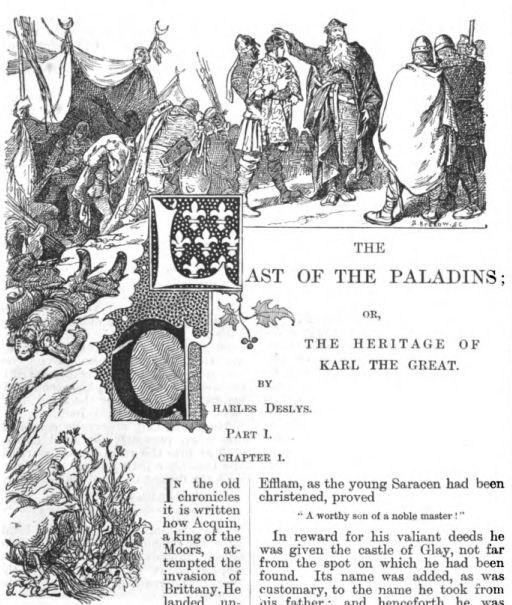
Will I read it again? Will I find it still has the fascinating appeal that it has had for me all these years? Or will it turn out to have lost all that, and to be magical only in memory? I find I am almost too afraid to put it to the test. Perhaps it will be better for the Last of the Paladins to be laid to rest, never to ride again.
- For non-British readers, a ‘public school’ in Britain is a private, fee-paying school. The leading ones include Eton, Harrow, Winchester, Rugby, and so on. Not for the likes of me, then. This is a fine example of the perfidious nature of some English usage, in which common expressions mean the exact opposite of what they say. ↩︎
- Very few of his works seem to be still available. The original of The Last of the Paladins is L’Héritage de Charlemagne. ↩︎
 Godspelled