“Despite the efforts of Marcion and others to detach Christianity altogether from its Jewish roots, it proved impossible to make sense of the Christian message without connecting it to the history and sacred books of Israel.”
Marcion of Sinope was a 2nd century theologian who believed that Jesus had come not to fulfil the prophecies of the Hebrew Scriptures, but to preach a completely different God. This was a loving heavenly Father, radically different from the belligerent, judging God named Yahweh. Christianity therefore was completely discontinuous from Judaism, and so the Hebrew Scriptures could have no place in the Christian canon.
Marcion was denounced as a heretic by the great Church Fathers of the 2nd century, Justin Martyr, Irenaeus and Tertullian, and was excommunicated by the Church in Rome in 144 CE; but his teachings were in large measure a catalyst which helped lead to the formulation of the canon which came to be accepted by the orthodox Church. As a result, Christians have always read the Scriptures of both the Old and the New Testaments, making connections backwards and forwards in order to make sense of the whole of God’s revealed Word.
The Reformation in the 16th century enabled people to read the Old Testament in their own language, and this on turn led to a greater interest in learning biblical Hebrew and reading the Hebrew Bible in the original. The writings of the Old Testament were formative not only in the religious thinking of Protestant Europe, but also in their political thinking. The Puritans who drove the English Revolution and the moves towards constitutional monarchy, and in the following century the Founding Fathers of the independent American republic, were all inspired by the Hebrew Scriptures. It is impossible to imagine modern democracy without this biblical foundation.
Yet in the late 20th and early 21st century, developments in Church life and worship have led many churches to pay less and less attention to the Old Testament. The Parish Communion movement first brought about a decline in the services of Morning and Evening Prayer, both of which had included readings from both Testaments. The Eucharist became the main service, and often the only service, that many Christians now attend. Although the Lectionary encourages the use of three readings, Old Testament, Epistle and Gospel, many churches have found this unpalatable. It makes the service unacceptably long. People don’t want to listen to that much Bible. The sermon would have to be shortened, or we would have to leave out a hymn or a ‘time of worship’, and we can’t have that. I’ve heard all these ‘reasons’ put forward. Although many cathedrals still use all three readings, in the church I attend we hardly ever hear a reading from the Old Testament.
What effect will this have on people’s faith, in the long term? If Rabbi Jonathan Sacks is right, it will mean that the Christian faith will become incoherent, it will no longer make sense. Is this why more and more people are simply walking away? In the Evangelical churches, which are often reckoned to be the most ‘popular’, ‘successful’ and ‘growing’, there is an increasing tendency to be almost exclusively Jesus-centred. Instead of worshipping God the Father, we worship Jesus. We pray to Jesus, we sing to Jesus, often calling him our God, we ask Jesus for forgiveness, we use a form of Creed (in which we ‘affirm our faith in God’) which makes no mention of creation or the Father or the Holy Spirit, but only of the death and resurrection of Jesus.
This sickness may very well prove terminal. Because Marcion has won. Many parts of the contemporary Church are not Christian at all: they are Marcionite.
I can’t believe I haven’t written anything in this blog about NaNoWriMo! Maybe in one of the earlier iterations of my blog? But I don’t know.
NaNoWriMo stands for National Novel Writing Month. It’s an Internet event which takes place every November, when aspiring novelists challenge themselves to write 50,000 words of fiction in the 30 days of the month. That’s 1,667 words a day. You’re not competing against anyone else, just against that (hopefully nearing) target. And you ‘win’ NaNoWriMo by reaching that target.
I’ve done NaNoWriMo 8 times, and won 8 times. I find the challenge gives me a great incentive to actually get some long-form writing done. It gives me the opportunity to be truly creative, and that has always been an almost mystical experience. I can start the project with hardly any idea of where it’s going, and then something magical happens. It’s like going out into the Wild Wood and ‘finding’ Story that is already there, meeting Story that comes towards you and embraces you like a fairy lover. Or whatever other image appeals to you. It makes me believe.
Of course, real writers sniff at a mere 50,000 words – that doesn’t make a real novel, they say. At best you might call it a novella. But I rather like the discipline of making a story and bringing it to a conclusion within that length. So here are the titles of my works over the years:
Dark Messiah – 2005
My first NaNo, which I wrote the month after Dad died, partly as a kind of grief work. It’s a fictional telling of the life of the biblical King Saul, told by 12 of the people who knew him.
A Month of Living Vicariously – 2011
This may be my favourite of all time. It concerns librarian Adrian Burrows, and takes the form of his diary during the month that he is doing NaNoWriMo. The research he does for his Excellent Plot results in three people trying to kill him, his conversion to Christianity, and his falling in love with his boss. I don’t know about anyone else, but I found it very funny. It still makes me laugh.
(Spoiler alert: Adrian doesn’t win NaNo. But he does get the girl.)
A Book of Changes – 2016
My Esperanto novella, written out of my anger over the Brexit vote, and what I believed would be the downfall of civilization as we know it. Our hero Joseph gets out of England while he still can, and embarks on a picaresque journey across Europe which leads to the discovery of the true heir of the Emperor Charlemagne, and the restoration of the Holy Roman Empire. The evil media mogul and would-be world dominator Marduk is defeated, and everyone lives happily ever after.
Blood Will Out – 2017
What happens if you are convinced your blood is tainted, that your genes are fated to produce generation after generation of evildoers? This fantasy history of the last half of the 20th century and the first decades of the 21st describes the age-old battle of Good vs Evil, and the final (?) triumph.
This is the only one of my completed novellas which has been ‘published’, because I wanted to learn how to produce a Kindle book. I did it! Though I wouldn’t be able to remember how. And it is available for purchase either as a Kindle book, or a print-on-demand paperback.
Latinitas – 2018
What if the Roman Empire had never fallen, and still ruled the world in the 20th century? Told by a Celtic British young man, Marcus Trinovantius Faber, this recounts how he is recruited by the Roman secret service but becomes part of a plot to overthrow the Empire, free the slaves, and make Christianity a legal religion.
Telling My Beads – 2019
Not a novel at all, but a memoir of my life and faith, and what I believe(d) – at the time. I haven’t revisited it recently to see if I still do believe it.
The Mild-Mannered Librarian Returns – 2020
Adrian Burrows has married his lovely boss and they are still working together at the library. There they discover a plot to use the powers of magic and the occult to overthrow the governments of major world countries and take control for their own secret organization.
Sadly, this is the only one of my NaNos that I never finished. I ‘won’ all right – it’s over 50,000 words long – but I couldn’t think of a way to bring it to a satisfactory conclusion. So as far as I know the plot to overthrow the world’s governments and install autocratic dictatorships is still operational. You’d never think so, would you?
Ye Watchers and Ye Holy Ones – 2022
Why are there so many religions? What was God thinking of? This is the story of the heavenly Watchers appointed by God to observe, and possibly even steer, the different world faiths. At the beginning of the 21st century, when religion seems to have become toxic, and is perceived by many as part of the problem rather than part of the solution, this story provides some answers.
I’m quite pleased with this one too, but wonder if it may be too controversial to publish.
You might have noticed that all of them are about God in some way. I just can’t keep God out of it! (The strapline of my blog may give you a clue why.)
I wasn’t going to write a review of the year 2022 after all nothing much has happened this year, has it? apart from a pandemic, a war in Europe, a recession, three prime ministers and a succession of ‘governments’, none of which has a clue about how to solve the problems of the country, even if they wanted to, after all they and their predecessors caused the problems, but never mind, the rich go on getting richer and richer, so why should the ‘governments’ that have served them so well even care? and that’s without thinking about the impending apocalyptic climate disaster which is what’s most likely to kill us all, so life right now often feels like we’re dancing in the ballroom of the Titanic, but hey, Strictly Come Dancing is the most popular programme on British TV, so there can’t be much wrong with the human race can there?
Yes, I am feeling a tad sad and angry and depressed about the state of the world and the nation, and who isn’t? If you’re not feeling that, you probably haven’t been awake this year. But just when I’m tempted to start really wallowing, I try to remember the wise words of the great prophet Gandalf:
‘I wish it need not have happened in my time,’ said Frodo. ‘So do I,’ said Gandalf, ‘and so do all who live to see such times. But that is not for them to decide. All we have to decide is what to do with the time that is given us.’
What is given to us, in our time when the country and the world are so very broken, is to try little by little – and what we can do usually feels like it is so very very little – to mend the broken bits we can mend. And hope. Hope that others will do the same. And even if we are all doomed, to go on hoping for as long as hope remains.
So, here in Thame, in our little corner of the world repair shop, Alison and I go on doing our very very little bit. Alison continues to enjoy being a member of the Community of Aidan and Hilda, and joins members of the community on Zoom each week for prayer and encouragement, as well as Zoom daily prayer with members of our parish church each weekday morning.
I am still allowed to officiate at the 8 o’clock BCP Holy Communion service once a month (sometimes more often, like a run of two for this Christmas Day and New Year’s Day, which falls on the feast of The Circumcision of Christ), and at St Catherine’s Towersey for their Common Worship services. Small congregations, but they seem to like me. They keep asking me back, anyway.
We’ve ventured out of Thame a few times for weekends and holidays – nothing abroad, yet. In March we went to Salisbury for a weekend for Alison’s MA graduation. It was one of the nicest graduations I’ve been to, because most of those receiving awards had been studying Theology at Sarum College, so it was appropriate for the awards ceremony to be a Christian service. Held in the church of St Thomas, with its astonishing Doom painting over the chancel arch. The speaker was Dr Eve Poole, who talked about how Theology was the best subject to study, in fact the only necessary subject, because it knows how to deal with the soul; and the soul is the only thing that differentiates human beings from Artificial Intelligence. This will become even more essential, the way that technology and communications are developing.
I am really missing Alison’s MA, and in particular her dissertation on A Spirituality of Child-Bearing. We had so many great conversations and discussions about this, while she was researching and writing it. It called into question – no, I would even say it undermined or exploded – many aspects of Christian theology and practice, or of Church teaching. They weren’t always things we really, really, believed; quite a few of them were things we were already, to say the least, uncomfortable with. For example, the doctrine of Original Sin, and its Calvinist extension of total depravity. The almost Gnostic dualism of much Church teaching, which denies the body and prioritizes the spirit, so that virginity and celibacy are prized above marriage. The emphasis on asceticism, fasting, and self-denial, instead of grateful enjoyment of all life’s good things. Most of the theories about the Cross, and how atonement works. And especially (of course) patriarchy, the suppression of women, the denial of their gifts. Because almost all the other things I’ve listed either flow from, or lead to, the monstrosity of patriarchy.
After all those years of Alison being connected with Sarum College, it was hard to sever the connection. So I have been taking courses there: a week’s intensive Introduction to Biblical Hebrew in August (wonderful, mind-blowing, hopefully ongoing), and a series of one-day courses on Reading Scripture Together, in which a Sarum staff member and a rabbi look at Bible passages and discuss the different ways our two faiths understand them.
We’ve taken a couple of short English holidays. In May we spent three nights in Lincoln, a city we have never visited before (can you believe it?) It’s hilly, but you probably know that. And we would recommend the pizza restaurant Dough LoCo, which not only serves great pizzas but also has an inspiring story. It started as a result of one couple baking pizzas for their neighbours during the first pandemic lockdown, from which a restaurant grew as if by magic. We were by far the oldest customers when we went there. But that seems to be happening more and more often, I can’t imagine why. Then drove on to York for 6 nights, exploring the city and driving out to explore some of the Yorkshire abbeys, including a day in Whitby which is always fun. Talks about Dracula among the abbey ruins… I wonder what St Hilda would make of that?
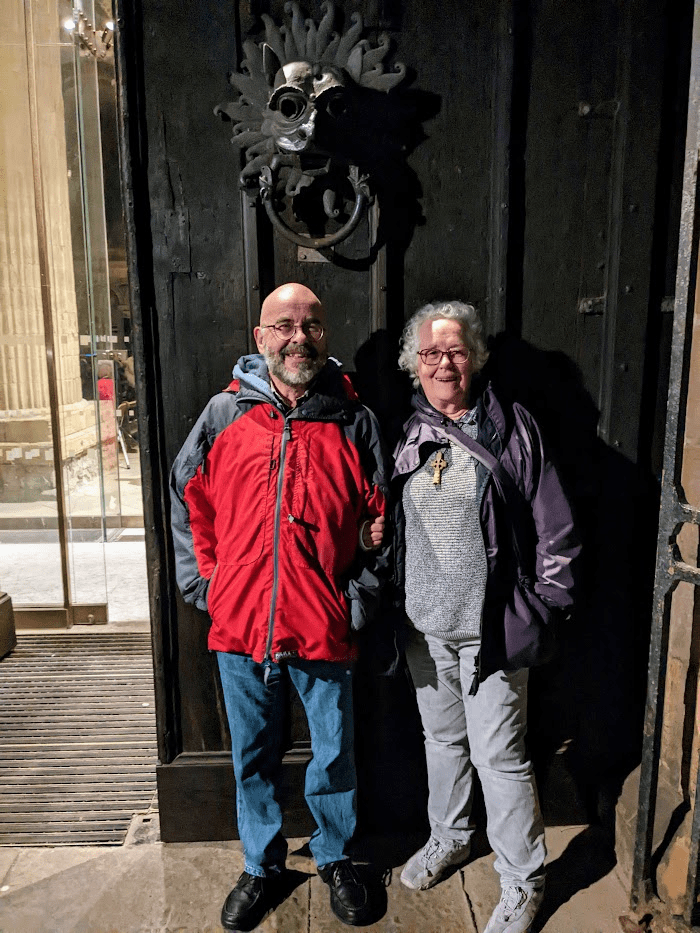
At the end of September-beginning of October we stayed on Holy Island, stopping in Durham on the way to revisit some old favourites:
Seeking sanctuary
Holy Island is always wonderful, of course, and we were lucky to have fine weather. It is so blissful when the tide comes in and the day visitors depart, leaving the island in peace.
On the return south we stopped in Chesterfield for one night. It’s a town that has seen better times, but the restaurant we enjoyed was the Sicily Restaurant where there really was an authentic taste of Sicily: friendly welcoming staff who were ready to advise about food and wine.
We’ve had times staying with Martha and Paul in their ‘new’ home in Frome, and with Esther and David in Suffolk. Naomi in Haddenham is the nearest of the children, so there’s rather more popping backwards and forwards, and fewer (i.e. no) overnight stays.
Oh, and we got COVID. After managing to avoid it for over two years, we caught it in June – at church! – when they started to lift restrictions. Neither of us had it very badly, but a couple of weeks later Alison began to show symptoms of Long Covid. We were out for a walk when her legs suddenly gave way. She didn’t faint, she just fell down. This was pretty scary and led to whole batteries of tests, MRI scans, ECGs and what not, to make sure she didn’t have anything really nasty. Naturally our imaginations supplied a long list of what really nasty could entail. (Stroke, heart disease, brain tumour etc. etc.) They found no signs of Any Of The Above, but neither could they explain what Alison did have. The likeliest guess was that Long Covid can sometimes cause sudden drops in blood pressure. Since Alison’s familial high blood pressure is well controlled by medication, the result of these sudden drops was falling over. And the workaround was tinkering with the doses of her blood pressure meds to try and get it right. Since then she is greatly improved in the sense that her ‘normal’ blood pressure became higher, she’s not falling down any more. But she still gets very fatigued if she forgets not to overdo things, she occasionally suffers dizziness which could make renewing her driver’s licence problematic, and she has the ‘brain fog’ that many people report as a lingering after-effect of the virus.
That’s enough of this, I guess. I’ll save reports about some of what we’re currently doing for another post. Perhaps.
It’s been a long time. But today – a few days before Christmas, what else should I be doing? – it feels like the right time to wake up the blog and the WordPress site. They’ve been resting long enough. Paying a year’s subscription feels like the incentive I need to get back to creating content on a more regular basis.
The big question: have I got anything to say?
I’ve felt for a while that I haven’t, really. What can one say, as we emerge (or do we?) from these months of pandemic and recovery, and draw near to the end of a spectacular annus horribilis. Three Prime Ministers, and still no sign of a Government that knows what it should be doing, or how to do it. A war in Europe, costing tens of thousands of lives, and God knows how many billions of roubles, dollars, euros, pounds. A global food and energy and cost of living crisis. And a fast-approaching climate catastrophe that may kill us all. How can one dare say anything?
Yet, there was a time when people thought I had something to say that was worth listening to. I even got paid to stand up in front of them and speak. I still get invited to, though now I’m retired I don’t get paid for it.
I grew up conflicted between the social and educational pressures to love my country and believe it was the greatest in the world – we Brits won the War, after all – and Dr Johnson’s adage that “Patriotism is the last refuge of a scoundrel”. As soon as I was able to see that we weren’t the greatest country in the world, and not only that but it wasn’t we who won the war either, I leaned more towards the Johnsonian view.
So I was resistant to recording John of Gaunt’s famous speech from King Richard II Act II: “This royal throne of kings, this sceptr’d isle…” It sounded to me like the extreme of mindless, overblown, and unfounded patriotism. But it’s not, of course. As so often, I had never really heard it through to the end and heard what old Gaunt is really saying.
It’s a lament, that the country he has loved and served all his life has become something to be ashamed of. By their reckless misgovernment its rulers have betrayed their people and everything the nation should be.
If we feel similarly betrayed in our time, perhaps the Psalms can provide a resource. The ‘psalms of lament’ that we find there include powerful prayers that cry out to God, at times when God seems to have abandoned his people. Why have you allowed us to be conquered by the Babylonians? Why have you allowed us to be taken captive by politicians who care more for enriching the wealthy and powerful, than they do for protecting the vulnerable, feeding the poor, healing the sick, providing a decent standard of living for all their people?
We may not like the answers. People who pray like this often hear that what has happened is a judgment for their idolatry and disobedience to God’s way. Or in a democratic society, that we get the Government we choose or deserve. Then our prayer may change to one of determination and hope. That we may return to God’s ways. That we may (quickly!) deserve better than our electoral record shows we do.
And we may take heart from John of Gaunt’s words too. Here they are:
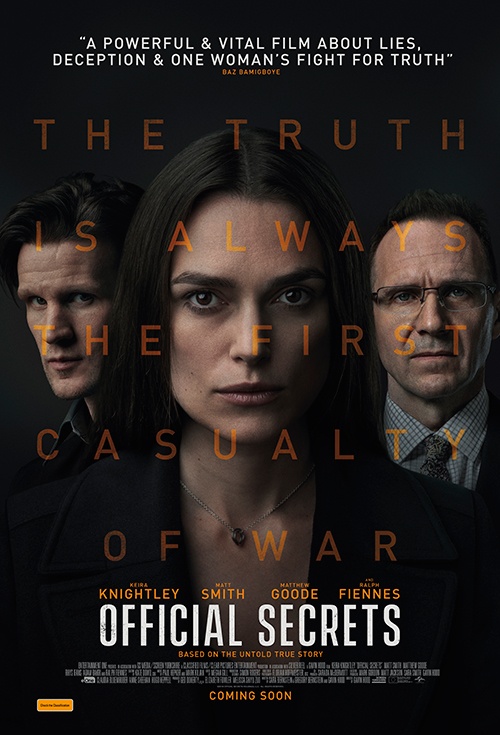
Everyone should watch the 2019 film Official Secrets, starring Keira Knightley, Matt Smith, Matthew Goode, Adam Bakri, Indira Varma, and Ralph Fiennes.
It’s the true story of Katharine Gun, who in 2003 was working as a translator at GCHQ in Cheltenham. At that time the American NSA were trying to facilitate President George W. Bush’s determination to invade Saddam Hussein’s Iraq, with the aim “to disarm Iraq of weapons of mass destruction, to end Saddam Hussein’s support for terrorism, and to free the Iraqi people.” As we soon learned, there were no weapons of mass destruction, and far from the Iraqi people being freed, they were subjected to decades of terror for themselves and the whole region, with the rise of so-called ‘Islamic State’ and the bloody wars that then followed to overthrow it.
The NSA emailed GCHQ requesting them to help with surveillance of the delegates from non-permanent member nations of the UN Security Council , with a view to putting pressure on them to support the 2nd resolution that was necessary to legitimate the invasion of Iraq. Katharine Gun was appalled by this, convinced that it was wrong for our security agencies to be used to support the policies of a foreign government, especially when this meant going to war without just cause. (Remember that millions of people all over the world, even in the UK and USA, were demonstrating against Bush and Blair’s policy.)
After great heart-searching, Gun sent a copy of the email to an activist friend, who in turn sent it to the Observer newspaper. The Observer had until this point supported the war, but when they investigated the email and found it genuine, as well as confirming that evidence of Iraqi WMDs was doubtful, they published it.
GCHQ staff were immediately questioned to identify the source of the leak, on the basis that it contravened the mighty Official Secrets Act. Katharine Gun could not bear her colleagues being subjected to this treatment and quickly confessed. She was immediately arrested and questioned. One of the minor heroes of this film is the (unnamed) young woman duty solicitor at this first questioning, who admits she usually only represents petty criminals on drugs and shoplifting charges, yet recommends that Gun should get in touch with the human rights advocacy group Liberty.
In a cruel twist, it was many months before Gun was formally charged — months in which the authorities left her in suspense about what would happen to her. When she was eventually brought to trial, the question was, How should she plead? She was clearly guilty of breaching the Official Secrets Act, yet she opted to plead Not Guilty on the grounds of necessity: that she had acted as she did in order to try to prevent an illegal war.
Here’s a Spoiler Alert, but I can’t resist it and it won’t spoil your enjoyment of the film: When the trial began, the prosecution announced that they would not be bringing any evidence. They gave no reason for this decision, though it’s pretty clear it was because the defence had asked to see the records that the Government had received during the run-up to the war giving legal advice about whether the war was lawful. Since these records would reveal that the Attorney General had originally ruled it unlawful (until he visited Washington DC where he was presumably pressured by the Americans to change his mind), the Government didn’t want this to be revealed. The astonished judge had no alternative but to dismiss the case, and Katharine Gun walked free.
Katharine Gun is a hero whistle-blower, and of course has had to live with and suffer the consequences. Though admired by millions and the recipient of awards, Wikipedia notes
After she was acquitted in 2004, she found it difficult to find a new job. As of 2019 she has lived in Turkey with her husband and daughter for several years.
This is an accurate presentation of a young woman who stood up to protest against one of the most evil decisions taken by British Government during my lifetime. Not only was it illegal and wrong, but it has unleashed violence and suffering on the world which we have yet to see the end of. But it is also an exciting and thought-provoking thriller.
If you haven’t yet watched this (it’s free on Amazon Prime) you should watch it as soon as possible. You really should.
When I am gone I would like it to be remembered that I took pleasure in the common things of life delighted in the joys of Everyday waking in the morning to life and breath and sound and sight and smell, and the taste of bread and the human voice and touch of those I love. That everything is Gift — and more than this — that there’s a Giver to whom one may give thanks.
That Everyday brings news of discoveries fresh adventures of learning and knowing words to hear and read and chew on, and minds to meet, music to charm the ear and people I love with whom to share the things that I have found who’ll share with me what they have found also
I’d like it to be remembered — that I was kind to others and myself that I would smile at people (not at cameras) laugh when I caught myself being over serious that truth and beauty made my spirit soar that I was wise with the wisdom of my years yet innocent as the child who still, somewhere, plays in my soul that I loved questions more than answers stories to tell, yet better, to inhabit — that I dreamed that there could be a better world yet never hated this one that isn’t so nor gave up hope of how it all might be. At day’s end never closed my eyes in sleep without I blessed the Author of my life.
If this is what I’d like remembered when I’m gone let it become my habit while I’m still here.
I haven’t recorded a poem for over two months. I’d been asked to read something by Shakespeare and was too afraid to try: how could I dare to do what the greats of acting and speaking have done? But hey – life’s too short to be a coward for long. And I took courage from the remembrance of things past about my classmate Judith, who recited this in our English Verse Speaking.

 Godspelled