The first churches in my life

One of the most influential teachers in my life used to tell the story of how and why he was a firm believer in infant baptism. Both of his parents were somewhere along the agnostic – unbeliever spectrum, one nominally Jewish, one nominally Christian, but neither of them practising their faith with any great conviction. He was born, however, in a time when some infant rite of passage was expected. So they decided that, if their child was a girl they would bring her up as a Jew, and if a boy, they would bring him up as a Christian. So when M was born, he was duly baptized. He always claimed it worked, in spite of his parents’ relatively low level of commitment to the enterprise, because when he was an undergraduate he came to fully-fledged Christian faith, and ended up being ordained and teaching me liturgy and much else besides.

It only goes to show. Though I’m not sure what.

But the story makes me often reflect on my own childhood, and the mysterious and unknown influences of what was done for me or to me. My parents were both of the generation who had enough of religion in their childhood. Dad sang in the choir at St Bartholomew the Great. He enjoyed the singing and the pocket money he earned him, and being able to get the autograph of film stars who occasionally showed up in the congregation, but he never told us much else about the experience. Mum had a pretty difficult childhood and teenage years, much of them spent as a weekday boarder in a children’s home. I don’t remember her ever mentioning church from those years.

But they had me christened, on 23rd October 1949, at our parish church of St Aldhelm in Edmonton. I wasn’t paying much attention at the time. Or at least, don’t remember anything of the experience. But that doesn’t stop me being grateful, and believing like my teacher M that it must have worked.

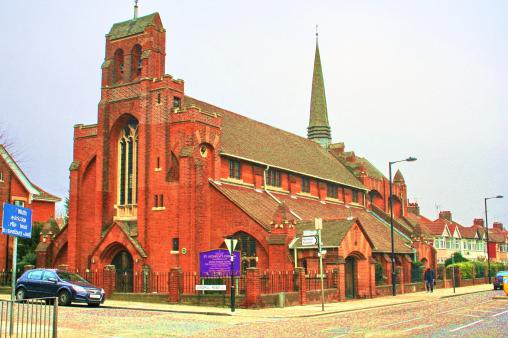
St Aldhelm’s Church, Edmonton

For some years Mum and Dad sent me and my sister to Sunday School, because that was the way your parents got you out of the house on a Sunday afternoon in the 1950s. There is another story about going to Sunday School and what I learned about myself in the going (rather than the being there). But I’m grateful for what I got from it, too.

And then the other church of my earliest years was St Cuthbert’s Wood Green.


St Cuthbert’s Church, Wood Green

This was my earliest experience of public worship, from the days of Church Parade with the Cubs. When I couldn’t think of an excuse for not going, I had to go there once a month, especially after I got to be a Sixer. There was no such thing as Family Service in those days. We got Prayer Book Matins, like it or not. There was, yes, some concession to the fact that children were present in the form of what I suppose was intended to be a child-friendly talk. But we still had the psalms and canticles and the language of the Book of Common Prayer.

How accurate, ever, are memories of when you were 9 or 10 years old, 60 years ago? What I think I remember, is puzzling over the language of those words, and feeling that I was beginning to get some sense of what they were about. And of being aware that what we were doing when we sang and prayed was Serious Stuff, so that I was impatient with my peers who kicked and scuffled under the pews, when we were expected to be somehow reverent about doing that Serious Stuff. I wouldn’t say I have loved Prayer Book Matins ever since. But I love it now, and still think there’s more solid meat and nourishment in it, than there is in most contemporary Services of the Word.

Yes, I am grateful for the first churches in my life. One ‘High’, one ‘Low’, both still seemingly alive and active, describing themselves as vibrant, friendly, inclusive, ethnically diverse, engaged with the local community: all the boxes that churches are supposed to tick.

I pray for them, their priests and congregations, that they may above all still be places where God meets people, and where children, women and men meet God. Even if they’re not paying attention at the time, or not fully understanding what it’s about. Who of us ever is?

What Else I Miss

This morning a happy collection of accidents led us to a very special service at the Cathedral. Our parish church decided not to hold a mid-morning service because they have their Christmas Eve extravaganza of Christingles this afternoon: three sittings, and every one of them packed. Apparently there were other churches in and around Oxford that made similar decisions, so those who wanted to celebrate the Fourth Sunday in Advent, and receive Communion, had to go elsewhere.

As it happened, the Cathedral’s Choral Eucharist was also the first celebration of the Eucharist by Canon Sarah Foot, the Regius Professor of Ecclesiastical History, who was ordained priest last Thursday by the Bishop of Dorchester. The Cathedral clearly love her, because they pulled out all the stops to make it a cracking good service.

And incidentally it reminded me of What Else I Miss. Because my last post was chiefly about quiet, often almost private prayer in a holy place. I realised this morning that a great deal of what I miss in priestly retirement is also about public worship. I realise that it is quite a while since I have felt I have really ‘met with God’ (whatever that means!) in corporate, public worship. And the things that helped me to have that sense of worship and presence and communion this morning included

  • the beauty of architecture in Christ Church Cathedral (though of course this can’t be essential, as you don’t get quite this quality in most places)
  • really excellent music – by Victoria, Palestrina and Buxtehude (ditto)

but then also some things which you might more reasonably expect in other places, even parish churches, as well:

  • real Anglican liturgy, as decently and reverently done as circumstances allow
  • Bible readings thoughtfully and well read
  • sincere, intelligent and godly preaching
  • hymns you can sing that actually mean something, that express worship and prayer, that teach the faith and give you something to think about, and aren’t the kind of candy floss piffle in the wind that so many modern worship songs are.

We love our parish church where the people have welcomed us so warmly, and we know God has called us to belong here, not least to support and encourage the clergy in their ministry. But I’m thinking that, for my own spiritual health and well-being, I need to plan in regular times when I can get away to the Cathedral or elsewhere to be ‘blessed up’, and to get the sustenance I need for the desert walking in between times.

What I miss

Reading some of the poems of R. S. Thomas, I’m reminded (again!) of some of the things I miss most, now I’m an ex-vicar. This one, among so many others:

Kneeling

Moments of great calm,
kneeling before an altar
of wood in a stone church
in summer, waiting for the God
to speak; the air a staircase
for silence; the sun’s light
ringing me, as though I acted
a great rôle. And the audiences
still; all that close throng
of spirits waiting, as I,
for the message.
Prompt me, God;
but not yet. When I speak,
though it be you who speak
through me, something is lost.
The meaning is in the waiting.

For twenty-five years and eight months, I had the privilege of access to a holy space, a centuries-old church building where I could go twice a day, morning and evening, and pray. More than the privilege: it was my duty and responsibility, so that kept me to the task even when I didn’t feel like it.

I still try and pray every morning and evening, when I can. But it’s not the same, now that I have to make a holy space in my own cluttered ‘den’. Not the same, now that, even if I go along to one of those other ancient holy spaces, I may not find it open, or may have to share it with other people doing other things. It’s not the same.

Writing tips

Isn’t NaNoWriMo fabulous? The magic works again, time after time; it’s working for me today after a shaky start; and here are the writing tips I’ve been relearning.

  1. Write like Trollope. Get a servant to wake you early (in my case, the servant is not supplied, so I have to rely on iPad’s Bedtime feature), then sit down and write.
    This wasn’t working too well for me this morning, I started feeling I didn’t like the story and it wasn’t going anywhere, but I kept writing anyway, and a breakthrough (eventually) came.
  2. Write like Dickens. If you’re stuck, go for a walk! Dickens used to walk from London to Rochester and back, but just round the block will do.

And then here’s one of my favourites — because so many of my fellow NaNoWriMo-ers obsess about plot:

Don’t start with plot! Find the characters, see them, describe them, listen to how they talk. Then let them run, and the story makes itself.

There’s magic. And it’s a lot of fun, too.

So, what was school good for?

This post first published on January 6, 2017

(From Pink Floyd’s classic music video)

It turns out several Web friends also still have their old school reports… so I have quietly refiled mine. (Better not tell Alison.) But that blog post about why I kept mine? and speculating that it was because being Top of the Class was the only thing I was any good at, the only thing that made me feel I was any good at anything… it all looks a bit bleak, doesn’t it? It looks as if I had a miserable, unhappy childhood?

And yes, I don’t remember being a child, still less a teenager, with any sense of joy or real happiness. My school days are not a time I look back on as ‘the best years of my life’. I can understand why teachers and adults generally try to perpetuate that myth. It could be the only thing they think they can be good at, is making children’s lives happy and worthwhile. I feel sorry for them too. But that’s another problem.

The things I remember about school days, are predominantly fear and boredom. I wasn’t afraid of the teachers; mostly I trusted them because I learned how to cope (obedience – at least when they were looking – and jumping through the academic hoops). But I was afraid of just about everything else: playtime, games, other children, being made fun of, looking foolish in the eyes of my peers… Often, being afraid of going to and from school. This was the dangerous place where you could easily become the prey of teachers if you weren’t wearing your school cap, or of other pupils if you were. Or, you ran the risk of meeting pupils from one of the other schools in town, especially the boys from Huxley Secondary Modern who were said to hate us, be constantly lying in ambush to attack us, taunt us with their hate song:

“Latymer loonies
Smell like cheese;
D’you wanna go to Huxley?
YES, PLEASE!”

Should I mention, at this point, that I never met any of them in seven years, and was never attacked – by them – on my way to school? Perhaps they had their own myths and fears about our hatred and ferocity, and ran for hiding when they saw me coming? Though with hindsight I have every sympathy with them. Why shouldn’t they feel aggrieved, who had been told at 11 that they had failed, and were second-rate scholars? The grammar school system, much vaunted as the great post-war engine of social mobility – and certainly it was what got me to university, as one of the first generation in my family to do so – was also the great divider of society, relegating the overwhelming majority of children to that stigma of ‘failed the 11-plus’.

And boredom. Hours and hours of boredom in dull dull lessons. I used to think in my arrogance that it was because I was bright, and had to spend so many hours waiting for the less bright members of the class to catch up. Who am I kidding? If I had been really intelligent, I would have used those opportunities to learn better, to learn more, to seek more knowledge and abilities than the basics, to aim for outstanding excellence, rather than just to satisfy the exam system and be Top of the Class. True, the teaching styles of the 1960s left much to be desired, based as they were on writing down everything the teacher said, rote-learning, regurgitating class-notes in tests. We didn’t have the inspirational, life-changing teachers you come across in other people’s lives, or in the movies. (Dead Poets Society, anyone?) The ones I loved, and who, yes, did change my life in some way, were relatively few. Lovely Miss Loewenstein who taught English, and scary-edgy Miss Edwards, who started me on Latin, but also gave me my love of German.

And yet. And yet. Miserable though it was and I was, school did make me the person I am, and for whatever is good about that, I am indeed grateful. It’s often said that the commonest and greatest phobia for many people, is the fear of public speaking. Well, my secondary school really worked hard at teaching us how to do that. Can you believe that, in the first year of secondary school, we had a timetabled lesson each week called Speech Training? Perhaps part of the agenda was to get all these North London kids speaking ‘properly’, using correct Received Pronunciation; but it was also a way of spotting and correcting genuine defects in speech. I wasn’t pronouncing my r’s: when they got me to read in house assembly, it came out like, “Pwaise the Lord with the sound of the twumpets.” And actually I’m glad they worked on me to try and change that. Though you can still hear it in my speech quite often, I’m at least glad I don’t sound as bad as Jonathan Ross. But see this video: is it really a speech defect, or is it simply becoming an alternative way of speaking?

Lots of the diaries from my school years (confession time: I still have most of those, too) record my pride but also my embarrassment about speaking in front of the class or the school. And of course I still have nerves about public speaking in unfamiliar settings. But it isn’t the huge terror many say it is: it has, after all, been my life.

Another thing for which I am forever grateful about my school years, is my faith. If I am a Christian, it’s down in large measure to the influence of school. In those days the law about a daily act of worship in schools was still actually observed. (There was none of this modern nonsense about teachers not wanting to lead an act of worship because they – or many of the children – don’t believe. Ritual doesn’t require belief: it requires performance. That is how faith is taught, communicated and nurtured. So probably the teachers’ reluctance to lead corporate worship is a fear that they themselves might ‘catch’ religion? Well, I couldn’t possibly comment.) It wasn’t designed to interest or entertain, like modern school religious assemblies are required to do. In fact I don’t recall anything like a comment or a homily. Assembly consisted of a hymn, a Bible reading, and a prayer read by the headmaster, often one of the BCP collects at Morning Prayer, but also sometimes prayers like the prayer of St Ignatius: Teach us, good Lord, to serve thee as thou deservest… It quietly, modestly, without fuss or perhaps even noticing, puts God there in the start of the school day.

And then there were the Christian teachers, who believed in what they believed, and wanted to share that Good Thing with the children. I was often blissfully unaware of it at the time, but even though I never went to the Christian Union (why would I?) there were other occasions. Like the day our form teacher invited some of us for tea and conversation about our ideas and what we believed. I didn’t realise at the time that there was a faith-sharing Agenda. As a teenager I was always bolshy about people trying to get me to believe as they believed. I was ‘C of E’, for God’s sake, like everyone else – what else did they want? Also a Protestant: I would believe as I chose to believe. It now seems extraordinary that the school even organised a group excursion to Earls Court in 1966, to hear Billy Graham speak during his London crusade. I especially resented his whole style of emotional manipulation and appeal, though it made a big impression on some of my friends… And yet here I am, where I am today. The Spirit works unpredictably, through all our life experiences.

So, yes, in ways that it and I probably never knew or imagined, school helped make me what I am. For sure, I can imagine ways in which it might have made me different. But that is fantasy. For what I am, it was certainly good for something.

(And, pace Pink Floyd, we do need yes education. The best of it is probably not conveyed by the Curriculum, the exams we study for, or the school system. But it may still, often, be somehow imparted by school in spite of itself.)

Songs for babies

Jeremy wasn’t having a very good day yesterday, so his mummy wasn’t, either. It was probably her own fault, really. She just didn’t seem to be able to understand what Jeremy was communicating to her – quite clearly, he thought – about what was the matter with him, and what he wanted to put it right. You see, she’d told him that Granny and Grandpa were coming to see him today. And – where were they, then? They weren’t there! He got himself quite worked up, he wanted to be wide awake when they came, but then he got more and more tired and fussed and didn’t know what to do with himself.

What eventually got him quietly asleep on Grandpa’s shoulder

was Grandpa singing to him. The song went like this:

Oh, the green wothe botheth every day
The green wothe keeps on bothing
It botheth in the morning light
And it keeps on bothing –
All the livelong night.1

When Grandpa got home at the end of a long, tiring day, he thought he would sleep really well all night long. But instead he was awake before the alarm, suddenly remembering how he used to sing to Jeremy’s Uncle Tom when he was little. It was a different song, because Grandpa was quite learned in those days, and he remembered singing it in the JCR at Cranmer Hall. It went like this:

Thoberamus Bobaramusque, what are you doin’?
Thoberamus Bobaramusque, you’ll be my ruin.
Thoberamus Bobaramus, aut semper aut tunc,
Thoberamus Bobaramus, dic mihi Quod nunc?

Jeremy wonders if other people’s grandpas sing nonsense songs to them, too?

  1. Devotees of James Joyce will recognise that this is the young Stephen Dedalus’s song.

Visiting Lichfield

On the spur of the moment, booking just the day before, we decided to visit Lichfield for a couple of nights. We may have driven through it or round it once before, but I don’t remember ever stopping or doing a proper visit. So, as a pilot for the project: Visiting Cathedral Cities We Don’t Know, we went to Lichfield. It’s only 90 miles from home, and apart from the usual unpleasantness of driving on the M42 round Birmingham, it only took a little over an hour and a half.

We stayed in the Cathedral Hotel in Beacon Street: a bit cheap and cheerful, and our room on the top floor looked out on the street and was a bit noisy, but the breakfast was good, with all the components of a Full English freshly cooked, the bacon especially nicely done. So it was good value for money.

The Cathedral is spectacular, built of red sandstone and the only three-spired medieval cathedral in the UK. It was built on the site of the tomb and first church of St Chad, the apostle and first bishop of the kingdom of Mercia. In the Civil War it suffered severe damage when Royalist troops fortified it against the attacking Parliamentary forces. I don’t know of many cathedrals which have been battlefields as well as holy places…

George Fox the Quaker was famously prompted by God to stand barefoot in the market place in front of St Michael’s Church and cry out, “Woe to the bloody city of Lichfield!” One version of the story tells that the bemused townspeople, far from being offended, were filled with compassion, “George, where hast thou left thy shoes?” Asked to give an account of the reasons for his protest (other than, God told me to do it) he said it was because of a great massacre of Christians in the city in the time of the Emperor Domitian. Certainly there had been much more recent bloody martyrdoms. Two plaques in Market Street record:

The following martyrs were burnt at the stake in this market place during the reign of Queen Mary: Thomas Hayward Sept. 1655 John Goreway Sept. 1655 Joyce Lewis of Mancetter 18th Dec. 1557

and

Edward Wightman of Burton-on-Trent was burnt at the stake in this market place for heresy 11th April 1612 being the last person in England so to die.

Lichfield was the birthplace of Samuel Johnson, and the museum in the house in Market Street, where he was born, is definitely not to be missed. Boswell’s Life is one of the big books on my To Be Read list that I may get around to OOTD… Quite a lot of places in Lichfield decorate their walls with pithy Johnson quotes. I particularly liked “You can never be wise unless you love reading.”

The other museum you should, absolutely should, visit, is the Erasmus Darwin House. Here you can learn about the polymath doctor, scientist, inventor, poet, who was the grandfather and forerunner of Charles Darwin, anticipating the development of the theory of evolution by a good 50 years, and a member of the Lunar Society of scientists and thinkers who drove forward many of the new discoveries of the Industrial Revolution. They were regarded by Church and State as dangerous freethinkers, and especially at the time of the French Revolution, several of them came under attack from violent mobs because of their views. Stirred up, I suppose, by the 18th century equivalents of the Daily Mail and Express. All to the shame of Church, State and popular opinion. It’s fascinating that Erasmus Darwin’s poems, which are probably unreadable nowadays, and included such titles as The Botanic Garden, setting out in rhyming couplets the results of his research. Coleridge was greatly impressed and acclaimed Darwin as one of the greatest poets of his age. Other Romantic poets including Blake, Goethe and Wordsworth were influenced by him, and his theories of galvanism were part of the inspiration that led Mary Shelley to write Frankenstein.

St Chad’s church is also worth a visit. It’s thought to be the site of Chad’s first oratory in the city, and when you enter the present church building (always open during the day) there is a real ‘good feeling’. It’s a place that is loved and cared for, and provides a good worship space for its congregation. They have produced a helpful little prayer guide for some of the places around the church that suggest scenes from the saint’s life.

Places to eat

We specially loved The Olive Tree, an award-winning independent restaurant, which was reasonably priced, pleasantly small and intimate, and serving excellent food. Good for lunches or teas was Chapters, the Cathedral cafe in the Close. Lots of these Cathedral refectory kind of places are very good value, offering fresh home-cooked dishes for very reasonable prices, in pleasant and peaceful settings. Chapters was specially nice because it wasn’t ridiculously crowded the times we were there.

Lichfield is definitely worth a visit.

Retirement Joy

And on the other hand…

Retirement is also fantastic, joy day after day like being on holiday for ever. Lots of times since ending those ’37 years of parish ministry’ I keep banging on about, I’ve found myself thinking, “This, at last, is the life I was born for!”

After you’ve stopped being a vicar, you no longer have to go to all those meetings: Parochial Church Councils, deanery synods, chapter meetings, diocesan synods if you’re unfortunate enough that it’s ‘your turn’, parish sub-committees on finance, buildings, stewardship, tiny charity meetings… and on and on. I was singularly blessed that most of those meetings were with lovely gifted faithful altruistic people, many of whom I counted as dear friends. But there were all kinds of things I would rather have been spending my time doing: like drinking in the pub with those friends, instead of sitting round a table in a draughty church hall, looking at balance sheets and wondering what to do. Some vicars must like meetings (else why would they make so many of them?), and I’ve even wondered if they prefer the ones that turn into bitter interpersonal wars, on the grounds that this makes them more interesting. But if this is the case, they must be a funny kind of vicar.

After you’ve stopped being a vicar, you no longer get all the stuff from the diocese that sometimes feels like people making work for parish clergy in order to justify their own salary… Gosh, that sounds appalling, doesn’t it? And it’s quite wrong. The lovely people who work in Church Houses up and down the land are lovely servants of the Church, without whom we would not be able to function. It’s just that sometimes you wonder: Why does that lovely person’s job of faithful service to the Church involve making more work for me in the parish? Counting beans and filing reports, when I might be visiting or pastoring or studying or even just passing an hour in quiet contemplation, spending time with God? When you’re in the thick of it, you feel guilty even asking the question. But someone ought to be asking it.

And after you’ve stopped being a vicar, you don’t have to be there every week. You can actually go away for something called A Weekend, like normal people do. You can go to a different church for a change: something that as a vicar you don’t like to encourage people to do, but actually you find it mightn’t be all bad. (It might even make them appreciate what they have in their home church, though normal clergy paranoia always makes you fear this is unlikely…)

And, after you’ve stopped being a vicar, much as I loved sharing people’s lives at the life-turning-point moments of births, marriages and deaths, you can take a break from doing that too. Taking these ‘occasional offices’ is a wonderful privilege that makes the job worth doing more than almost anything else, but sometimes I found myself thinking, Do I have to start another year’s round of publishing banns of marriage, marriage preparation, rehearsals and managing the day itself? Like lots of clergy, I often found funerals more ‘enjoyable’ (or fulfilling? or worthwhile?) than weddings.

And, of course, retirement joy is more than just all the things you no longer have to do. Much more, much better, are all the things you can now do that you didn’t have time to do before. Visit children and grandchildren. Take holidays. Read the books you’ve never got around to reading, or have long wanted to reread. Study and learn new things. Walk. Life being what it is, you don’t get around to doing half as much as you could do or would like to do. There are still constraints like whether you have the time or the money. And then, we’ve not yet been doing this Retirement Thing for a whole year. We’re still learning, still a bit stunned by it.

But one of the things that came to me when I was out for a walk one day, not particularly praying or being holy, was a new watchword, mantra, daily prayer, whatever you like to call it.

IT’S GREAT TO BE ALIVE.

Of course it is. But when you’re working full-time, you don’t always have the time or the space or the energy to remember it. Being retired means you don’t have that excuse. So, day by day, day by day: It’s great to be alive.

A survivor’s guilt

Irish Famine Memorial, Dublin

We returned earlier this month from a lovely ten-day tour of Ireland, which took us from Dublin through the southern counties of the Republic, to Galway, Connemara, the Burren and the Ring of Kerry, and back through County Cork. It was a smallish tour, with 25 participants among whom Alison and I were the only English people. (Run by My Ireland Tour – highly recommended!) Tony McGoey was a our driver and tour guide, who informed us, told jokes and stories, even sang to us! And of course, there was a lot of information about the history of Ireland.

I knew about quite a bit of it. But most of what I knew was the story the British tell. So, very little about the penalties imposed on Roman Catholics for much of the 17th to 19th centuries, the attempts to eradicate Irish language and culture, the greed and land-grabbing of the Anglo-Irish gentry. We know of the Irish Potato Famine as a huge, terrible ‘humanitarian disaster’ as we term them now. What the British histories don’t tell us is, that while the Irish peasantry were starving and being driven off their land in their millions, the landowners’ fields were producing bumper harvests of grain, which they were exporting very profitably across the Irish Sea. Recent attempts to rebrand the period as not the Irish Famine but the Irish Genocide make more sense now.

Notice to Quit, served on the Widow Mary Campbell in 1849. Derry Bog Village, Ireland

It was a wretched experience to hear these accounts, along with those of the brutality of the British suppression of the protests and uprisings against the system, and know I was one of the race that is guilty of these atrocities. It’s not much consolation to think, “It’s not me that’s responsible. It wasn’t even my ancestors who were the governing classes or the gentry – my ancestors were the people Below Stairs, or if they were lucky, the clerks slaving away at their writing desks, like Bob Cratchit.”

And all this guilt, if it is guilt, came while I’ve also been reading Simon Schama’s History of the Jews, with its catalogue of the persecutions of the Jews by Christians, ever since – well, forever, really. Certainly since Christianity became the State religion under the Emperor Constantine. History is a long, long record of abominable things that powerful groups of people have done to less powerful people, and the English are among the worst offenders. History may, or must, always be written by the victors, but it’s also true that any of us who have survived (so far) are in fact the victors in the human (rat) race. Even if we are only the victors’ running dogs.

Can we atone for our share in what has been done? No. Do we need to atone? I’m hoping that Someone Else has done that, but perhaps atonement can only work for us, if we recognise that survivors’ guilt isn’t an imaginary thing, but is indeed real guilt. And recognising guilt surely means doing all that we can to avoid guilt by association in the evil things that are still being done. What genocides are the British people still complicit in? Maybe by selling arms to despotic regimes like Saudi Arabia, so that they can kill Yemenis or support Islamist terrorism? Maybe by paying the taxes that pay for the bombs killing people in Syria? Maybe by tolerating Governments that continue to make the rich richer, at the expense of the poorest in society?

When we stand before the Great Assize and the only plea we have to offer is Guilty, I hope it really is true that the Bleeding Charity1 is also greater than anything we have so far imagined.

  1. ‘What do you keep on arguing for? I’m only telling you the sort of chap I am. I only want my rights. I’m not asking for anybody’s bleeding charity.’
     ‘Then do. At once. Ask for the Bleeding Charity. Everything is here for the asking and nothing can be bought.’
    C. S. Lewis, The Great Divorce

Relative to Time

Aged 20, I spent one of the formative years of my life in Germany. It was a year out from my university studies in German and French, when I was supposedly working as a language assistant in a German Realschule, and enjoying an immersive language experience.

What I ‘knew’, back then, was that I was going to be a writer. During those sometimes lonely months, I wrote two novels. The first, Hemlock, was set in an imaginary Mitteleuropa, in which the eponymous hero is fleeing from a vengeful nemesis, who is seeking to exact punishment for some monstrous, though accidental, injury. When she finally catches up with him, after many winding ways and sufferings, Hemlock learns to his horror that she has been dead all the time.

It wasn’t very good…

My second attempt, A Fractured Time, was a semi-autobiographical, stroke wishful-thinking, account of a young man who is going abroad for a year in the middle of his university course, leaving behind his girlfriend, the love of his life. Simon – was that his name? – feels that for this all-too-short period of his life he is free, but presently the System will take control of him and he will be trapped for the rest of his working life in a cycle of time-keeping daily drudgery of work. He will be a prisoner of, or in, time. But for this brief moment he is free, a freedom symbolised by the breaking of his wristwatch, the manacle which holds him in thrall to the tyranny of convention and normality. This summer, while he’s waiting for his watch to be mended, while he’s spending a last few weeks with his girlfriend before going away, is the time-out-of-time, the ‘fractured time’ of the title. It comes to an end… he goes away… but he has glimpsed the possibility that there exists Something Other than the slavery he longs to avoid.

The theme of Time continued to preoccupy me. I contemplated a third novel which was going to be about a young man who discovered the Meaning of Life. He is the son of an obsessive master clockmaker, whose clocks rule the lives of those who ‘own’ them, but the son is determined that he will escape from this tyranny of Time. I didn’t write more than the first chapter, because I realised that I didn’t have a convincing answer to the question of the Meaning of Life…

What is Time? It’s the element in which we part-fleshly, part-spiritual amphibians live, like a fish lives in water. Yet even St Augustine writes, “What then is time? If no one asks me, I know what it is. If I wish to explain it to him who asks, I do not know.”

It was partly this reflection on Time and its meaning, that drew me to a spiritual search, and ultimately to faith in God. Years and years later, I’ve stopped worrying quite so much about Time. Time and eternity are mysteries I don’t want to hurt my head trying to understand, so I have learned simply to Let Be.

But a funny thing happened. My old wristwatch – which I’ve had for more years than I can remember – is getting a bit tired. And when I was in Ireland last week a pocket watch took my fancy and I bought it.

And suddenly I feel again that a wristwatch is a kind of a manacle. But a pocket watch is something else. It requires much more of an effort to take it out of your pocket and open it and look at it. So I find I’m not looking at it every few minutes, the way I must have been doing a lot of the time. I’m hoping this will mean I am not so much the slave to time, that Simon feared adult life would make him. Will this help me to live more in the present moment? learn how to measure the passing of time more accurately in my own mind and body and environment, like our ancestors did? simply find other ways of checking the time every few seconds, like knowing where there’s a clock in the room, or looking in the corner of my phone or computer screen?

I don’t know. I read that pocket watches have enjoyed a small revival in popularity, because of the appeal of steampunk. So perhaps that’s another new image, or hobby, or activity, for me to begin to explore?