What Else I Miss

This morning a happy collection of accidents led us to a very special service at the Cathedral. Our parish church decided not to hold a mid-morning service because they have their Christmas Eve extravaganza of Christingles this afternoon: three sittings, and every one of them packed. Apparently there were other churches in and around Oxford that made similar decisions, so those who wanted to celebrate the Fourth Sunday in Advent, and receive Communion, had to go elsewhere.

As it happened, the Cathedral’s Choral Eucharist was also the first celebration of the Eucharist by Canon Sarah Foot, the Regius Professor of Ecclesiastical History, who was ordained priest last Thursday by the Bishop of Dorchester. The Cathedral clearly love her, because they pulled out all the stops to make it a cracking good service.

And incidentally it reminded me of What Else I Miss. Because my last post was chiefly about quiet, often almost private prayer in a holy place. I realised this morning that a great deal of what I miss in priestly retirement is also about public worship. I realise that it is quite a while since I have felt I have really ‘met with God’ (whatever that means!) in corporate, public worship. And the things that helped me to have that sense of worship and presence and communion this morning included

  • the beauty of architecture in Christ Church Cathedral (though of course this can’t be essential, as you don’t get quite this quality in most places)
  • really excellent music – by Victoria, Palestrina and Buxtehude (ditto)

but then also some things which you might more reasonably expect in other places, even parish churches, as well:

  • real Anglican liturgy, as decently and reverently done as circumstances allow
  • Bible readings thoughtfully and well read
  • sincere, intelligent and godly preaching
  • hymns you can sing that actually mean something, that express worship and prayer, that teach the faith and give you something to think about, and aren’t the kind of candy floss piffle in the wind that so many modern worship songs are.

We love our parish church where the people have welcomed us so warmly, and we know God has called us to belong here, not least to support and encourage the clergy in their ministry. But I’m thinking that, for my own spiritual health and well-being, I need to plan in regular times when I can get away to the Cathedral or elsewhere to be ‘blessed up’, and to get the sustenance I need for the desert walking in between times.

What I miss

Reading some of the poems of R. S. Thomas, I’m reminded (again!) of some of the things I miss most, now I’m an ex-vicar. This one, among so many others:

Kneeling

Moments of great calm,
kneeling before an altar
of wood in a stone church
in summer, waiting for the God
to speak; the air a staircase
for silence; the sun’s light
ringing me, as though I acted
a great rôle. And the audiences
still; all that close throng
of spirits waiting, as I,
for the message.
Prompt me, God;
but not yet. When I speak,
though it be you who speak
through me, something is lost.
The meaning is in the waiting.

For twenty-five years and eight months, I had the privilege of access to a holy space, a centuries-old church building where I could go twice a day, morning and evening, and pray. More than the privilege: it was my duty and responsibility, so that kept me to the task even when I didn’t feel like it.

I still try and pray every morning and evening, when I can. But it’s not the same, now that I have to make a holy space in my own cluttered ‘den’. Not the same, now that, even if I go along to one of those other ancient holy spaces, I may not find it open, or may have to share it with other people doing other things. It’s not the same.

The Splash of Words

Subtitle: Believing in poetry,

by Mark Oakley

This book has been on my Wish List since the summer. Then I gave up and bought a copy myself: who knows if anyone else would have bought it for me, if not?

(If you’re near Blackwells, they have a £2 off offer on it; Amazon never give much of a discount on Canterbury Press books, so support your local bookshop!)

It’s a timely book; it’s a book I need to read right now, with all of the soul- and heart-and-mind-searching that has come with retirement. All the questions about: What is all this God-stuff about, anyway? Has the Church lost its mind? What the devil does it think it’s doing? (And I probably mean that in its ancient Prince of Darkness sense…) What is God up to, letting us and our religions get in the God-awful state they’re in?

Mark Oakley is Chancellor of St Paul’s Cathedral, and poetry is one of his passions. In this book he collects nearly 30 poems, to each of which he appends a bit of introduction and explanation (but not too much) and a meditation on what it can help us to see about what God is up to, ‘the unignorable intuition that lies at the heart of everything written here, that God is in this world as poetry is in the poem’.

His introductory essay alone is worth the money. It made me laugh and weep and sigh with pleasure. (Also with envy that he’s so brilliant, but that’s another problem.) And want to learn it by heart so I can use it and pretend I thought of it. If you’re an underlining kind of reader, get your pencil ready: there is so much here you want to store up and think and think about.

One of my special favourites, among oh, so many, is his ultimate rejoinder and rebuttal of all those people who have conned us into thinking we must make Christian faith and worship ‘relevant’:

Christians should be poets in residence and their worship should be poetry in play because, at the end of the day, we are not seeking relevance but resonance — not the transient ideas of today that can convince for a time but the truths that address the deepest longings of a human life and a fragile world.

If you follow this blog you can probably expect lots more quotations from this book in days to come. Better yet, go out and buy it for yourself.

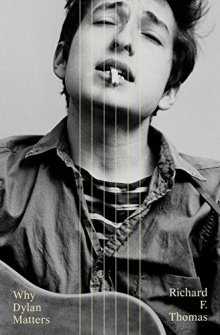
Why Dylan Matters

I have been unfaithful to Bob Dylan. That’s what it feels like. As a student, I listened over and over to those early albums, The Freewheelin’ Bob Dylan, Highway 61 Revisited, Blonde on Blonde, John Wesley Harding. I didn’t actually buy any of them: I had friends at college who could afford to do that. (Actually, I was still buying Francoise Hardy, but don’t hate me for it.)

Later on, when he was reported to have become a Christian, we bought Slow Train Coming and Shot of Love — not vinyl by now, but on tape cassette. (So actually, much less use than vinyl; except that we didn’t have a record deck at the time.) Since then we’ve listened to a few of Dylan’s later titles, those that made it to The Essential Bob Dylan collection. But for the most part I just haven’t kept up with the evolution of his career and his music.

Then I read a review of Richard F. Thomas’s book Why Dylan Matters, and knew this was what I needed to read to make some amends for my decades of infidelity. Thomas is a Professor of Classics at Harvard; more than that, he has been a Dylan fan since pretty much forever. That’s ‘fan’ in the full sense of fanatic: he is a Dylan freak, an expert, a nerd. What he doesn’t know about Dylan, or doesn’t know how to find out, ain’t knowledge. The thesis of this fascinating book is that Dylan is a classic, just as much, and in just the same sense, as Virgil, Ovid, Catullus, Homer, Aeschylus and all those others are.

Our own favourite classicist Mary Beard agrees:

At last an expert classicist gets to grips with Bob Dylan. Richard Thomas takes us from Dylan’s high school Latin club to his haunting engagement with Ovid and Homer in recent albums. He carefully argues that Dylan’s poetry deserves comparison with Virgil’s — and Thomas, senior professor of Latin at Harvard and author of some of the most influential modern studies of Virgil, should know!

This book provides an oversight of some of the twists and turns of Dylan’s musical Odyssey — another good classical allusion — with a timeline-discography of all Dylan’s albums, a discussion of the broad outline of their development, and detailed analysis of the texts of many of the songs, and how they have changed in performance over the years. Because one of the great themes is that Dylan’s work is all about performance: in his Nobel Prize lecture he frequently made the point that Shakespeare was not interested in whether or not he was writing ‘literature’: his concern, like Dylan’s, was with the details of the performance. Getting everything right, so it was the best possible performance it could be.

The final chapter takes us through Dylan’s being awarded the Nobel Prize for Literature in 2016, “for having created new poetic expressions within the great American song tradition”. It’s not certain that all the details of what happened will ever be known. Dylan famously delayed for some time in responding to the Swedish Academy’s news of the award — perhaps because he couldn’t believe such an august body would really recognise his work as ‘literature’. Then he didn’t turn up in person to make his acceptance speech in Stockholm, asking the U.S. ambassador to Sweden to read it on his behalf. But he did — somewhat at the last minute — deliver the obligatory Nobel Prize lecture. Thomas describes it in his book, and you can listen to it on YouTube. It’s also touching to watch Patti Smith performing ‘A Hard Rain’s A-Gonna Fall’ at the ceremony. No doubt she was mortified by losing her way at one point, which she attributed to extreme nervousness, but she was warmly applauded and encouraged by the audience of the great and the good of the Nobel Prize.

It’s a book that I loved, a book that makes me want to go back to listening and listening to Dylan’s more recent albums, and a book that makes me want to read those ancient classics of Greek and Rome, either again or for the first time.

Addendum

I’ve created a playlist on Spotify which includes most of the songs Thomas discusses in this book. If you’d like to save yourself the trouble of searching for them all, you can find them here.

NaNoWriMo — How was it for me?

It wasn’t my best ever NaNoWriMo: for that I still think my favourite story ever was 2011’s A Month of Living Vicariously. It cheered me up and made me laugh every time I read it for weeks afterwards. But this year was the most interesting in terms of process.

The plan I started with was to write a fictionalised autobiography. But the more I thought about it, the more I realised that writing about how my life might have been, or how I would have liked it to be, was somehow devaluing the life I’ve actually lived. Don’t get me wrong: I go in for wishful thinking, what-ifs and if-onlys as much as anyone. But I’m also feeling pretty good about my life at the moment, which is a good place to be, and one I’m not proud of, because I’ve done nothing to earn it, but just very grateful for.

Instead of the autobiography, it morphed into the life story of someone who has livedthrough much the same historical period as I have (c. 1950 to the present day). (Good idea this, it means there’s less historical research necessary. Though still some: we found ourselves asking, When was the first supermarket introduced in Britain? When did DNA paternity testing become a thing?)

John (good name!) bears a dark inheritance: in every generation of his family there have been evil people, and his parents felt the burden of having to atone for this, or somehow make amends so that the ‘bad blood’ doesn’t continue to wreak havoc through the generations. When John inherited this burden, and discovered the evil twin sister he never knew he had, his story turned into a decades-long struggle between Good and Evil. How can Good triumph, when it is so weak, so powerless in comparison with the monstrous evil that is done?

I still don’t know the answer to that question; so in part this fiction expresses my own wrestling with hope, and faith, and doubt. It reaches some kind of resolution, but I’ll leave it to you to judge how convincing it is. About as convincing as the final victory of Good over Evil, I guess.

But along the way I learned some interesting things about myself, about creativity, and about how I create. Part of the story hinges on the ‘fairy godfathers and godmothers’ who attend John’s christening, grant him gifts and blessings, and help out at key points in the story. To my surprise, two of the godfathers I started out with turned out not to be the right ones, or the ones that were needed later on. Also, I had given away too much about them when they first appeared. So I had to go back, in a partial reworking phase, and both take back what I had given away, and change the identity of the two who were the wrong ones. You may find, if you read carefully, a hint about the identity of one of the original godfathers. Also, that DNA test that would have established beyond doubt the relationship of the twins: I had to think of a workaround there, and I think the workaround turned out to be better than a DNA test would have been. All of this is such fun! It really is as if you set your characters off at the beginning, and find they assume a life of their own, which they then show you, rather than you showing them. It’s almost as if they solve the problems they find themselves in, rather than you having to solve them.

In other ways, this novel is more experimental, more surrealistic, and maybe even more religious, than some of those I’ve written before. I had fun with this, too. And there was a change of title. After having the title Bad Blood all through the writing month, and even when the ‘win’ was registered, when it came to revision that felt too worn-out, and it got changed to Blood Will Out. A phrase which, it turns out, already appeared in the text.

I don’t have any plans to publish it: that all seems too much like hard work. But I would love it if any friends or readers feel like reading it. At 52,000 and some words, it shouldn’t take more than a couple of hours. It’s not like it’s Moby Dick. I’ve put the latest PDF version of it here on Google Drive, and you’re welcome to read it there or download it to your own computer or device. I would love to hear how you get on with it, what you think of it, if you made it to the end or gave up (and why) — in fact any feedback at all.

So, if you have been, thank you for reading!


Writing tips

Isn’t NaNoWriMo fabulous? The magic works again, time after time; it’s working for me today after a shaky start; and here are the writing tips I’ve been relearning.

  1. Write like Trollope. Get a servant to wake you early (in my case, the servant is not supplied, so I have to rely on iPad’s Bedtime feature), then sit down and write.
    This wasn’t working too well for me this morning, I started feeling I didn’t like the story and it wasn’t going anywhere, but I kept writing anyway, and a breakthrough (eventually) came.
  2. Write like Dickens. If you’re stuck, go for a walk! Dickens used to walk from London to Rochester and back, but just round the block will do.

And then here’s one of my favourites — because so many of my fellow NaNoWriMo-ers obsess about plot:

Don’t start with plot! Find the characters, see them, describe them, listen to how they talk. Then let them run, and the story makes itself.

There’s magic. And it’s a lot of fun, too.

It’s all about you, Jesus

I suppose it’s natural for the Christian Church to go through fashions and cycles in what it believes and does, just like everything else. (This is what the Tao Te Ching teaches us.) It’s just distressing when you’re having to live through a particularly unattractive and heterodox phase, which may also be unhelpful and downright dangerous.

The other day I posted a bit of a rant on Facebook about some of the modern ‘worship songs’ that are typical of the current cycle. They are so relentlessly Christo-centric — this is the essential characteristic of what I’m describing — that I wanted to stand up and shout “Jesus is NOT. GOD. ! He is the incarnate Second Person of the Holy and Blessed Trinity (ever heard of it?)!”

Of course this was a bit of an exaggerated reaction, as some of the comments pointed out. But when you’re protesting about bad theology, you probably have to use somewhat intemperate terms. (cf. some of Martin Luther’s descriptions of the Pope.)

Diagram of the Trinity

Of course I believe Filius est Deus, as it teaches in the popular medieval Trinity diagram. But of Jesus I would prefer to say he is the Son of God, or the Son of the Father. (Or even, as he preferred, the Son of Man, which some of my scholar-friends would like to explain as the Human One.) The problem with many of today’s worship songs is, you could almost believe Jesus alone was God, there was no Father in sight, and the Spirit was, of course, the Spirit of Jesus only. Now, the reason I’m a Christian at all is that I love Jesus — he captivated me and won my heart when I first seriously began to read the Gospels. But, though I may sometimes pray to Jesus, when I fall down to worship, I mean to worship God, the Father, the Son and the Holy Spirit. This has been orthodox Christian practice for ever.

It turns out that many of the songs I find difficult come from the same source: they are copyright Hillsong. If you look at the Wikipedia article on Hillsong Church, where they originate, you may well wonder why so many of the mainstream churches would want to use them as much as they do? It turns out they are a Pentecostal Evangelical church with some very reactionary attitudes.

An example from last Sunday is the popular Your grace is enough, which has the chorus

Lifted on high from death to life
Forever our God is glorified
Servant and King, rescued the world,
This is our God.

Sure, I want to say “If you want to know what God is like, look at Jesus.” But it’s much too much of an over-simplification to say of Jesus, “This is our God”. And I’m not sure Hillsong Church really looked at Jesus when they drew up their list of beliefs. I can more easily imagine Jesus looking at this list and shaking his head and saying, “Hey, that’s not what I meant at all!”

Lots of their songs also have a heavy emphasis on the Second Coming:

He shall return in robes of white,
The blazing Son shall pierce the night.
And I will rise among the saints,
My gaze transfixed1 on Jesus’ face

At a time when so many world leaders and their followers seem to be intent on pursuing policies that could destroy the human race, all life on earth, the whole planet, it’s particularly unhealthy and unhelpful (and frightening!) for Christians to be promoting an end-of-the-world mentality — even hope, God help us. It just encourages the crazies who seem to think that by destroying the earth, they could precipitate the longed-for Parousia. It would be much better to have a generation-or-more moratorium on thinking about the Second Coming at all. Yes, don’t expunge it from the Creeds, but don’t preach about it or give anyone the impression we’re expecting it imminently2.


The Bishop of Oxford has just written a hymn to accompany his diocesan focus on the Beatitudes. I applaud his creativity, which is way beyond what I could do, and also that his hymn is way more literate than the Hillsong lyrics I’ve quoted. But I note, as well, that it’s a hymn to Jesus. No harm in that per se: there are lots of great hymns about Jesus. But the words suggest that the kingdom, the earth, the church, the Spirit, are all Christ’s; the Father doesn’t get a look in (except by implication that the Son of God must be Son of somebody.) And in the light of the present climate of Christolatry, it would be good for some of our best hymn-writers to be working on correctives, and good if all the hymns we sang were more about God the Trinity.

When I mentioned this to Alison she said, “Yes, but it is about the Beatitudes, and the theme is about us becoming more Christ-like.” But in fact the Sermon on the Mount has a different emphasis from encouraging Jesus’ followers to be more like Jesus (desirable, and uncommon, though that would be.) A couple of years ago I made a detailed study of the Sermon on the Mount, while I was in the process of learning it by heart in order to tell it at the Scholars’ Seminar of the Network of Biblical Storytellers. And I’m clear that the major theme of the Sermon on the Mount — you could say the major theme of Jesus’ teaching altogether — is: You have a Father in heaven – God. Live, then, as God’s children.”

That’s much more of a Jesus Agenda than modern worship songs are promoting, for all their claimed devotion to Jesus.


  1. You keep using this word. I do not think it means what you think it means.
  2. Martin Luther again had the right attitude: “If I knew the world would end tomorrow, I would still plant a tree today.”

Montaigne and how to live

How to Live by Sarah Bakewell cover

I just love this book: I’m currently reading it for the second time; it gives me that kind of warm glow of comfort and pleasure, that makes you want to sigh “Aah” as you read it; I’ve marked and commented on so many passages throughout the book, smiled at many of the annotations I made the first time round, and added many more. Hey, I’ve even picked up my copy of Montaigne’s Essays and am trying again to actually read them.

The title and sub-title tell you exactly what’s between the covers: How to Live: A Life of Montaigne in one question and twenty attempts at an answer. Sarah Bakewell knows and loves Montaigne, and she delivers so much more than she promises. This isn’t just the life of Montaigne, but his after-life as well, as she tells the story of how Montaigne has been loved and hated, interpreted and misinterpreted, by readers in every century since his own. He was a hugely popular author from the first publication of the first edition of his Essays, yet the Roman Catholic Church placed it on the Index of Prohibited Books less than a hundred years later, where it remained for nearly two centuries until 1854. Descartes and Pascal, Diderot and Rousseau, George Sand, Flaubert, Nietzsche, T. S. Eliot and the Woolfs, Stefan Zweig: the list of writers and intellectuals who have been fascinated and attracted or repelled, but certainly, always, influenced by this modest 16th century French writer-philosopher, still goes on. And together with them, goes the crowd of ordinary, anonymous readers who have loved Montaigne and feel they know him as an intimate friend.

Just what is going on here? What’s this all about?

Michel Eyquem de Montaigne (1533-1592) was a French nobleman who in 1570 ‘retired’ from local politics and resolved that from then on he would write down his thoughts. About life, the universe, and everything; but chiefly about himself. He looked into his own heart and soul, and saw there the whole of humanity. His resulting Essays are a kind of ragbag of stories, drawn from his own life, from his wide reading of classical and contemporary authors, like the rambling conversation of one of your closest and most entertaining friends. And that’s what generations of readers have found: not just amusement and entertainment, but a mirror of their own souls also. Bernard Levin wrote, ‘I defy any reader of Montaigne not to put down the book at some point and say with incredulity, “How did he know all that about me?”’

So the Essays become something like the sea in e.e.cummings’s poem:

For whatever we lose(like a you or a me)
it’s always ourselves we find in the sea

Montaigne lived through the terrible and destructive civil wars of religion, which ravaged France between 1562 and 1598; a time of violent turmoil which makes even our own fear-filled times look peaceful. So his way of living and writing has something for us in our own troubled times: it speaks of how we can remain human, when the whole of society around us seems insanely intent on tearing itself to pieces. And what are these answers to the question, How to live?

Here’s just a selection of Sarah Bakewell’s twenty attempts at an answer:

  • Don’t worry about death
  • Pay attention
  • Read a lot, forget most of what you read, and be slow-witted
  • Question everything
  • Be convivial: live with others
  • Live temperately
  • Guard your humanity
  • Reflect on everything; regret nothing
  • Give up control
  • Be ordinary and imperfect

Montaigne has been described, e.g. by Brainpickings, as the godfather of blogging. That sounds fun, and maybe my ‘essays’ on this blog will be a way for me to explore thoughts in retirement, as Montaigne did.

And in the mean time, let me pick up my copy of his Essays again.

Just a little test


How do you publish text from StackEdit to WordPress?

So: here’s what this stub is about. Today I’ve been playing with StackEdit which I discovered. It’s a Markdown editor which works in any browser, or as a Chrome extension (maybe a Firefox extension, too?) And I wanted to find out how to use it to publish to my WordPress blog. Looks like it has worked. Though I still don’t know how it worked.

Written with StackEdit.

Being a man

Retirement. It’s a time that any philosopher – and who doesn’t want to become a philosopher when they retire? – can delight in. A time for taking stock of your life: for looking back, for looking forward, most of all I hope for living fully in this present moment. A time for reflecting on the meaning(s?) of life, and of death, of the universe, and everything.

And here’s one of the things I’m finding. That this time of reflection is calling into question many of the things I’ve been taking for granted for most, if not all, of my life. Like who I am, including just being a man.

Yes, just as the present time is a hard time to be a Christian, or to be any variety of religious at all, so too it’s a hard time to be a man. And I don’t mean that in the way that the anti-feminists do, who think women have things so much their own way these days, that it’s men who are the disadvantaged sex. That’s just a load of BS.

No, it’s in the light of all the recent news and discussions about the ways men have thought and spoken about women, have abused and exploited them in the workplace, in relationships, have treated them as objects for their own ends. From the Weinsteins and Trumps of this world, who think that abusing women is something they have a right to do because they have the power, right down to the wolf-whistling builders and gropers in crowded places. And probably, unbeknownst to many of us, even by us who have never meant to be abusers, but just didn’t know any better.

Just the other day we were eating lunch in a local restaurant. At the table behind me were four young people, probably no more than older teenagers. A boy and three girls, two of whom looked as if they may have been Indian sisters, and the other a blonde girl who looked as if she might have had Downs Syndrome. I noticed them because the boy was talking so loud I could hardly hear myself think, let alone take part in the conversation among my own (hardly quiet) family. He sounded as if he was on some kind of soapbox, as if he was actually haranguing these poor girls, pontificating as only an opinionated male can, setting out what he knew and believed as if it could not possibly brook dissent or contradiction. Alas, the words that stood out most from the stream of verbiage were ‘Scripture’ and ‘baptism’: as if to pour vinegar into my wounded soul, the noisy young Alpha male was also a ‘Christian’.

So where does this kind of attitude and behaviour come from? This youth was no hardened male chauvinist, cauterised in the fires of a long life of domination over women. He did, it’s true, look and sound like a boy who had ‘benefited from’ a private education. Was this the way his private school was teaching him to think of, relate to, and speak to women? Even worse, was it the way his church or Christian fellowship taught him that men should speak to women? Was it the way his father spoke to the boy’s mother and sisters, or to his female colleagues, and other women of his acquaintance? Had he just imbibed it from his peers, from social media or contemporary culture? Is it genetic, in our nature, or only in our nurture? Or, God forbid, both?

There was a degree of Verfremdung about the whole event, because this wasn’t some middle-aged hooligan or boor, but a member of a generation which, I would have hoped, might have been learning, or be being taught, better. So that I felt all the more embarrassed for my sex. All the more resolved: this is not how I want to be. And if I have been this way, I ask for the grace to change, and if necessary to make amends at least to some of the women I may have wronged.