Seeking a more biblical Church

When I was on retreat at Mucknell Abbey at the beginning of December, Fr Stuart Burns recommended a book I hadn’t heard of before: David F. Ford’s The Gospel of John: A Theological Commentary. It promises to be an excellent read, touching on many of the themes I now realise I need to pursue about John’s Gospel. Ford urges that the Church and the world need a new ‘Johannine Renaissance’, rediscovering, or more deeply discovering, Who Jesus is, and Why Jesus Now? 

Among so many passages I want to reflect on and remember, today I made a note of this:

“The Psalms are the part of the Bible that probably is most fully part of Christian (and Jewish) personal and community prayer and worship, most committed to memory, most set to music, most important in shaping the imagination. They take up into poetry and worship leading themes of Israel’s Scriptures and the main elements of its faith and practice — creation, patriarchs, the exodus, the law, prophecy, wisdom. Both Jesus and John were, clearly, steeped in the psalms, and continually reading the psalms in conversation with the Gospels deepens understanding and nourishes fuller faith, further following, and richer worship.”

Yes! And I wonder, then, why the Psalms are so routinely omitted from much (I’m tempted to say, most) of contemporary worship? Dare I say, especially in ‘Evangelical’ churches? In the days when I used to think it was the Evangelical wing of the Church that I felt most at home in, I firmly believed it was the Bible, and its authority, which were the features that attracted me. Since that time I’ve come to believe that, in fact, the major weakness of ‘Evangelical’ churches is that they are so unbiblical. Instead of proclaiming what the Bible says, they are more likely to proclaim what the preacher, or their favourite church leader, says the Bible says. They’ll hammer home the parts that say what they want the Bible to say, while ignoring the parts of the Bible which contradict their favourite message. 

David Ford’s commentary is honest about the apparent contradictions and different viewpoints, for example in the ways the Bible has often been used to preach a ‘supersessionist’ message, and contempt for Judaism. The remedy is to stay with that question of Who Jesus is, until we fully understand what it means that Jesus shows us, and leads us into relationship with, a God who is for all people, and for all creation.
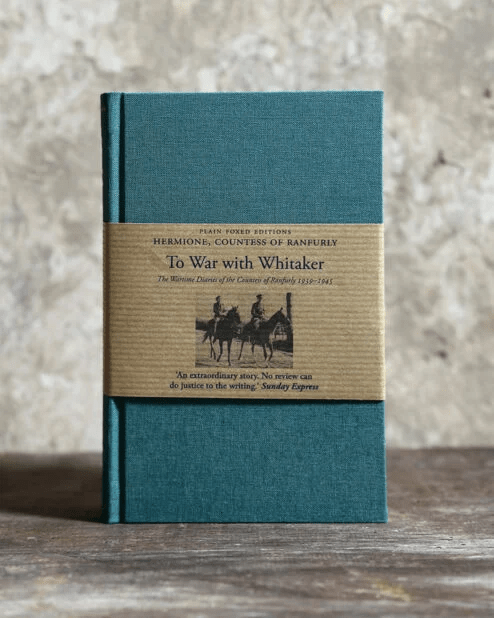
Hermione’s War

I’ve owned a copy of this book for several years, but have only now got around to reading it.

To War with Whitaker, by Hermione, Countess Ranfurly. (Slightly Foxed edition)

It’s a war book with a difference. It’s not about the military campaigns and battles. It’s a woman’s diary, written during the 6 years of the Second World War, but not edited and published until 1994.

The diarist was Hermione, Countess of Ranfurly. She married her husband Dan in January 1939, knowing that war was likely if not inevitable. When it did break out in the following September, Dan was posted with the Sherwood Yeomanry to the Middle East. Hermione was determined to go with him, even though it was ‘against the rules’ for Yeomanry wives to accompany their husbands. But she was an accomplished stenographer and typist; and more to the point, a woman with the stubbornness and perseverance to take on the military bureaucrats and jobsworths who tried repeatedly to get her sent back to England. She made herself indispensable to a succession of generals and other leaders, who were happy to ignore the ‘rules’. She became not only their secretary, but a ‘fixer’ for all kinds of hospitality, accommodation.

Dan was captured in the North African desert and spent years in a prison camp in Italy, before escaping and eventually making his way back to Allied-occupied territory. Hermione, meanwhile, though she was only in her 20s, was eventually recognized as having “the highest woman’s job in the theatre” (of war). She records meeting kings, prime ministers, senior military officers, film stars, and others. It was six years of unremitting hard work, flying backwards and forwards around the Mediterranean – when she was afraid of flying, and frequently air-sick. Six years of fun and enjoyment of new experiences, which she records with a keen eye. Six years, too, of anxiety for Dan, and for the outcome of the war, especially during the years of Axis victories and advances in North Africa and Eastern Europe. The tide eventually turned, of course; but through it all there is hardly any hatred of the enemy.

Towards the end, there are many details which we don’t always find in the more military histories of the war. I wasn’t aware of the problems in many places, when countries were finally liberated from enemy occupation, of acute food shortages, raging inflation, and fighting between former partisan factions, communist or democrat. Noting the mounting air supremacy of the Allied air forces, and the huge bombing raids on Germany, Hermione grieves over the suffering and the level of damage and casualties being caused. After the second atom bomb was dropped was dropped on Nagasaki, and the war finally ended, she notes:

Walking back to the office, with paper cascading from office windows and swirling in gusts along the streets, and people on the roofs and balconies singing and shouting, I felt terribly sad. It is so wonderful that the Second World War is over, and no wonder people celebrate, but what we have all done — to defend ourselves and to win the war — is too frightful for words.

And Whitaker? Whitaker was Dan and Hermione’s faithful butler, who insisted on accompanying them to the Middle East and Mediterranean, and was a loyal and amusing friend throughout the time.

WAR! What is it good for?

Memories of a lost school-friend

It’s disconcerting in an age of instant communication of so many things (that often don’t even need to be communicated) when you come across a notice of something that happened several years ago, that you would have liked to know about sooner.

So it was this afternoon, when I opened the Winter Newsletter for alumni of my old school (Latymer Links: Always A Latymerian). Naturally I clicked on the link to the Obituaries page, as I find myself doing more and more often. And find that one of my cohort of 1960 joiners appears there.

Let’s call her J. At the most recent school reunion, in July, there was a special table for those who had joined the school 65 years ago. There were fewer of us than there used to be, though a number of ‘the missing’ were absent not because they’ve died, but because they were ill or just don’t like to drive on the M25 or A10 these days. J was one of the people I hoped I might see there, but she wasn’t there, and no one knew anything about her. And today I read that she died in April 2022.

I last met her at our 55th anniversary reunion in 2015 (the 60th in 2020 one was cancelled because of COVID…) and our conversation that day was a Blessing to me. Because, you see, for years I had had a bad conscience about J. Long ago, in our schooldays, I Did Her A Wrong. Back in the Sixth Form, I and some other lads took it upon ourselves, or maybe were asked to take it on, to edit the Sixth Form magazine. A scruffy and poorly-duplicated thing called i. J submitted a piece for the magazine. And we told her we would print it if she changed it. I can’t remember whether it was a poem and we asked her to put it into prose. Or a piece of prose and we told her it had to be broken up into lines of verse. The point was there was nothing at all wrong with her contribution. We did it solely Because We Could. It was the raw, posturing power of adolescent males. And I really really hope it wasn’t laced with the misogynistic possibility that we were doing it because she was a girl. (But alas, I can’t be sure of that.)

So the last time I spoke to J, I reminded her of what we had done, and apologized. I can’t be sure she even remembered the incident, still less whether for nearly 50 years she had harboured the seething resentment we richly deserved. Instead of that, she graciously accepted my apology and assured me I was (or had long been?) forgiven.

What I read in her obituary made me wish I had known her better… But of course 59 years ago I was terrified of the girls of my age, already women when I was some way off being a man. J had had a tough childhood, but she was a nice person, and went on to be a good woman.

Christ Blessing

Last week I saw a report on BBC News about a ‘lost’ masterpiece by the Flemish artist Quentin Massys, which had recently been ‘rediscovered’ by experts from the National Gallery. It had hung for many years behind the altar at Campion Hall in Oxford, the Jesuit study centre for research and learning, but has now been moved to the Ashmolean Museum on long-term loan, so that more people can see and appreciate it.

How could I resist? On Friday I went in to Oxford to visit the Ashmolean and have a look. The volunteer at the enquiry desk didn’t know about it… she asked the staff at the entrance… they directed me to Gallery 47, the German and Flemish Art gallery. And there it was: stunning, beautiful. Much brighter and cleaner than this image shows, as if it has just been cleaned and restored. Every detail is shining, crystal-clear.

If you’re near Oxford or passing by, this is well worth a visit.