
In the course of nearly six decades of adult life, with numerous changes of address, most of them upsizing to a larger house, but latterly including a major downsize, we’ve acquired large numbers of books. Anyone who thinks ‘too many’ is clearly not One Of Us – for We all know there is no such thing as too many books. Nevertheless, there comes a time when downsizing means there will not be enough shelf space for all of our books… and certainly not enough for all the books we are bound to continue to buy. So during those six decades, we have not only acquired, but also from time to time shed books.
I’ve often wondered about the criteria for deciding which books to get rid of, and which to keep. Sometimes it’s easy enough: ‘I hated that’, or, ‘I’m never going to want to read that again.’ Sometimes you get rid of a book and later regret it and buy it again. In the worst case, you buy a book you think you got rid of, only to find the original copy is still there on your shelf. But that doesn’t happen very often. And sometimes there is something that makes you keep a book you haven’t opened for 20 or 30 years, because – well, what? Because it has some special significance in your life, because you feel it spoke to you or changed you in some really important way.
I was reminded of one of those books this week, when the Collect for the Third Sunday of Advent asks God to ‘grant that the ministers and stewards of your mysteries may … prepare and make ready your way’. It’s a reference to St Paul’s First Letter to the Corinthians, where he writes ‘Think of us in this way, as servants of Christ and stewards of God’s mysteries. Moreover, it is required of stewards that they should be found trustworthy.’ (1 Cor. 4.1) The slender book on my shelves (only 88 pages) that takes its title from that verse is Stewards of the Mysteries of God, edited by Eric James, published by Darton, Longman & Todd in 1979 at £1.95.
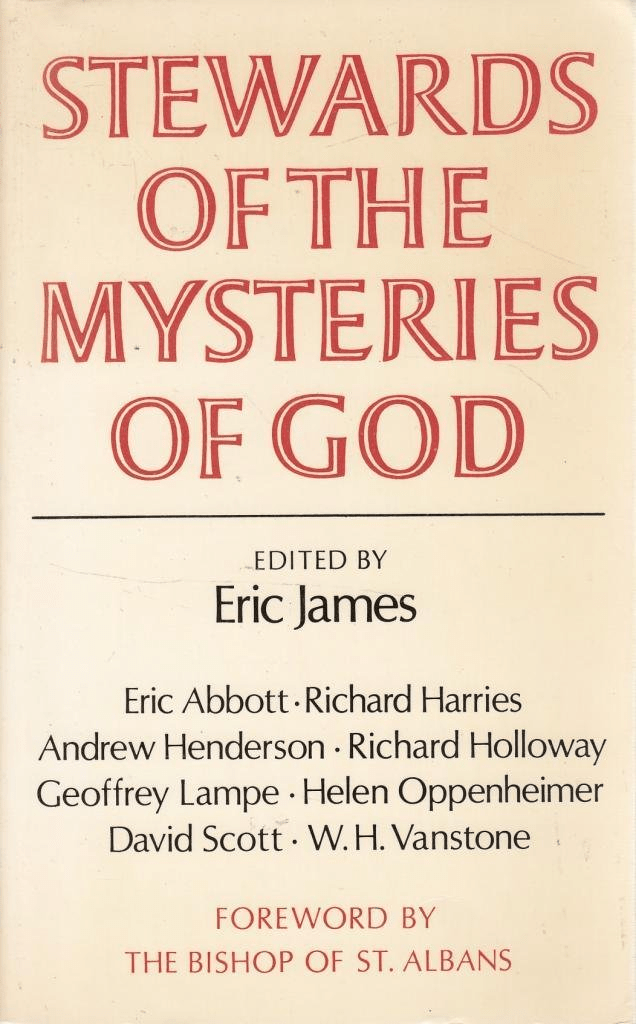
It was a collection of essays written by a number of theologians whose names read like a Who’s Who of the Church of the 1970s. Richard Harries – not yet the Dean of King’s College, let alone Bishop of Oxford or Baron Harries of Pentregarth… Richard Holloway, not yet the Bishop of Edinburgh. But all of them, in some way, connections of the then Bishop of St Albans, the Rt Revd Robert Runcie. The book was planned as a preparation for the St Albans Clergy Conference in September 1979, but published as something of interest to the wider Church (as well as, incidentally, to help with the costs of producing the book and so save the diocese money.)
And the significance of that clergy conference, for me, was that it was the first major diocesan event that I attended after my ordination as Deacon just two months before. I can’t remember how many clergy attended – it must have been a few hundred – but we all travelled to the University of Kent at Canterbury, then a mere 14 years old. And there were all the things you would expect a clergy conference to include: worship, lectures, discussion groups, meals, drinks in the bar… Of which I remember almost nothing. It was 45 years ago, after all.
And yet. And yet. I believe now that the conference, and the book that I had (obediently, as a new young curate) read in preparation for it, represented a big turning point for me. It was perhaps not the first thing, but certainly one of the first things, that opened my eyes to the undoubted truth that there was more to Christianity than ‘Conservative Evangelicalism’ had to offer1.
So I took the book off my shelf and read it again, and find it does indeed have many insights which may not always have been part of my faith before then, but certainly have become important in the years between.
Concerning the importance of Mystery in the Christian faith, rather than certainty. The mysteries of God are not things that are secret or concealed, but things we could not discover by our own efforts, which God reveals to us. The ‘deep affinity between the mystery of God and the mystery of humanity’. Gabriel Marcel writes, ‘A mystery is something in which I am myself involved’. Patrick White’s epigraph to his book The Solid Mandala:
There is another world,
but it is in this one.2
I thought I came across this only years afterwards with the shock of recognition, ‘Yes, that’s true!’ but no, I first read it in 1979.
Vanstone, on the Church’s purpose:
“The raison d’être, the responsibility, of the Church is to recognize what is happening in the world, and what is actually at stake in what is happening. What is at stake is the triumph or the tragedy of the love of God.”
And on What God needs: (How radically daring it was, to consider that God needs anything!)
“God needs only that which love itself needs — the response of the beloved other, without which love’s own work of giving remains incomplete.”
Richard Holloway, on the proper role of the Church, following Jesus, a ‘spiritual terrorist’, out of whose mouth came both the certainty of hell and damnation for sinners, and a gentleness and pity for us in our lostness:
“The Church is really the trades union of the damned. … I have come to believe that it is always the Church’s task to plead with the divine anger on behalf of the divine mercy. I say this because I believe that this, finally, is the meaning of the mystery of Christ. … The final mystery, then, is forgiveness.”
And Richard Harries, arguing that the Church needs to take seriously the reasons for the radical unbelief of many in contemporary society. While remaining faithful to our own convictions, we must not immediately leap in to refute unbelievers, but listen and give full weight to the reasons for the unbelief that is in them. We must learn to be comfortable with inhabiting the space between faith and unbelief: “A person will therefore be a person of the borderlands, to use a word of Professor Donald MacKinnon.”
Listing some of those ideas now, they all seem so obvious. They make it sound like discovering Stewards of the Mysteries of God was a small thing. It wasn’t, at the time.
 Godspelled